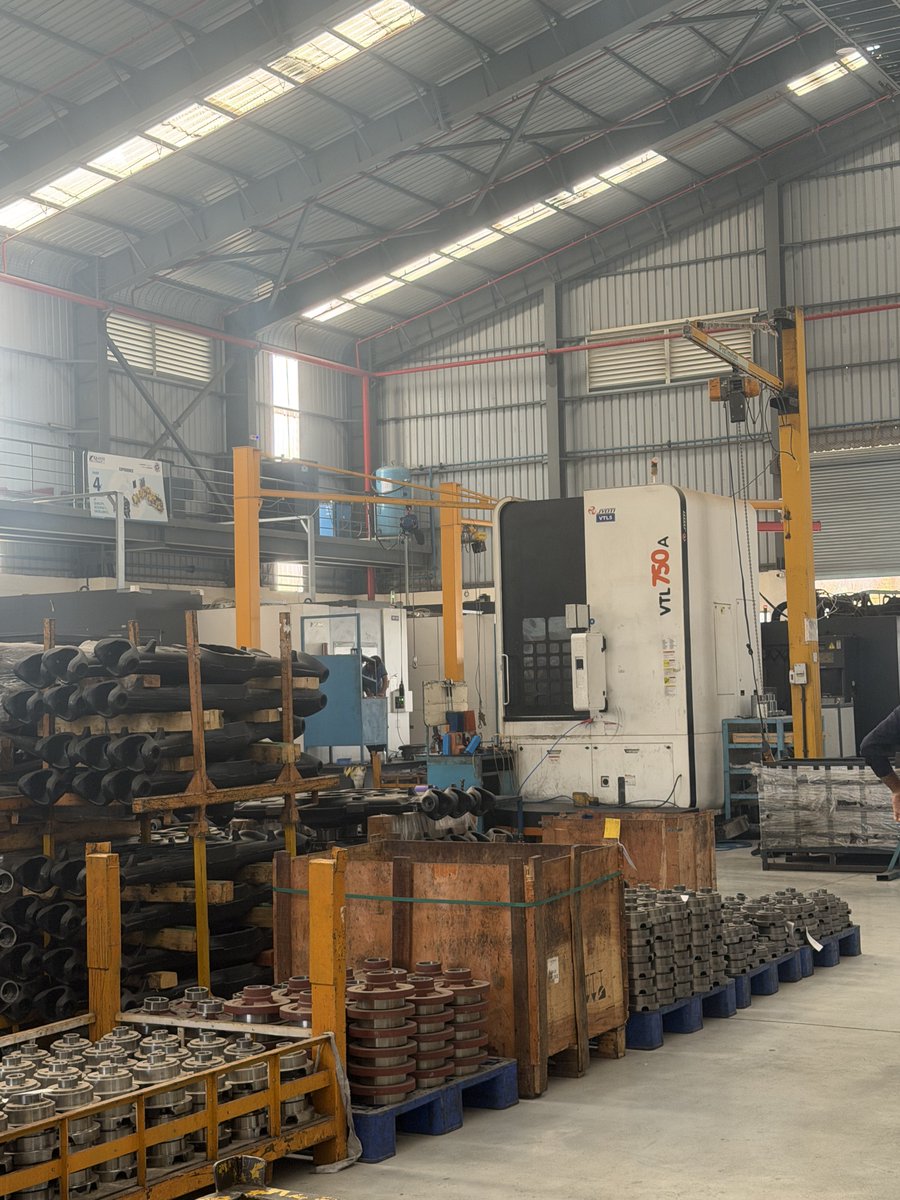
Kranti Industries drives global manufacturing with precision OEM components, supporting automotive, electric vehicles, railways, and heavy engineering sectors.
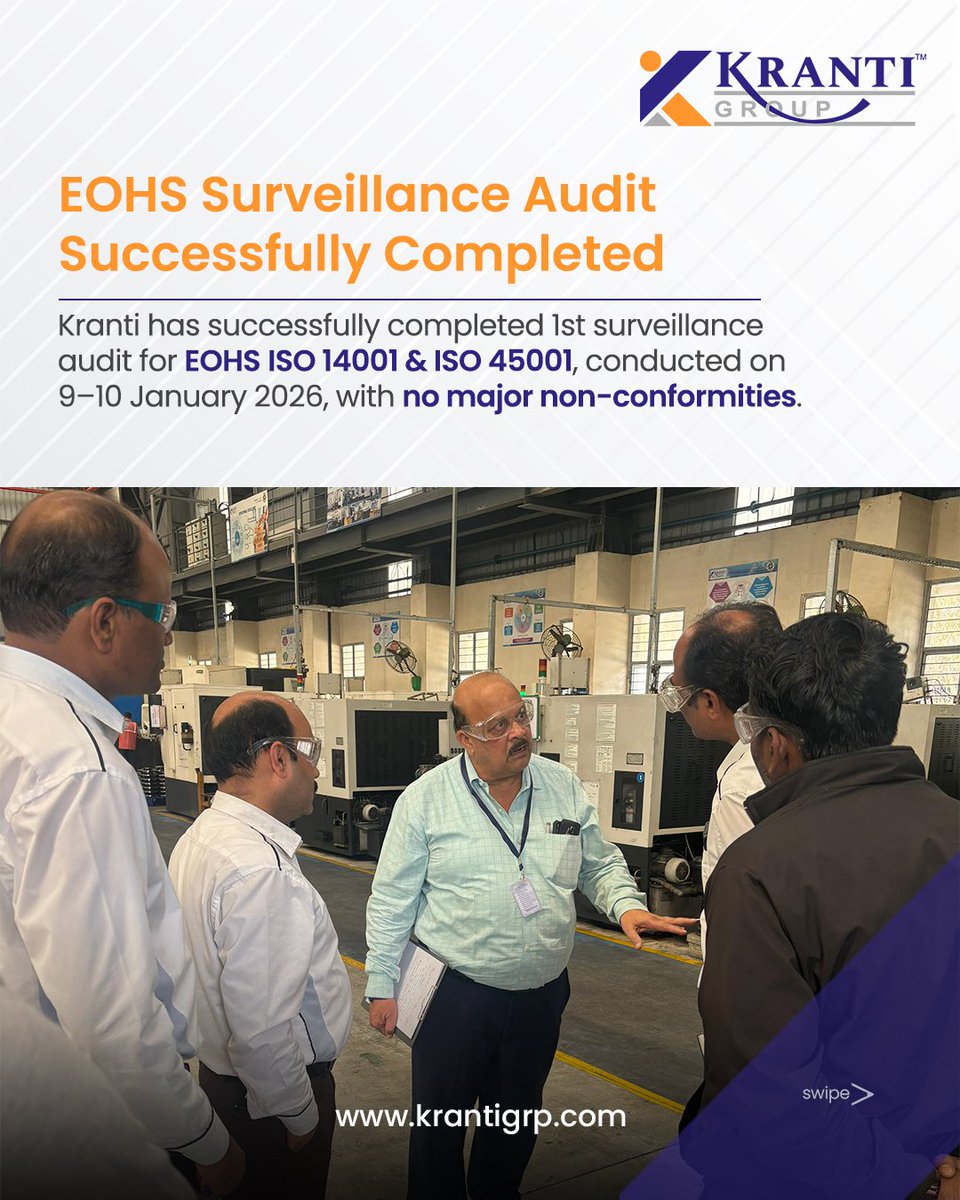
We are delighted to share the successful completion of our 1st Surveillance Audit for EOHS – ISO 14001 & ISO 45001, conducted on 9th–10th January 2026.
This audit reaffirms our structured and consistent approach to environmental compliance, risk-based safety management,
reduced environmental impact, and continuous sustainability improvement—while ensuring a safe and healthy workplace.
Sincere thanks to Mr. Madhav Kelkar from the audit body for his valuable guidance, and heartfelt appreciation to our dedicated team.
.
.
https://t.co/Tq8wuYIIfg
.
reduced environmental impact, and continuous sustainability improvement—while ensuring a safe and healthy workplace.
Sincere thanks to Mr. Madhav Kelkar from the audit body for his valuable guidance, and heartfelt appreciation to our dedicated team.
.
https://t.co/Tq8wuYIIfg
.
@KamayaKyaIndia's Visit to Kranti Industries – Inside a Pune Machining Company and the Industrial Lessons It Revealed. (Credits for documenting: @vileh111 )
A Factory Visit That Ended Up Being Much More
Our visit to Kranti Industries, a precision-machining company based in Pune, started with a simple idea: understand how a small engineering company actually runs.
What it turned into was a lesson in:
how difficult it really is to get approved as a vendor,
how a small supplier thinks about scale, debt and capacity,
how defence is a very different business from auto,
why exhibitions matter but are not a magic bullet, and
how one visit to a single factory can teach you about half a dozen industries at once.
This is not a stock tip or endorsement.KamayaKya has no vested interest in the company. It’s a ground-up look at a quiet company and the ecosystem it lives in.
A Legacy Built by One Generation, Extended by the Next
Kranti Industries was founded in the late 1980s by Late Shri Subhash Vora with a simple proposition: do difficult machining work reliably, and do it for the long term.
Today the company is run by his sons:
Sumeet Vora
Sachin Vora
What products Kranti makes
In its core business, Kranti machines critical automotive components such as:
differential housings, axle components, and
transmission parts.
These parts go into: tractors, passenger vehicles, and
commercial vehicles.
This is not low-stakes work. These parts are safety- and performance-critical. Failures are expensive — for the OEM and the brand.
Key Clients (Bonfiglioli, Ingersoll Rand, Auto OEMs)
Kranti today works with a strong mix of marquee clients across automotive and industrial machinery. In the auto ecosystem, the company supplies critical machined components to multiple tractor OEMs, like CNH and Escorts, passenger vehicle manufacturers and commercial vehicle players. On the industrial side, Kranti has deepened its relationship with Bonfiglioli, emerging as a trusted supplier after achieving “First Time Right” approval for heavy-duty gearbox housings.
Relationship with Ingersoll Rand
Additionally, the company has recently begun development work with Ingersoll Rand, and if this progresses to commercial supply, it could materially expand Kranti’s industrial customer base. The company in the pilot phase is supplying more than 10+ components to Ingersoll Rand
Exports Focus and Changing Product Mix to boost margins
Exports are beginning to form an increasingly important part of Kranti’s growth roadmap. While still early in the journey, the company has started supplying select components to international customers and is positioning itself to scale this vertical meaningfully over the next few years. The trajectory so far has been encouraging:
· Exports contributed ~3–4% of revenue last year
· This has already increased to ~6% in the current year,
· Management’s long-term ambition is to scale exports to 10%+ of the revenue mix, supported by maturing relationships with Bonfiglioli and upcoming opportunities with Ingersoll Rand
A stronger export base also improves the company’s margin profile. Export machining work typically involves higher-value components, tighter tolerances, and longer lifecycle programs, all of which align with Kranti’s capabilities. As this mix shifts toward more complex industrial and agri-implement components, management expects exports to directly support their medium-term push toward an 18% EBITDA margin.
The Validation Cycle – Where Time Becomes a Moat
On paper, it’s easy to say “they supply to X OEM”. In reality, getting there is a long, technical, draining process.
A typical customer validation cycle involves:
Drawing review & feasibility – can the part even be made reliably?
Prototype machining – first physical parts.
Dimensional checks – CMM, gauges, tolerances.
Metallurgical and surface tests – to ensure no hidden failures.
Durability / field tests – how it behaves in actual use.
PPAP and documentation – production part approval.
Pilot batch – small-run, production-level validation.
Ongoing audits – to see if quality is stable over time.
This can take 6–12 months, sometimes longer.
Two big consequences:
Entry is slow and expensive
A new supplier cannot “suddenly” grab large business. The OEM wants proof, not promises.
Stickiness is very high once approved
If an OEM wants to replace Kranti, they must repeat this entire cycle with someone else. That carries real cost, risk and time.
This is why B2B machining supply chains don’t behave like B2C brands.
Tariffs can change, sentiment can swing, but no one casually tears up a validated vendor and restarts a year-long process unless something has gone badly wrong.
Branching Out: Beyond Pure Auto Components
Over the last few years, Kranti has started consciously moving into more complex, higher-value segments.
Heavy Industrial Gearbox Housings – The Bonfiglioli Step
One big milestone: the company now machines heavy-duty gearbox housings for Bonfiglioli, the Italian industrial drive and gearbox major.
Here, Kranti achieved something significant:
Bonfiglioli granted them “First Time Right” clearance.
That means the very first set of production parts met all the required standards – a strong reflection of process discipline. This translated into a ₹6.84 crore annual order, with potential to scale if execution stays consistent.
Agriculture Implements – Logical Adjacency
Leveraging its strong presence in the tractor ecosystem, Kranti has also received pilot orders in agri-implement components.
As India’s agriculture mechanises further, this becomes a natural adjacency: same ecosystem, different product set, slightly different use case, but similar machining DNA.
Defence Machining – A Different Kind of Business
Kranti has also taken its first step into defence, with an initial machining order.
The important point we learnt here is that defence is structurally different from automotive:
Auto is typically RFQ-driven – recurring requirements, competitive quotes, parts awarded and re-quoted periodically.
Defence is far more contract / orderbook-driven – larger projects, long gestation, structured tenders, milestone-linked execution.
That changes everything for a small company:
The bidding strategy is different – fewer but bigger opportunities.
The capacity planning is different – you need to be sure you can deliver once a contract is won.
The cash flow profile is different – payment milestones, documentation, inspections.
For Kranti, this means defence cannot be approached like “just another RFQ”. It needs a deliberate strategy: what to bid for, where to build capabilities, and how much risk the balance sheet can take.
Machines, Capacity and an Asset-Light Way to Grow
Today, Kranti runs 78 machines in Pune – a mix of CNC turning centres, VMCs, SPMs, grinding and other support machinery.
Instead of buying machines aggressively, they’ve chosen a more measured path:
They entered into a long-term machining alliance with Universal Autofoundry in Rajasthan.
This gives them access to around 45 machines without owning all of them outright.
With this structure, they are working towards a clear target:
~150 machines by FY27
This is not hyper-growth. It’s growth matched to:
the validation-led demand cycle,
their own comfort on debt, and
the realities of manpower and process control.
Customer Concentration – Risk or Embedded Relationship?
On a spreadsheet, a large share of revenue coming from one big customer looks like a red flag.
But the conversation on the shop floor added nuance:
Kranti supplies to eight different plants of that customer.
For several components, they are a critical approved source.
Replacing them would require restarting the entire validation cycle with someone new.
So yes, there is concentration.
But there is also depth of integration – technically, operationally and in terms of trust. In such businesses, the real question is not “What if the customer leaves tomorrow?” but “What would make the customer go through the pain of changing?”
People and the Hidden Employment Story
Despite its modest scale, Kranti employs 300+ people.
Machining is labour-intensive because:
fixtures need setting & tuning,
dimensions need repeated checks,
parts must be handled, moved, finished and packed,
machines need operators, supervisors and quality staff.
So while the revenue line may not look huge compared to a large listed OEM, the employment intensity per rupee of revenue can be substantial.
This is one way small companies quietly support India’s industrial workforce.
What the Visit Told Us About the Wider Ecosystem
As the discussion moved beyond Kranti’s own operations, a few broader themes emerged.
How Indian Machining Has Climbed the Quality Ladder
The promoters pointed out that Indian machining and machine tools have improved leaps and bounds.
Local machines now compete respectably in many categories. But for extreme precision or specialised grinding, they still prefer:
Mazak – often their top choice in terms of efficiency.
Studer – seen as best-in-class grinding, though sometimes too expensive to justify for a small company.
The result is a hybrid landscape: Indian machines for many applications, global machines where the last few microns really matter.
This mixed toolkit itself is a sign of industrial maturity.
PEB Structures – Faster Isn’t Always Cheaper
We also spoke about Pre-Engineered Buildings (PEB).
PEB can:
dramatically cut construction timelines,
standardise structural designs, and
get plants running much faster.
But for a smaller unit, PEB is not always commercially viable. Upfront costs can be higher relative to size and cash flows.
So despite their efficiency, PEB adoption in this segment is selective and economics-driven – not just “good tech, so must use.”. PEB co's need to have multiple plants all over the country for quick turnaround time.
Exhibitions – Branding, But With a Cost and a Responsibility
One of our suggestions to the management was to participate more in industry exhibitions ��� to showcase what they can do and widen their visibility.
They agreed with the logic, but added an important reality check:
Exhibitions are expensive – stalls, logistics, travel, stay, sample parts.
You don’t get orders immediately; it often takes years of repeat presence before serious business comes.
More visibility also means more enquiries – and they do not want to accept orders they cannot fulfill reliably.
So while exhibitions are important for brand-building, they also demand:
capacity preparedness,
financial commitment, and
the discipline to say “no” to the wrong kind of growth.
For a small engineering company, that balance is not trivial.
One Visit, Many Industries
We walked into Kranti’s plant to understand a machining company.
We walked out with insight into:
automotive components,
tractor and agri-implement ecosystems,
heavy industrial gearboxes and drives,
defence orderbook dynamics vs auto RFQs,
PEB economics,
machine tool choices (Indian vs global), and
employment patterns in small industrial units.
That’s the real value of these conversations – one interaction, many industries.
KamayaKya’s Lens – And a Clear Disclaimer
At KamayaKya, our approach is simple:
Don’t just read numbers.
Meet people who run the business.
See the plant.
Ask what keeps them awake at night.
Observe where the money and time actually go – validation, fixtures, tooling, machines, people.
This visit reinforced a few beliefs:
Moats in such businesses are built in years, not quarters.
Validation cycles and relationships are often harder to replicate than machines.
“Defence”, “export”, “PEB”, “precision” – these are not buzzwords, they have practical constraints attached.
Small companies can teach you more about how the industrial economy really works than any keynote.
We have no position in Kranti Industries and no commercial arrangement with the company.
This article is not a recommendation to buy or sell anything.
It is simply an attempt to document what we saw, what we learnt, and how one day inside a modest Pune factory deepened our understanding of India’s industrial backbone.
Because in the end, knowledge – like compounding – often grows quietly in places that don’t make headlines.
Disclosures:
SEBI Research Analyst Registration No: INH000009843
BSE Enlistment No: 5583
Disclosures: https://t.co/zMHExwE8GP
Wishing our strategic leader, Sumit Subhash Vora, a very happy birthday! 🎉 Your vision, leadership, and unwavering dedication inspire us all. 💡 Today, we celebrate not only your special day but also the journey of progress and innovation you’ve led Kranti Group towards.
This Guru Nanak Jayanti, may the eternal light of Guru Nanak Dev Ji illuminate our paths with compassion, truth, and humility. At Kranti Group, we strive to reflect these values in everything we do—guided by precision, inspired by purpose, and enlightened by his divine teachings.
From vision to victory! Kranti Group proudly salutes the unstoppable spirit of India’s Women in Blue for clinching the ICC Women’s Cricket World Cup 2025. Your grit and glory inspire a nation. Here's to strength, strategy, and historic success—just like the components we craft!
Perfectly aligned by trust, engineered by love — this Bhai Dooj, Kranti Group celebrates the unbreakable bond between siblings.
May your lives be filled with strength, innovation, and joyous memories that stand firm through time.
.
#KrantiGroup#BhaiDooj2025#SiblingBond
Innovation meets tradition this Diwali Padwa. At Kranti Group, we believe every spark of creativity leads to a brighter tomorrow. Let this festival inspire new ideas, strength, and growth for you and your family. Wishing you light, progress, and innovation this Padwa.
.
.
.
.
This Diwali, Kranti Group celebrates the spirit of innovation and excellence.
May the festival of lights illuminate your life with success, joy, and new beginnings.
.
.
Let’s keep building a brighter future, together.
Happy Diwali from Kranti Group! 🛠️✨🪔
.
.
.
.
This Dhanteras, Kranti Group celebrates the light of innovation, the strength of progress, and the richness of purpose. May your journey ahead be filled with golden opportunities and growth built to last. Shine bright, build right! 💡🏗️✨ #KrantiCelebrates
.
.
.
.
#KrantiGroup