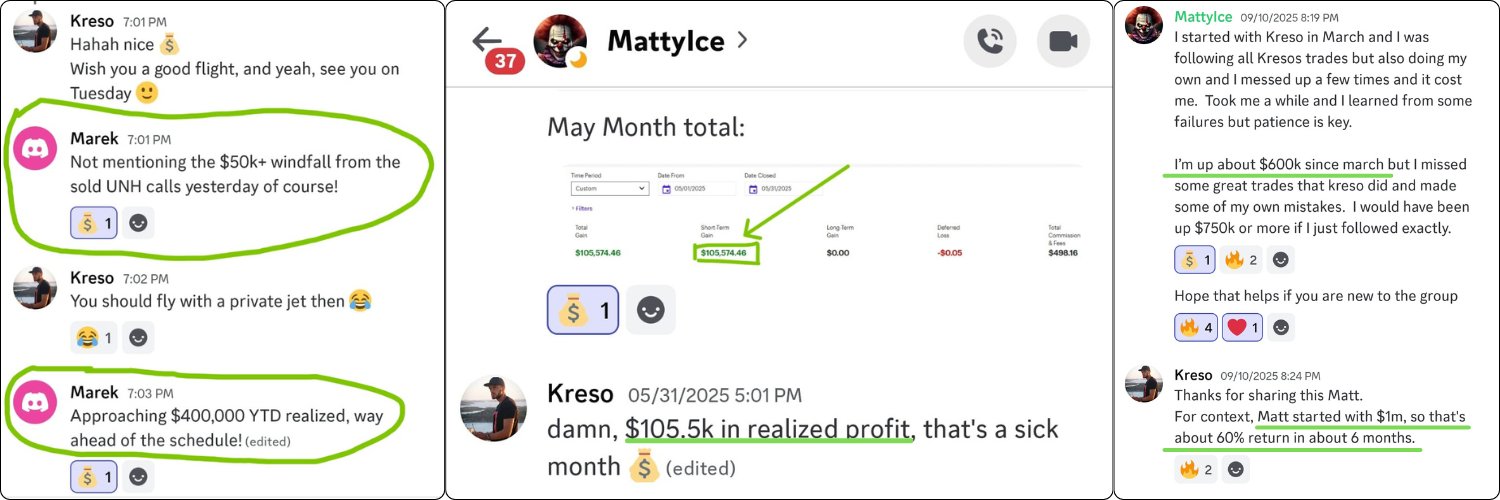
$59,665 in realized profit from selling options in October.
Stocks traded:
$CELH
$ELF
$ENPH
$HIMS
$HOOD
$NBIS
$OSCR
$PATH
$PGY
$RDDT
$SOFI
$ZETA
Every trade was shared in real time with my coaching clients inside Discord.
Headlines are written to get your attention, not to make you money.
Before you act on one, ask: did anything change about what this business earns?
Usually the answer is no.
The news changed the mood, and mood changed the price.
That's a fair point. The chart is information, but it doesn't necessarily mean that information is an accurate reflection of the company's fundamentals or intrinsic value.
Investors are often driven by emotions, panic, headlines, and short-term sentiment. You also have forced liquidations, margin calls, algorithmic trading, and other factors that can push prices significantly lower, sometimes irrespective of any meaningful change in the underlying business.
Markets can be wrong, especially in the short term. That's why I think it's important to distinguish between a change in price and a change in the underlying business. They're not necessarily the same thing.
Trader:
"Everything is red. Should I sell?"
Investor:
"Did the business change, or just the price?"
Trader:
"...just the price."
Investor:
"Then you're not reacting to information. You're reacting to a feeling."
Checked the market at open: everything was bleeding.
Went to the gym, showered, came home, made dinner, ate, had a chat with my dad.
Checked the market again.
Back to flat.
This market needs a therapist. 😂
$QQQ $SPY $NVDA $NBIS $TSLA $PLTR $META $AMD $GOOGL
This is exactly why I preach against using margin.
Yes, margin can be used responsibly in theory.
But most people either don't understand the risks well enough or lack the emotional discipline and risk management required to use it properly.
I'd rather tell everyone to stay away from margin altogether than tell them to use it responsibly.
I genuinely believe the former will do far more people good than the latter.
Can you learn to stomach a big decline?
Yes, mostly.
Not by becoming tougher, but by building a setup that makes it easier.
Nobody tells you this when you start: drawdowns aren't a bug in investing. They're the price of admission.
If you can't stomach a big decline, your position size is wrong, not the market.
Some people are naturally calmer than others.
But what you do while the portfolio is bleeding is a skill, and here's what helps:
1. Size positions for the worst case, not the average case
This is the biggest lever. If a 40% drop on a position keeps you up at night, it's too big. Shrink it until the drop is annoying, not terrifying. Same stock, same thesis, but now you can hold it.
2. Know what you own and why
Conviction comes from research, not from price action. If you understand the business, you can tell the difference between "the price fell" and "something broke." If you don't, every red day feels like the second one.
3. Don't be forced to sell
No margin, no money you'll need next year, and a cash buffer for life. Staying calm is a lot easier when selling is a choice and not a requirement.
4. Write your rules while you're calm
Decide in advance what would make you sell, what you'd buy more of, and what you'd ignore. When the market is falling, you may not be at your smartest, so let the earlier version of you make the call.
5. Expect it before it happens
Look at how deep past declines went and how long they lasted. A 30% drop isn't a shock when you already knew it could happen. It only feels like an emergency when you assumed it wouldn't.
6. Check less
Watching your portfolio every hour doesn't give you information. It gives you stress. A business doesn't change every time the ticker does.
7. Build reps with smaller amounts
Nobody learns to handle a big decline by reading about it. You learn by living through a smaller one without panic-selling. Each one you handle well makes the next one easier.
8. Separate your income from your portfolio
If your portfolio has to pay next month's bills, every drop feels like a threat to your life. If it doesn't, it's just a number moving around.
Notice that most of these happen before the crash, not during it. Staying calm in a down market is mostly preparation.
You won't enjoy a big decline. The goal isn't to enjoy it, just to not do anything stupid while it's happening.
Portfolio up 13% at the open
Moves I made last week paying off
Stocks I sold up only a couple of percent while the ones I bought up 20%+
Good rotation
$NVDA brought back Jensen
crazy stuff
peak comedy
-$120,031 realized loss in November so far.
On purpose.
$TTD accounted for -$144,673 of it. Sold for tax-loss harvesting and redeployed into higher-conviction names with better risk/reward.
Gains elsewhere offset ~$24.6K.
I also sold names that held up well or were lower conviction ($PATH, $CELH, $ELF) to buy ones that got decimated or are higher conviction ($NBIS, $NVDA, $HIMS, $OSCR, $HOOD, $SOFI).
Every trade shared live in my Discord.
@NghivBui Down 12% for the year.
Which I'm pretty happy with given the carnage in the last couple of weeks.
On the next rally to new ATHs I'll likely make a killing with the recent moves I made and dips I bought.
The goal in a down market isn't to avoid the pain. It's to still be in the game when it ends.
There are two goals, in this order:
1. Survive
1.a) Avoid margin.
Margin turns a drawdown into a forced sale. You don't get to wait for the recovery, because your broker decides when you're out, usually near the bottom. If you can be forced to sell, you don't fully own your decisions.
1.b) Don't gamble on short-term options.
Short-dated options may be tempting. But you have to be right on direction and timing, and one sharp move can wipe the position out in a day. That's a lottery ticket, not a strategy.
1.c.) Don't confuse cheap with discounted.
A good business at a lower price is a discount. A bad business at a lower price is just a bad business that got cheaper. Weak balance sheets and shaky stocks are the ones that don't come back.
2. Buy the discounts
Surviving isn't the finish line. It only gives you the chance to act.
A down market is usually the only time quality businesses go on big sale. If you've done the research, this is what it was for.
To do it without being reckless:
- Have your watchlist ready before the drop, not after it.
- Know what you'd pay and why.
- Buy in pieces. You'll never catch the exact bottom, so don't try.
The investors who build wealth in down markets aren't braver than everyone else.
They're prepared: no margin, no lottery tickets, no junk, and cash plus a watchlist ready to go.
Survive so you can act. Act so you can profit.
Brutal day.
$QQQ
-5.5% today
-10% in a week
-20% since high
Major correction teritorry.
Did a lot of buying & portfolio shuffling today.
Sold names that held up better, bought names that got decimated.
It feels bad at the moment, but it will pay off in the future.
Bought:
$NVDA $NBIS $HIMS $OSCR
Sold/trimmed:
$ELF $CELH
Stop asking “how much premium can I collect?”
Ask this instead:
“What happens to my account if every put I sold gets assigned on the same day?”
Most people size each trade on its own. Markets don’t drop one stock at a time.
Size the whole book.