Einstein scientists Dr. @arnegennerich & Dr. Lu Rao report in Nature Cell Biology that dynein transport complexes adapt to mechanical load by recruiting a third motor – boosting force to keep cargo moving, especially in neurons. Read more: https://t.co/mQKEVKRCKk #EinsteinMed
Our scientists developed the MICrONS Explorer, a virtual observatory of the cortex, to support #neuroscience discovery 🧠🔭 https://t.co/fo4VHGB607
This #opendata portal includes #electronmicroscopy-based reconstructions of circuitry from mouse visual cortex.
Brain-wide neuron tracing reveals that the mysterious mouse claustrum is highly connected to the rest of the brain.
In this extreme example, several neurons wrap their axons entirely around the cortex, forming a crown-like structure. 👑
More: https://t.co/eNfwVdZSe3
#SciShots
Long-overdue thread on our latest work using the IBL data to reveal the shared organizational principles of the neural code in the cortex.
A systematic analysis of categoricality 🧱 and dimensionality 📐 of the neural code across 40+ regions.
https://t.co/42Z2KwUkYS
👇 1/n
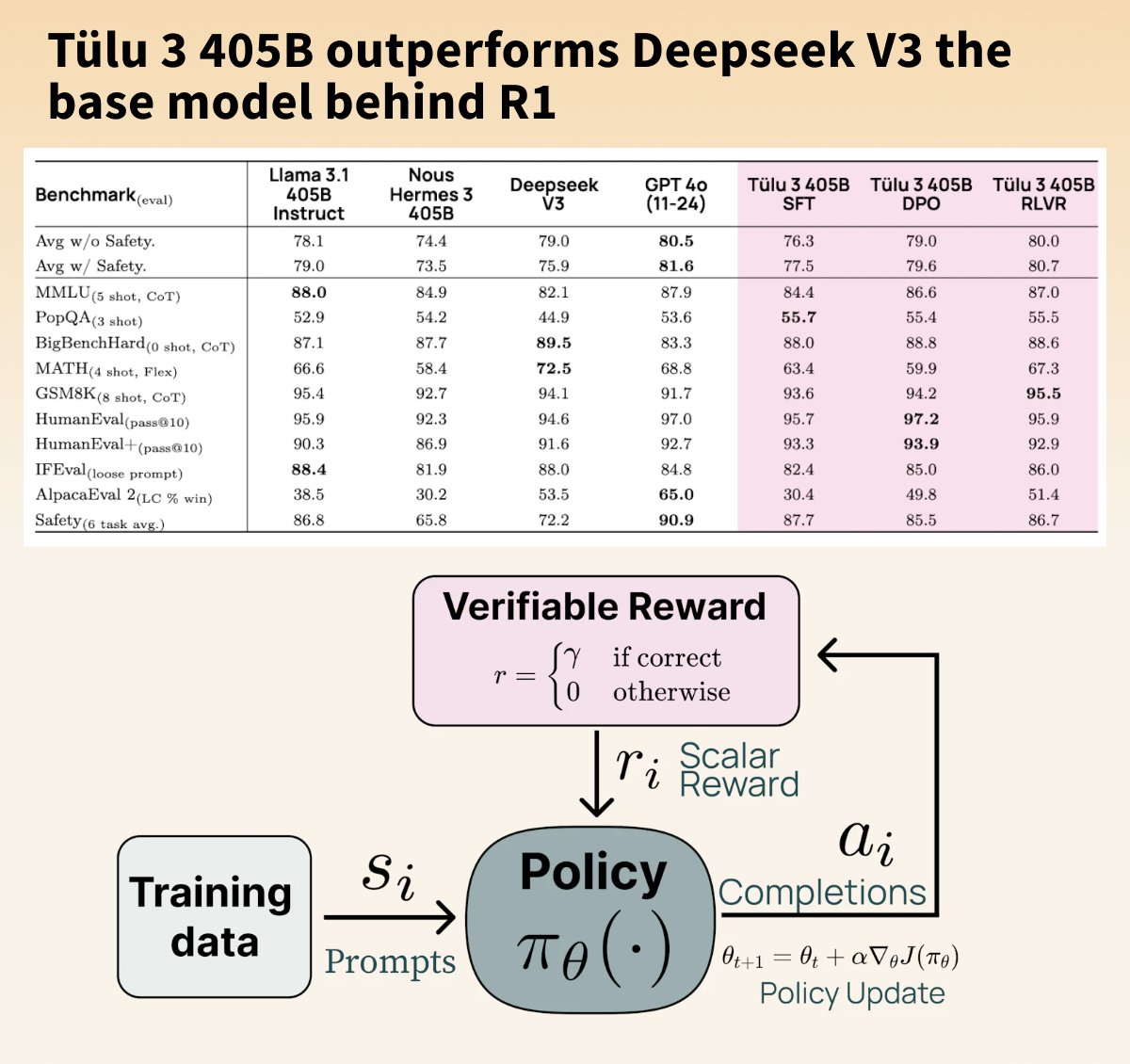
Deepseek V3 beaten! @allen_ai released Tülu 3 405B, an open-source post-training model built on Llama 3.1 405B. It outperforms Deepseek V3 the base model behind Deepseek R1 and is on par with @OpenAI GPT-4o. 👀 Tülu 3 405B is not a Reasoning model like R1 or o1, but team shared that they are working on it! 🔥
Tülu Recipe:
1️⃣ Data Curation: Collect a diverse mix of public datasets and synthetic data using persona-driven methods, focusing on core skills like reasoning, coding, and safety.
2️⃣ Supervised Finetuning (SFT): Train initial models on a carefully curated mix, iteratively refining the mix and decontaminating against evaluation datasets.
3️⃣ Preference Tuning (DPO): Optimize models using Direct Preference Optimization with a mix of on-policy (SFT vs. other models) and off-policy data.
4️⃣ Reinforcement Learning on Verifiable Rewards (RLVR): RL (PPO) based optimization on specific skills like math and instruction following verifiable rewards, .e.g. math
Rho GTPase 1 (Miro1) loaded MDV nanogels with macrophage-targeted function facilitated the #mitochondrial transfer process from macrophages to BMSC. The “Mito-Battery” can regulate the levels of ROS, ATP, and OXPHOS in BMSC through intercellular transfer, thereby affecting intracellular mitochondrial function and metabolic status and promoting the formation and growth of bone #regeneration.
https://t.co/DksIicrppb
Superb video of the mitochondrial community in a single cell—hundreds of squiggly microorganisms sensing, processing, and signaling energy and information
By @chillinwithpfn1
https://t.co/EG8Pk55Nwc
We are thrilled to share that our first paper from my new lab, Spateo (https://t.co/a0BC0Cf3Ec) for spatiotemporal modeling of molecular holograms, is now online in Cell: https://t.co/UUZkyXYJtG. Spateo is a comprehensive analytical framework for 3D whole-embryo spatiotemporal modeling. Its advanced features include:
• 3D alignment and reconstruction at the whole-mouse-embryo scale (see the animation).
• 3D spatial domain digitization and cell-cell communication analysis to understand spatial gene expression gradients and both inter- and intracellular communication.
• 3D morphometric and volumetric analyses along with 3D morphogenesis vector field modeling to quantify dynamics such as surface area, volume, and cell density across organs, and to dissect the interplay between morphogenesis factors and cell migration.
• A “Google Earth”-like browser, Spateo-viewer (https://t.co/s33SS7jvYL and https://t.co/BbY6bIJtS0), for interactive and intuitive exploration of 3D spatial data.
• Additional features, such as RNA signal-based single-cell segmentation.
We are also honored that Nature “News and Views” has highlighted this work as well: https://t.co/8F4s6GJeBY.
This is really an amazing outcome after two years' heroic revision process that rewrite the entire paper using a new data (https://t.co/xbahWSeGgx) for whole mouse embryos.
Excited to report that we have discovered a new, endogenous molecular clock in unmodified human cells and tissues. It is ticking away right now in almost every cell in your body.
Specifically, in a new paper on BioRxiv, we show that RNA editing by the near-ubiquitous ADAR1 in unmodified human cells is sufficient to allow us to infer the ages of thousands of species of RNA. This provides a new way to infer past transcriptional dynamics, without any metabolic labeling or genetic engineering, in anything from cultured cells to patient biopsies.
Work by @agreeb66, @JamesBa95200124, @AaronWagen, and many more, and funded by @LNuzhna's Impetus Grants, along with generous support from @ericschmidt and @wenschmidt.
1/
Excited to share CpGPT, a new foundation model for DNA methylation, crafted to understand the 'language' of epigenetics! 🧬🤖
What’s CpGPT?
CpGPT is a transformer model pre-trained on CpGCorpus, a huge dataset of public DNA methylation info. By integrating sequence, positional, and epigenetic data, it captures complex epigenetic interactions from even a small part of the methylome.
📄 Preprint: https://t.co/ZpIAbYa59V
Why CpGPT?
DNA methylation is key for gene expression and chromatin structuring, with CpG sites often varying in diseases like cancer and aging. Here’s what sets CpGPT apart:
✨ CpGPT Highlights:
🔧 Deep Pretraining: Trained on over 100K samples from 1,500+ studies, covering 1M+ CpG sites.
🗺️ Zero-Shot Skills: CpGPT imputes methylation from minimal data, mapping different Illumina arrays to a common reference.
🐭 Cross-Mammalian Reach: When fine-tuned, CpGPT accurately imputes methylation in new mammalian species.
📈 Strong Performance: Fine-tuned CpGPT ranks 2nd overall and 1st on the public leaderboard for age and mortality prediction in the Biomarkers of Aging Challenge.
Special shoutout to Lucas (@ollimacsacul) for his outstanding leadership on this project! Big thanks as well to all the co-authors (@rv_sehgal, @prof_horvath, etc.) for their dedication and swift feedback throughout.
We're committed to open science and are actively preparing the code. Expect the full code and model weights to be available soon—likely within the next few weeks!
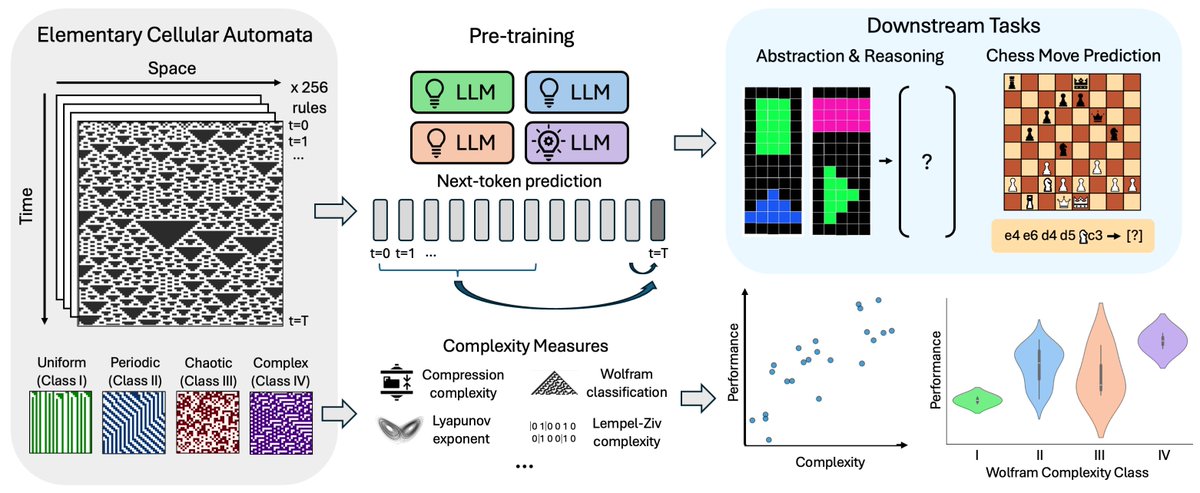
How does complexity shape intelligence? 🤔
In our new paper Intelligence at the Edge of Chaos, we explore the relationship between complex systems and the emergence of intelligence in AI models. Can complexity alone unlock smarter systems? 🌌🧠 #AI#complexity
https://t.co/nnLMDkzwtx
The most complete map for any organism so far. 🪰🧠✨
@sara_reardon for @nature explains why we should care about the fruit fly brain: https://t.co/UNELfS5Cw3
🎥 Video by @Princeton#SfN24
Neural #stemcells dividing in the growing mouse brain. Notice how they undergo mitosis at the ventricular border and one daughter cell shoots up quicker than its sibling? One might think it is the neuron starting to migrate but no, it is the new precursor. Credits: @C_Kittock
Imagine bacteria mining cryptocurrencies. We moved a step closer by encoding a 2-bit MD5 cryptographic hash algorithm – a precursor of SH256 used for Bitcoin - across 66 E. coli strains. It required over 1 megabase of DNA, the size of a small genome. https://t.co/CyjhE88JwZ
Published today in @Nature, we describe an approach for single-molecule protein reading on @nanopore arrays. By utilizing ClpX unfoldase to ratchet proteins through a CsgG nanopore, we achieved single-amino-acid sensitivity. https://t.co/ZTFNZkwpcj