Will the US go into a recession this year? Will the world? These are just a few of the questions I’m getting after the announcement of “Liberation Day” tariffs. Here are three scenarios to consider.
https://t.co/NFnAdVvoTv
Investors are faced with a high level of uncertainty, which has led to market jitters and a significant sell-off in US stocks last week. I’m asked more and more whether investors should change their portfolio allocation.
For investors who have a long time horizon and a well-diversified portfolio, I generally favor staying the course. The market’s history has been marked by sell-offs — some very dramatic — but stocks have had a way of moving higher over the longer term.
The Organisation for Economic Co-operation and Development revised its economic forecasts in light of signs of softening global growth prospects and rising economic policy uncertainty.
We’re also seeing a tectonic shift in fiscal stimulus around the globe, with the US reducing fiscal spending and economies like Germany and China clearing the way for increased fiscal stimulus.
While the dot plot from today's Federal Reserve meeting indicated a rising risk of stagflation, Chair Jay Powell said his base case for inflation is that it's transitory. Overall, the Fed seems like it's leaning dovish, which would be good news for markets. Here are some more of my key takeaways from today's Fed news.
I assumed it would be very difficult given the uncertainty. But that’s why I find it encouraging that they still penciled in two rate cuts this year. This Fed is leaning dovish.
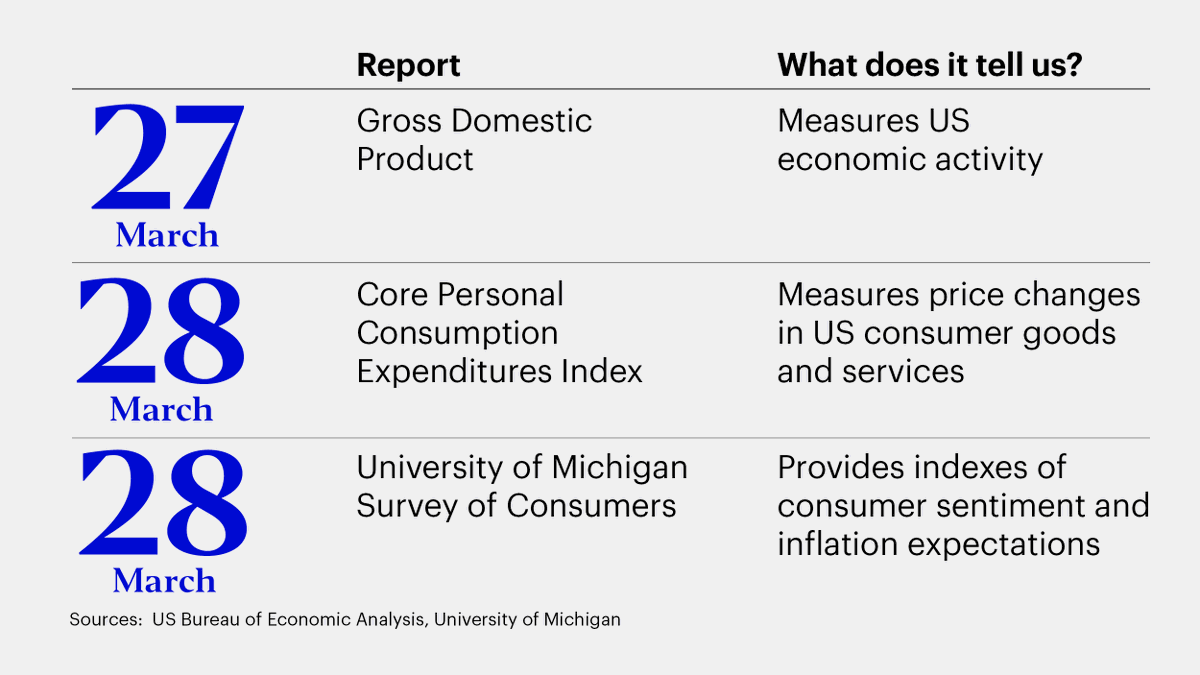
University of Michigan five-year ahead inflation expectations have risen meaningfully in the last several months. I hope the Fed is not too complacent when it comes to consumer inflation expectations because they can become self-fulfilling prophecies.
Powell shared that he believes inflation expectations are STILL well-anchored because the Fed is only looking at longer-term inflation expectations. I disagree.
In the press conference, there was much talk about the impact of tariffs but very little talk about the Department of Government Efficiency (DOGE) — especially the economic impact of aggressive government spending cuts. In my view, that’s the biggest risk to the US economy.
Powell said the Fed's base case is that higher inflation this year will be transitory. His argument is that the last time there were tariffs, higher inflation was transitory as well.
Powell shared that the Fed is looking for signs of weakness in the real data. In other words, he is looking for "brown shoots," just like I am.
Powell seems focused on labor dynamics. He says the labor market appears balanced, but a pickup in layoffs could be concerning since the hiring rate is low.
I’m looking for “brown shoots” — signs that the US economy is beginning to wilt. I’m hoping not to find any, but recessions have historically been caused by policy mistakes, so it’s important to watch vigilantly for them. Here’s what I’m seeing.
https://t.co/hJt18SGnG7
Chair Powell is making it clear that the Fed will be patient and wait for greater clarity through more data. That is certainly prudent given the current environment of policy-driven uncertainty.
However, today’s “dot plot” is not bad news, in my view, as FOMC members still expect a median two rate cuts in 2025, and will sell off less of its balance sheet each month. I find that encouraging. This is a supportive Fed.
I think talk about “stagflation” will be louder now that the Fed has downwardly revised growth expectations and upwardly revised inflation and unemployment expectations for 2025.