The future of cultural leadership will depend on our ability to hold two truths at once: protecting the irreplaceable value of human artistry while developing the intelligence to navigate a world where AI increasingly participate in how knowledge, creativity, and decisions made.
2026 is a participation economy.
Presence, engagement, identity, network, emotions, and visibility are now part of the labor model. We’re no longer just making work. We are producing ourselves.
“The Participation Economy” @Substack https://t.co/LJxQDH3RgM
#CreatorEconomy#ArtTech
Culture is no longer defined by what is made, but by how meaning is selected, structured, and maintained under conditions where making is no longer scarce.
We talk about automating creative labor while ignoring the human labor of meaning.
Not just making things — interpreting, contextualizing, preserving, curating, teaching, questioning, and sustaining culture itself.
Outputs alone do not create culture.
Human stewardship does.
The question is no longer:
“How do we fund art?”
The question today is:
How do we build ecosystems capable of sustaining meaning, participation, beauty, and human connection in a rapidly transforming civilization?
Art is not outside the economy.
It’s one of the last places where meaning is still produced at scale.
The systems around it are changing fast.
Cultural power, artistic sovereignty, and what comes after institutional gravity.
My @Substack https://t.co/Q8OgI6AzW5
#ArtsEconomy
The venue isn’t a logistics challenge.
It’s a governance problem misread as ops.
When it breaks, it’s not failure—it’s misalignment between culture and structure.
Stop optimizing. Start redesigning who defines the space.
Full piece on my @Substack:
https://t.co/z6aNlUJNhk
Exposure scales attention. Experience scales value.
The arts have confused the two—and the market has responded accordingly.
What would it take to reverse that equation?
Read more on my @Substack:
https://t.co/HK8sjHHpvg
#Leadership#Strategy#Innovation#ArtandEconomics
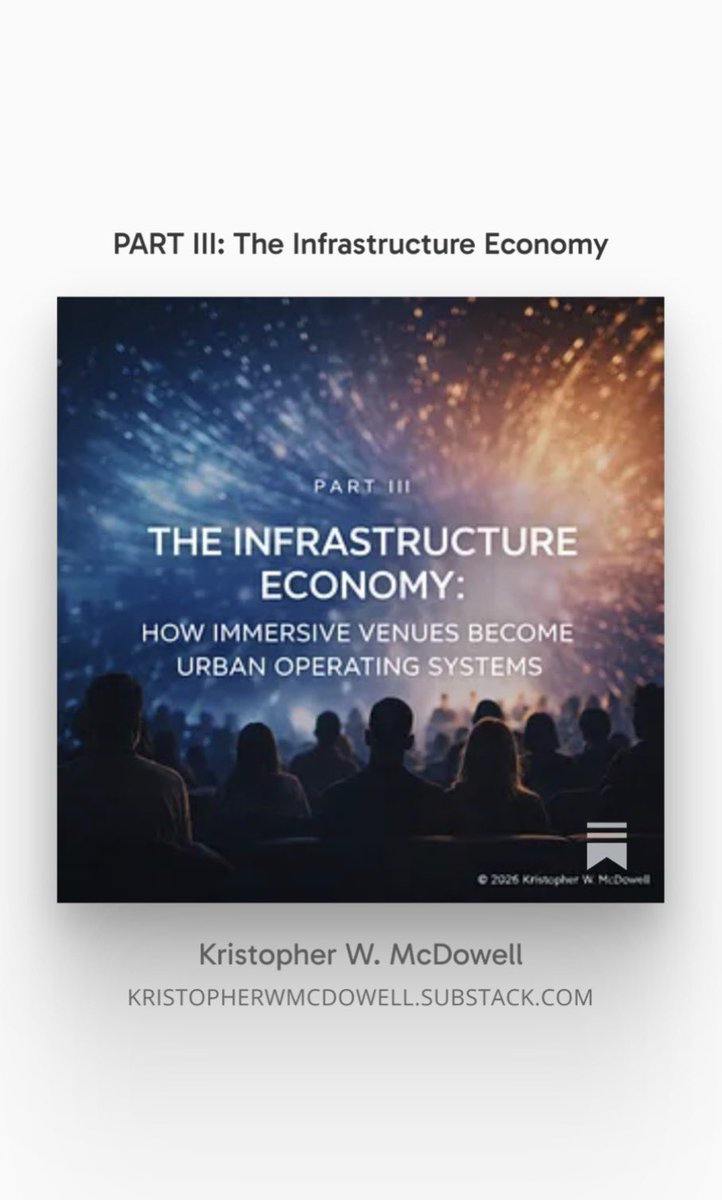
Most immersive work is still thinking like theatre. Build a world. Place the audience inside it.
But the real shift? The space is not the setting. It’s the storyteller.
Until that changes, immersion is just decoration.
Read Part III on my @Substack: https://t.co/lEK1W8RSTL
The creative industry is stuck in a venue mindset. Yet the leverage isn’t in spaces—it’s in systems.
Systems outlive events.
Systems compound VALUE.
Part I @Substack →
https://t.co/etXRNNgbYZ
Part II is live. Part III tomorrow.
#CreatorEconomy#SystemsDesign#CreativeWork
Most creators don’t have a content issue. They have a constraint challenge.
The algorithm rewards noise.
The market rewards clarity.
Choose your constraint—
or become someone else’s.
Part II @Substack
https://t.co/ShGTldDBqQ
Part III tomorrow.
#ContentStrategy#CreatorEconomy
There’s a funding gap in the arts.
But the real problem? An imagination gap.
No imagination → cautious funding → no imagination.
The cycle continues.
Read: https://t.co/lTl4XhQuq2
#FutureOfArts#ArtMatters#InvestInArt#CreativeEconomy
The arts don’t lack audiences.
They lack systems that know how to meet them.
We’re not in a funding crisis.
We’re in an infrastructure gap.
→ Cultural Intelligence Economy on my @Substack
https://t.co/tc4OAcI9mq
#ArtsInnovation#CulturalIntelligence#CreativeEconomy
We don’t have a creativity challenge.
We have a coordination challenge.
I’ve spent 20+ years watching brilliant work stall—not because it’s weak, but because the system can’t move it.
A thread on decision-making, touring: 🔗 https://t.co/EpcgJwNqoT
#CreativeEconomy#Touring