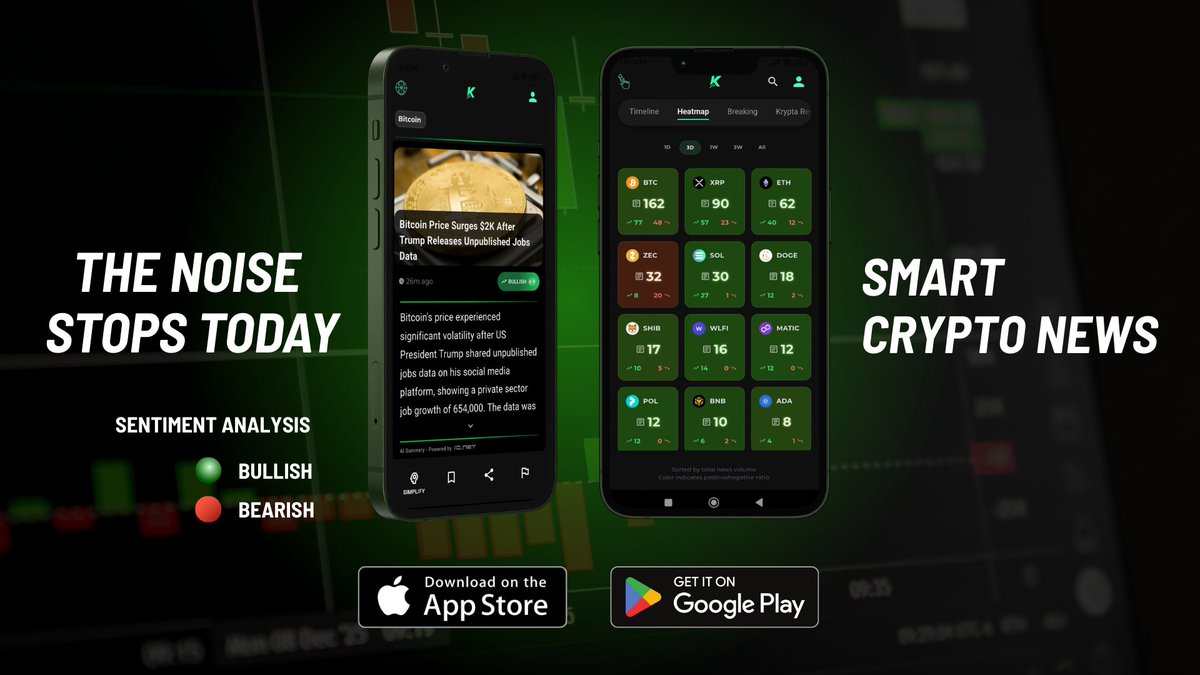
The noise stops today. 🛑
Krypta is officially live on iOS and Android. No more doom-scrolling through pure hype. Get clean crypto news, real-time sentiment analysis, and market heatmaps in one place.
Download now:
🍏 https://t.co/6c3ZL0M8cK
🤖 https://t.co/QftrTmcK8V
$BTC 65K. US-Iran ceasefire. SpaceX #Bitcoin treasury revealed.
Today is a masterclass in why macro signal matters more than price action. When the world shifts, don't get lost in the noise.
Krypta: Simple news intelligence for the real world.
Social noise is loud. Market impact is often quiet until it’s too late.
In crypto, 90% of the "news" you see on your feed is sentiment-driven fluff. By the time the crowd reacts, the move is often over.
We built Krypta to filter the noise at the source. Better data = better decisions.
Don't just follow the trend. Understand the impact.
Institutional money isn't just "coming" anymore, it's settling on-chain.
BlackRock’s #BUIDL reaching new milestones is a clear signal: Real-World Assets (#RWA) are the bridge between #TradFi and #DeFi.
What this means for you:
• Higher transparency for "off-chain" yields.
• More institutional-grade assets to track in your portfolio.
• The line between "crypto" and "finance" is disappearing.
Stay ahead of the noise.
Index futures are less about betting single coins and more about giving institutions a single hedge/exposure line.
CME + Nasdaq on the label matters for compliance and clearing familiarity.
Slow adopter channel, but it tightens crypto's tie to traditional risk desks over time.
@Crypto__Haris $60k matters because it's where positioning clusters, options, psychological levels, and prior demand overlap.
Support isn't a floor because a chart says so; it holds if buyers absorb supply without leverage cascading. The level is a test of flows, not a guarantee.
@lookonchain Whale-sized leverage longs are a sentiment gauge, not a signal to copy.
$1,571 liquidation on a $60M notional tells you how tight the trade is, one volatility spike and it's a forced exit that moves the tape.
Watch the unwind, not just the entry.
@JakeGagain@Pumpfun Memecoin volume rotating chains is usually liquidity chasing lower friction and fresher narratives, not a permanent "exodus."
#Solana's issue was throughput of launches, not throughput of the chain. The cycle repeats until the next venue feels overcrowded too.
Agent payments sound niche until you realize it's about machine-to-machine settlement rails, cards plus stablecoins under one API.
Early partners list is the signal: incumbents testing crypto as plumbing, not as a trade narrative. Adoption path is B2B long before it's retail-visible.
Three different failure modes in one week: bridge/exploit risk, app wallet custody, and unlock supply timing.
Lumping them as "crypto is broken" misses the point, each needs a different due-diligence filter.
Hacks aren't new; concentrated unlock + opaque team flows are the quieter repeat pattern.
@AshCrypto The comparison is striking but the mechanics differ, metals had a violent deleveraging move, crypto's already been in a separate drawdown.
Shared theme is liquidity stress hitting multiple "hedge" buckets at once, not one asset winning. Correlation spikes in weeks like this.
4.2% with energy as the driver is a different story than broad demand overheating. Markets often punish the headline first and sort the composition later.
Watch whether core services cool as oil mean-reverts, that's usually when BTC/risk correlation shifts, not on the initial print.
If goods inflation stays contained while energy was the May shock, the market's hike pricing may be reacting to headline CPI, not the core trend.
For risk assets that usually means rate-path volatility matters more than the print itself, especially with conflict-driven oil still in the mix.
@rektcapital 200-week SMA breaks get attention because they're rare, but deviation alone doesn't clock a bottom or top.
Historically these zones are where sentiment maxes out, not where macro reverses on cue. Worth pairing with flows and rates, not just the orange line.
@WatcherGuru Cramer's frame is really about liquidity rotation, not $BTC vs gold as assets.
IPO windows, margin calls, and tax-loss selling can hit "stores of value" and "quality tech" in the same week.
The useful question is duration, one-off supply or sustained outflows.
Last week in crypto, three things stood out:
• The CFTC moved forward on a path for U.S.-listed #Bitcoin perpetual contracts, another sign that regulation is getting more concrete.
• Spot $BTC ETFs finally snapped a record 13-day outflow streak, and $ETH ETFs also broke their own red-red streak.
• Bitcoin still had a rough week as capital rotated toward AI stocks and megacap IPOs.
The bigger picture: policy is opening new rails, but flows are still deciding the tape.
What mattered more this week: regulation, ETF flows, or price action?
@saylor AI capex and #Bitcoin scarcity aren't mutually exclusive narratives, but 'temporary pressure' and 'premier asset' can coexist in the same cycle without one causing the other.
The gap is usually timing: liquidity stress hits risk assets before scarcity thesis shows up in price.
@AshCrypto A weekly flush plus one green day often overstates 'recovery' in a single headline.
$116B market cap add sounds dramatic, separating dead-cat bounce from flow reversal means watching whether volume and ETF flows hold after day one, not just the print.
@coinbureau Record-low RSI measures sentiment exhaustion, not a bottom timetable.
$ETH has hit 'historically oversold' before and stayed there through macro shocks.
Flow context usually matters more: #ETF prints, stablecoin supply, and whether selling is discretionary or forced.
@Cointelegraph Germany's sale level is a reference point for sentiment now, not a support floor.
Sovereign disposals mattered for timing back then, today's drivers are ETF flows, rate path, and leverage positioning. History rhymes; it doesn't anchor price.
@RoaringKitty The timeline shift is real, volatility converts cultural accounts into macro accounts overnight.
Engagement follows fear; retention follows something else.
The interesting question is who stays when price goes sideways again.