Intelligence shouldn’t require an internet connection or a cloud bill on every prompt.
Watch Alpie Seed 9B read and reason over a full restaurant menu from a photo on an iPhone in Airplane Mode. Zero Wi-Fi. Zero cellular. Zero data leaving the device.
4-bit quantization is doing for AI what MP3 did for music: shrinking massive multimodal intelligence down to a footprint that fits in your pocket without sacrificing real-world utility.
Here is what’s running locally on that phone:
• Architecture: 9B multimodal reasoning model (text, image, video) with a 262K context window
• Footprint: ~5GB in 4-bit GGUF runs smoothly on iPhones, Android flagships, and consumer laptops
• Post-Training: Built on Qwen3.5-9B via a two-stage SFT + GRPO pipeline with DoRA adapters, trained with 4-bit NF4 quantization and BF16 compute for edge-ready efficiency
• Cost: $0 per token, forever
• License: 100% open weights (Apache 2.0)
You don't need a cluster to test it. Run it on your machine right now in one command: ollama run https://t.co/7GqHxQQsvF
We’re building sovereign, device-native AI for the next billion devices from phones in airplane mode to air-gapped enterprise workflows.
Drop your device specs + tokens/sec in the replies if you run it locally 👇
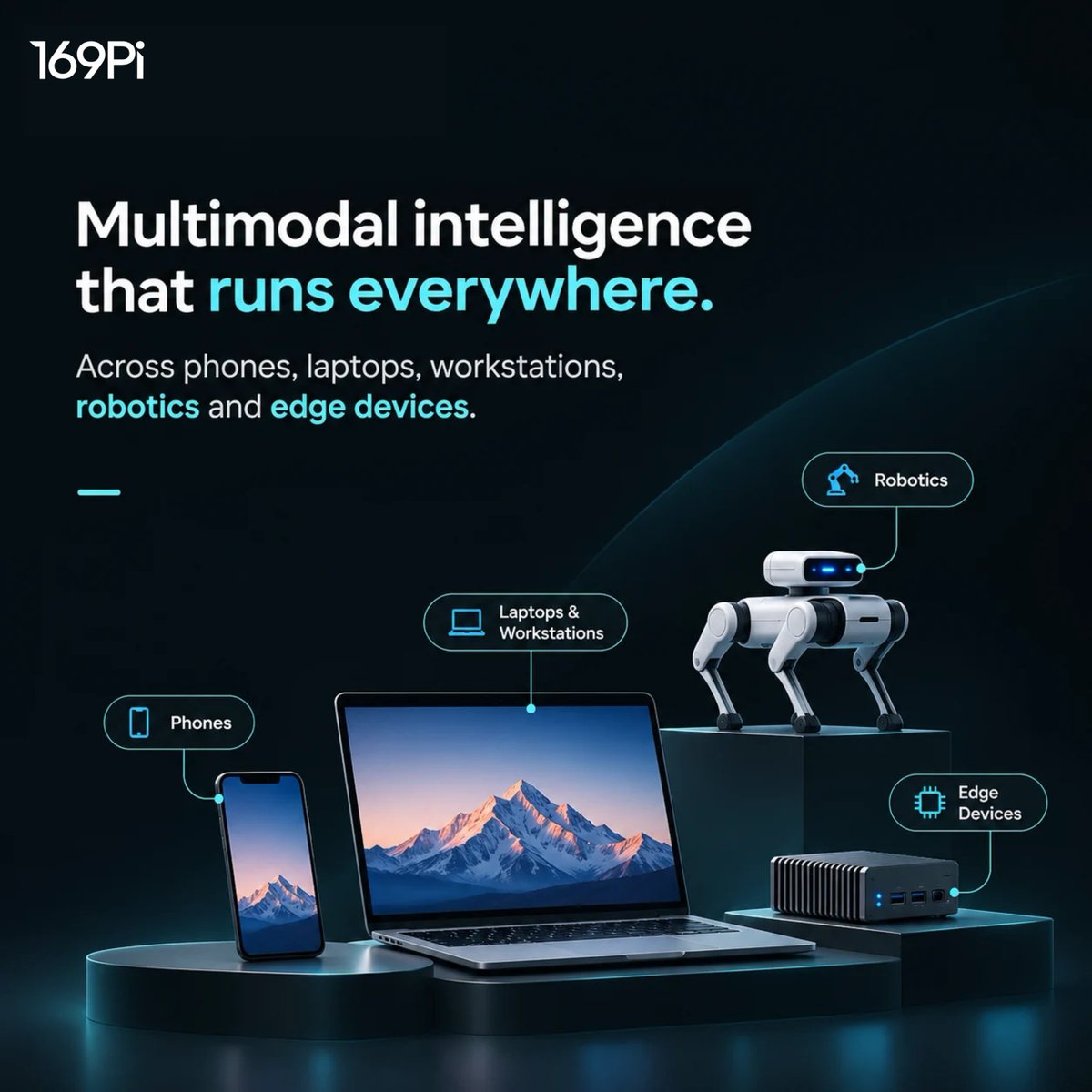
A robot doesn't need a massive model to navigate a room. Your phone doesn't need a data centre to understand a document.
Different devices. Different constraints. Different jobs.
So why should they all depend on the same kind of AI?
With Alpie Seed, we're exploring multimodal intelligence across phones, laptops, workstations, robotics and edge devices.
The goal isn't to put the biggest model everywhere.
It's to make capable AI work where it's actually needed.
One model. More ways to put intelligence to work.
Explore the model here:
@huggingface: https://t.co/Jpujzrnnoy
GGUF: https://t.co/tD332KqcCo
@ollama: https://t.co/7GqHxQQsvF
@kaggle: https://t.co/WMJN6SbUFN
Don't throw away your old phone.
Don't sell your old laptop.
The AI that needed a data center two years ago runs on them now.
The hardware was never the problem. The models were just too big.
That's changing faster than anyone is pricing in.
Within a year, every device you own will think on its own. Your car. Your TV. The cheap Android phone.
Intelligence is about to stop needing permission.
Keep the old phone.
We put our phone in Airplane Mode. Then we asked it to do something most people still expect AI to need the internet for.
Write code. Read text from images. Understand photographs. Translate between languages.
It kept working.
This is Alpie Seed, running locally on a smartphone without an internet connection or cloud inference.
We wanted to test a simple idea: could one model do more than answer text prompts, while running entirely on the device people already carry?
So we tested it with real tasks:
→ Coding & reasoning: Writing and working through code directly on the phone.
→ Reading text in images: Extracting and understanding information from visual documents.
→ Visual recognition: Analysing images and describing what is actually in them.
→ Multilingual understanding: Handling translation and language tasks across Indian languages.
All of this, with the model running locally.
For developers, this opens possibilities for AI applications that work without a constant network connection. For enterprises, it creates new options for processing sensitive information within controlled environments. And for everyday users, it means AI can remain useful even when connectivity doesn't.
Your AI shouldn't stop working when your internet does.
Building capable AI is one challenge. Making it practical to run locally is another.
With Alpie Seed, we set out to work on both.
Alpie Seed is a 9B multimodal reasoning model built on the Qwen3.5-9B foundation. At 169Pi Research, we retained the underlying architecture and applied our own two-stage post-training pipeline.
Stage 1: Supervised Fine-Tuning (SFT)
We used DoRA-based fine-tuning to adapt the model's behaviour across a range of tasks. The resulting adapter was frozen and retained as the reference policy.
Stage 2: Group Relative Policy Optimization (GRPO)
We introduced a separate trainable DoRA + RSLoRA adapter, using the SFT policy as a frozen reference. The selected adapter was then merged into the original FP16 base to produce the Alpie Seed release.
The next challenge was deployment.
We developed our own optimisation approach to make lower-bit inference more practical, with a focus on reducing memory requirements while preserving model behaviour.
In a separate BF16 vs NF4 experiment on a 295,893-token text corpus, we measured:
→ 58.73% lower model footprint: 17.527 GB to 7.232 GB
→ 4.13% increase in perplexity
→ 0.062325 mean KL divergence
→ 88.40% top-1 agreement with the BF16 reference
These are measured results from a text-corpus experiment, not a claim of lossless quantisation or identical accuracy across every task.
Alpie Seed is available in Q4_K_M, Q3_K_M and Q2_K formats. We are continuing to refine our optimisation methods and will share more about the methodology and experiments behind them.
And this is where Alpie Local comes in.
Alpie Seed is the model. Alpie Local brings model intelligence into local workflows, connecting it with files, tools and everyday tasks.
We have tested offline inference across Apple Silicon, desktop GPUs, smartphones and CPU-only systems. For example, our tests recorded 9.59 tokens/s on an iPhone 17 Pro and 5.90 tokens/s on a Galaxy Z Flip8.
The larger goal is to make capable AI more accessible beyond cloud infrastructure.
Alpie Seed is one step in that direction.
@huggingface: https://t.co/Jpujzrnnoy
GGUF: https://t.co/tD332KqcCo
@ollama: https://t.co/7GqHxQQsvF
@kaggle: https://t.co/WMJN6SbUFN
It's been a while since posts. But I've still beem holding a good portion of the bag from highs to lows. For this reason.
$PIE has phenomenal potential.
Alpie seed is out, and i've been waiting months to post this.
full tech report is live too. every benchmark, every device we tested, nothing hidden.
a 9B model that runs on your phone. turn on airplane mode and it still reads, sees, reasons and writes code. i've watched it run offline so many times and it still gets me.
Here's what 9B on your phone looks like:
61.2 on SWE-bench Verified. 72.99 on LiveCodeBench v6. beats models up to 3x its size at coding. every number is in our public benchmark repo, go check it
and it's not just a coding model. 84.32 GPQA Diamond, 82.54 MMLU-Pro, 98 GSM8K
On an iPhone 17 Pro it reads your prompt at 230 tokens/s and writes at ~9.6 tokens/s with zero signal. faster than you can read. a 16GB M2 mac does ~14. give it a workstation GPU and it does 110
The whole model is ~5GB
Text, documents, images and video. one model
2, 3 and 4-bit versions so it fits whatever hardware you've got. GGUF, Ollama, MLX, Kaggle, all live on day one
apache 2.0. download it once and it's yours. no api key, no expiry, nobody can switch it off on you
it's also the brain behind alpie local, our private assistant that lives on your laptop. waitlist is open at 169Pi website
Phones and laptops are where this starts. drones, robots, anything that can't wait for a network comes next.
Private AI starts on the device in your pocket. go break it 🌱
What if capable AI didn't need a data centre to run?
We are showcasing Alpie Seed's offline inference performance across GPUs, laptops, smartphones and CPU-only systems.
Alpie Seed is designed not just to answer questions, but to bring intelligence closer to where it's needed.
One model. Different devices. Real-world possibilities.
We tested Alpie Seed across five hardware configurations:
→ NVIDIA RTX PRO 4500: 110.66 tokens/s generation
→ Mac M2 (16 GB): ~14.1 tokens/s
→ iPhone 17 Pro: 9.59 tokens/s
→ Samsung Galaxy Z Flip8: 5.90 tokens/s
→ Windows CPU-only: 1.95 tokens/s
The RTX PRO 4500 also delivers prompt processing at over 3,057 tokens/s.
We are continuing to optimize Alpie Seed across 2-bit, 3-bit and 4-bit quantized variants, with a focus on improving efficiency while preserving and improving model accuracy across different hardware configurations. We will be sharing more on it soon.
But local inference is only part of the story.
Where can it make a difference?
- Local AI: Run on laptops, smartphones and resource-constrained hardware.
- Multimodal intelligence: Understand documents, images, charts and diagrams.
- Agentic workflows: Use tools, operate software and execute multi-step tasks.
- Edge applications: Potential applications in healthcare, finance, defence, robotics, autonomous systems and more.
A foundation for real-world deployment:
The potential of local AI extends far beyond personal devices. It opens possibilities across regulated environments such as healthcare, finance and defence, as well as edge computing, robotics, drones and autonomous systems.
These are the deployment directions we believe are worth building towards. Each requires its own validation, integration and safety work.
Our focus is on making capable AI more accessible, efficient and deployable, whether it runs in the cloud, on a workstation or directly on a device.
Built to run beyond the cloud. Explore the model:
Hugging Face: https://t.co/Jpujzrnnoy
GGUF: https://t.co/tD332KqcCo
Ollama: https://t.co/7GqHxQQsvF
Kaggle: https://t.co/9ZHdYgSjBB
Introducing Alpie Seed, our 9B multimodal reasoning model, built by @169Pi_ai Research.
A private AI model, built to think deeper, do more and run right on your device.
82.54% on MMLU-Pro.
84.32% on GPQA Diamond.
72.99% on LiveCodeBench v6.
61.20% on SWE-Bench Verified.
90.30% on OCRBench.
From advanced reasoning and software engineering to visual understanding, Alpie Seed brings a broad range of capabilities into a compact model.
But performance is only part of the story.
Alpie Seed supports multimodal inputs, a native 262K-token context window, and multiple quantization options for local deployment.
A model designed not just to perform, but to run across real hardware.
We built it. Now we're putting it out there.
Meet Alpie Seed.
1/5
Another benchmark, another strong showing!
Alpie Seed by @169Pi_ai 9B (4-bit) scores 82.54% on MMLU-Pro, edging out Qwen3.5-9B at 82.50% and outperforming the other models shown.
Now imagine what the next few years would be like.
A highly anticipated day will be happening next week. Sit tight!😎
#AI #Models
A 9B AI model. Running on an iPhone 17 Pro. No cloud required.
What if your AI assistant worked just as well on a flight, in a remote location, or with your internet switched off?
We are working to make that a reality with our 9B model. We’ve successfully run it locally on the iPhone 17 Pro, recording 230.65 tokens/sec in prompt processing, 9.59 tokens/sec in generation, and 7 GB peak memory usage in our benchmark.
This is what makes local AI interesting beyond the technology itself. Developers can explore apps that work offline. Enterprises can bring AI closer to sensitive workflows. And users can access AI for coding, research, and writing without every interaction depending on a remote server.
AI that works without the internet changes where, when, and how you can use it.
We are pushing this further at @169Pi_ai. Our work on the model is ongoing, with a focus on making the model more accurate, faster, and more efficient on consumer hardware. Getting all three right on a phone is the challenge we’re working to solve.
The iPhone 17 Pro is one step. There’s more to come.
Tomorrow, we’ll share how Alpie Seed runs on other devices.
The goal is simple: make capable AI available wherever you need it, not just wherever you have a connection.
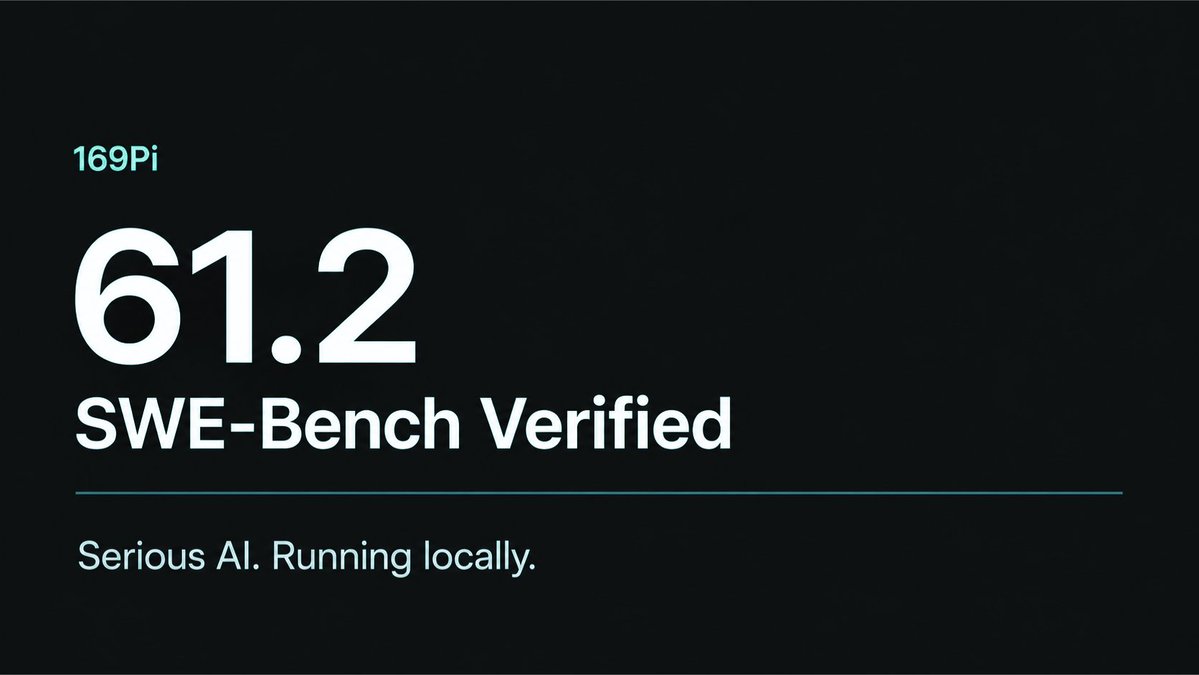
A 9B model scoring 61.2 on SWE-Bench Verified is interesting.
Making that level of coding capability available to run locally is what makes it exciting.
At 169Pi, we are working towards AI that can tackle real software engineering and scientific reasoning tasks without always depending on the cloud.
Think about what that could mean for developers, enterprises working with proprietary code, researchers handling sensitive work, or anyone who wants capable AI even without an internet connection.
Less dependence on remote infrastructure. More control over where intelligence runs.
We are pushing the limits of what's possible with efficient models, and we're getting ready to show you what we've built.
Starting now, we'll be sharing something new we are building every other day. The research, the experiments, the breakthroughs, and the work behind them.
More soon.