Large grey langur troops were once common across Santhal Pargana, Jharkhand. Now they have almost vanished.
In Dumka, I mostly see singles or small groups at village edges, not in the forest. Is grazing pushing them out?
https://t.co/sncvCHveQM
#Primates#wildlife#Jharkhand
Happy to share that I’ve joined the IUCN SSC Hyaena Specialist Group as a Commission Member for 2026–2029. I study the striped hyaena outside protected areas in Santhal Pargana, Jharkhand, where it lives close to people but is rarely recorded. #StripedHyaena#IUCN@IUCNssc
Our citizen science atlas in Jharkhand has 17,000+ records. Butterflies everywhere. Mammals? Almost none.
Not because they aren't here — because they're hard to photograph. That's the gap we want to fill.
Record what you see
https://t.co/9KIeJOnqUW
#iNaturalist#Jharkhand
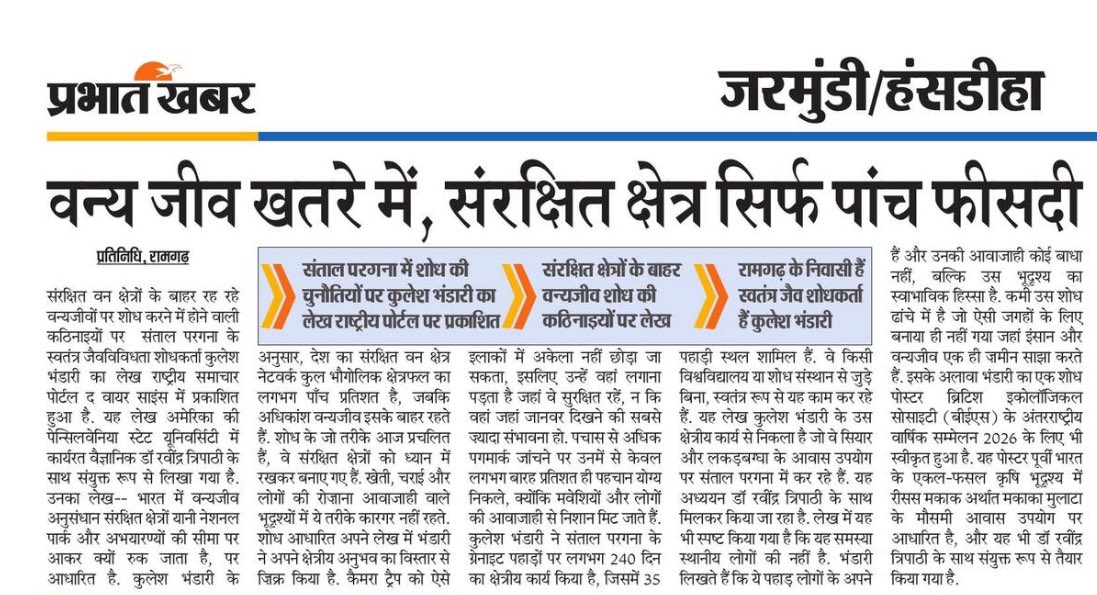
My piece in The Wire Science, written with Ravindra Tripathi of Pennsylvania State University, on why wildlife research in India stops at the boundary of its protected areas and what that looks like from 240 field days outside them.
Santhal Hul Express has carried the news today
A technical report: preliminary checklist of the birds of Godda district, Jharkhand. 102 species, 44 families.
Godda has ~12% forest cover vs 29.81% statewide, and no protected area. No checklist of its fauna existed until now.
https://t.co/nJREAzeaRn
https://t.co/TEyvHqjlQ2
Two pieces of work out.
A paper on a cultivated Cereus hildmannianus in Jharkhand carrying both monstrose and crested growth on one plant — abnormalities that rarely coexist. Among the first records from eastern India.
Cactus and Succulent Journal 98(3): 234–237
India may hold the largest striped hyaena population of any country. It also has no official census for the species.
I work in a landscape in eastern India with no published hyaena record at all. Absence of records is not absence of the animal.
https://t.co/oN8DBoHLtj
Fieldwork is mostly this sitting on a verandah, listening.
Asking whether people still see striped hyaena along the nullahs. How often, what time, when they last saw one.
No published record for this landscape. Before you survey a species, you establish it’s there.
#Fieldwork
From flying fox roosts in Jharkhand to energy models at IISc the bridge is being built.
Wrapped up the Climate & Energy Policy Workshop at @IIScBangalore with @FutureEarth. Tribal wild food systems invisible in energy models that’s the gap. 🦇
#IISc#ClimateChange#Biodiversity
Day 1 at @IIScBangalore’s iconic Senate Hall. Attending the Climate Change & Energy Policy Workshop by Divecha Centre for Climate Change & @FutureEarth A flying fox researcher from Jharkhand learning, connecting, and expanding horizons. 🦇 #IISc#ClimateChange#Biodiversity
New piece in @TheWireScience 🦇
The Bats That Conservation Forgot — on Indian Flying Foxes in Santhal Pargana, and why eastern India’s bat landscapes remain invisible to conservation science.
https://t.co/VBNocodkTS
#IndianFlyingFox#Jharkhand#BatConservations#Bats
New piece in @TheWireScience 🦇
The Bats That Conservation Forgot — on Indian Flying Foxes in Santhal Pargana, and why eastern India’s bat landscapes remain invisible to conservation science.
https://t.co/VBNocodkTS
#IndianFlyingFox#Jharkhand#BatConservations#Bats