For the last few years, a lot of my work has been driven by the feeling that deep learning is not magic — there are principles, mechanisms, and laws waiting to be understood.
This paper is our attempt to say that clearly!
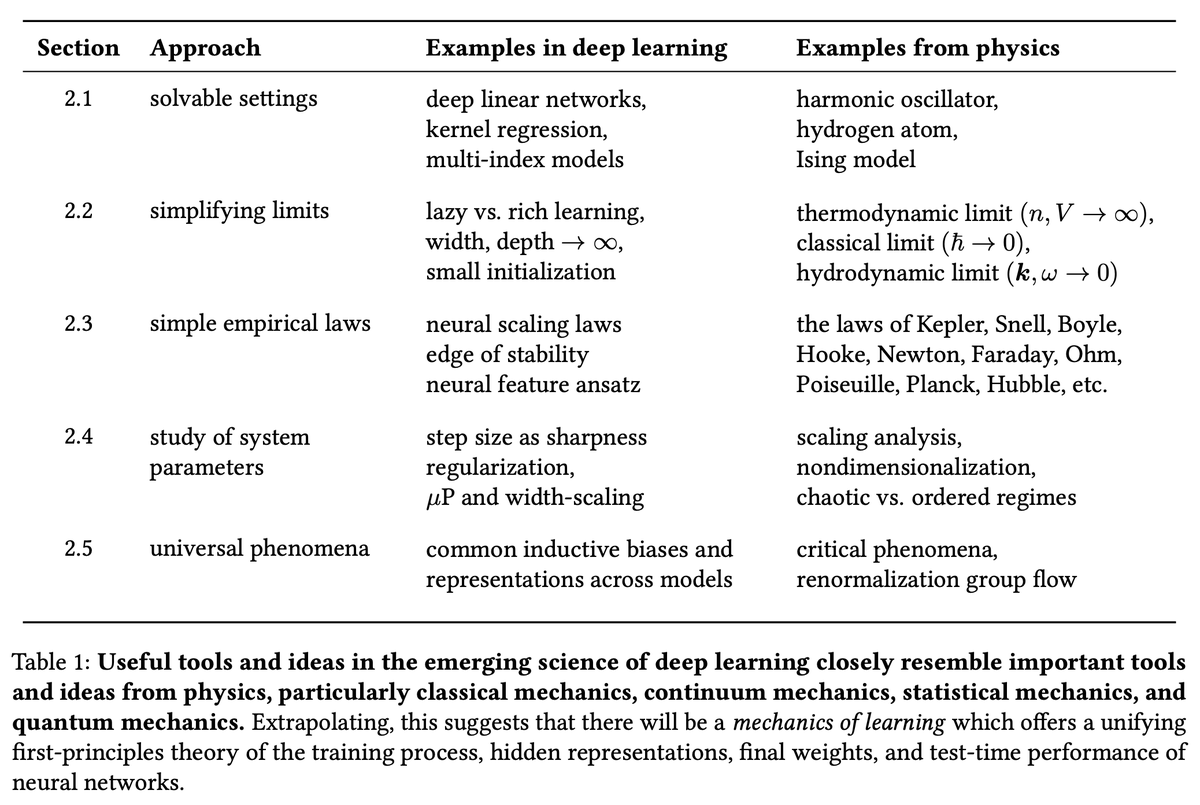
1/ Deep learning is going to have a scientific theory. We can see the pieces starting to come together, and it's looking a lot like physics!
We're releasing a paper pulling together these emerging threads and giving them a name: learning mechanics.
🔨 https://t.co/92nSIHameW 🔧
A longstanding dream of interp is to decompose activations into distinct, interpretable parts.
But when should we expect that to work, and what even are such parts?
New from Simplex: transformers factor their world into orthogonal subspaces, even when it costs accuracy.🧵👇
Excited to share that our paper “Sequential Group Composition: A Window into the Mechanics of Deep Learning” was accepted to ICML 2026 in Seoul!
Co-led with @giovannimarchet
and @AdeleMyersPhD@hopfbifurcator@ninamiolane
Paper: https://t.co/8HsLrKWtlf
For me, this paper is learning mechanics in action!
Mech interp first identified that NNs use Fourier features in algebraic tasks - great work @bilalchughtai_@justanotherlaw@NeelNanda5
Learn mech asks why training produced those features, in that order, with that architecture
Yes — by leveraging associativity.
We explicitly construct efficient solutions: RNNs can compose elements sequentially in k steps, while deep MLPs can compose adjacent pairs in parallel in log k layers
and we find preliminary evidence that GD can discover these solutions!
From "Mathematical theory of deep learning: Can we do it? Should we do it?" to "There Will Be a Scientific Theory of Deep Learning".
It's respectively the title of a talk I gave four years ago, and the title of an arxiv paper from four days ago.
I really like the "learning mechanics" perspective (think of it as a continuation of "statistical mechanics", "quantum mechanics", and so on). Several of my last academic papers can be viewed under that lens (e.g. Learning threshold neurons via the “edge of stability”; or LEGO). I'm not as optimistic as the authors of the recent arxiv paper that we will EVER be able to reach what the "physics mechanics" field have achieved, but it's certainly worth trying.
Talk: https://t.co/QsBPHP0fDm
Paper: https://t.co/N4JSj3AkYZ
@tydsh Yes, agreed. “Learning mechanics” is a scientific program many researchers have been building toward for years; our goal was to clearly state the evidence for such a theory
Your works are great examples of 2.1 (have read many), we should have cited them, adding them now for v2
For the last few years, a lot of my work has been driven by the feeling that deep learning is not magic — there are principles, mechanisms, and laws waiting to be understood.
This paper is our attempt to say that clearly!
1/ Deep learning is going to have a scientific theory. We can see the pieces starting to come together, and it's looking a lot like physics!
We're releasing a paper pulling together these emerging threads and giving them a name: learning mechanics.
🔨 https://t.co/92nSIHameW 🔧
Great perspective on the theory of deep learning from a stellar group of authors!Physics-inspired ideas will play a central role in shaping this field. Congrats to my group alumni @blake__bordelon and @ABAtanasov for their contributions here and across many influential papers.
100% agree. Neuroscience embraces studying the brain at multiple levels — computational, algorithmic, and implementational. I’m excited to see deep learning moving toward the same conversation, with theory and interpretability informing each other!
It's been so heartening to see deep learning theory folks engage seriously with interpretability recently, and I hope these two communities can talk much, much more. We should seek a unified understanding of neural networks across many levels of analysis.
Great to see the next generation taking the lead in the science of deep learning! Also proud that two brilliant members/alumni of my group are a part of this: @KuninDaniel & @MasonKamb
@SuryaGanguli@MasonKamb Many of the ideas, works, and intuitions discussed in Sections 2.1–2.5 grew out of your group — I’m very grateful to have been part of the Ganguli gang!