In markets, confident opinions are everywhere. Evidence is rare. I would rather show you the evidence than sell you the confidence.
If you want to understand markets instead of gambling on them, this account is for you.
I take the things people in finance repeat as fact and test them against real data.
Sometimes they hold up.
Sometimes they fall apart.
Either way, I’ll show you what happened, why I think it happened, and what the evidence still can’t tell us.
No signals. No price predictions. No “trust me.”
And you shouldn’t have to take my word for any of it. That’s the point.
I’m based in Zurich, obsessed with markets and how they actually work. I hold an MSc in Finance & Money, and that curiosity eventually led me to build Helvetic Research so I could test market ideas instead of just arguing about them.
Here you’ll find macro, markets, crypto and quant, tested in public.
I’ll be wrong sometimes. I’ll change my mind when the evidence changes.
I’m not trying to be the loudest person in markets.
I’m trying to build the account I would’ve wanted to follow: curious, evidence-led, and comfortable saying “I don’t know.”
If that sounds like how you want to think about markets too, follow along.
September: just 29,000 new jobs.
And last month's "strong" 162,000 just got revised down to 133,000. July flipped from a gain to a loss.
Do you still trust the first jobs number they report: yes or no?
@spotTheGap Exactly. Speed isn’t really the hard part anymore.
The hard part is accountability: who eats the loss when the agent makes the wrong call? Until that’s clear, banks won’t fully hand over the keys.
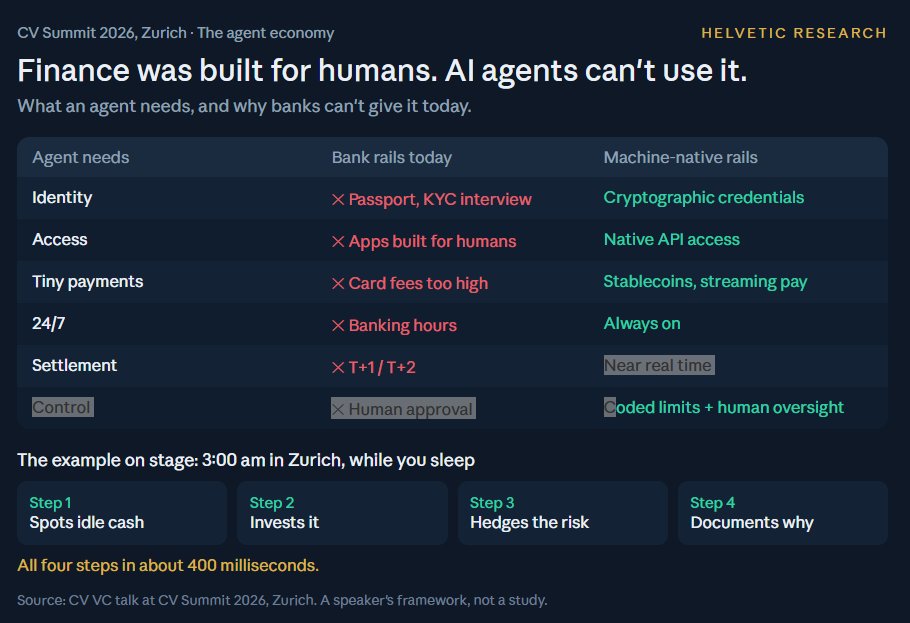
Learning #2 from CV Summit 2026: AI agents can't use banks.
An agent can't show a passport, can't sit through a KYC interview, can't wait for banking hours or T+1 settlement. Our financial system was built for humans.
So the agent economy is being built on different rails:
• Identity: cryptographic credentials instead of a passport
• Money: stablecoins like $USDC and Swiss franc stablecoins instead of bank accounts
• Rules: spending limits and circuit breakers written in code, with humans watching
The example on stage: 3:00 am in Zurich, an agent spots idle cash, invests it, hedges the risk and documents why, in about 400 milliseconds, while you sleep.
The hard part isn't the tech anymore. It's who's liable when the agent gets it wrong.
Would you let an AI move your money while you sleep?
From the CV VC talk at CV Summit 2026 in Zurich. The stack they showed has three layers: machine identity (cryptographic credentials, secure execution), programmable money (stablecoins, agent wallets, streaming payments, instant settlement), and governance (spending policies, audit trails, circuit breakers, human oversight). Their line: you don't give AI an open checkbook, you give it fixed boundaries. This is a framework from the stage, not a study, and liability is still unsolved.
Your biggest holding drops 30%.
Nothing about the business changes.
What do you actually do first: buy more, sell, or panic-check the price every 5 minutes?
The economy adds 29,000 jobs and stocks go UP.
What do you mean weaker hiring is now somehow bullish because rates might stay lower.
That is such a weird market.
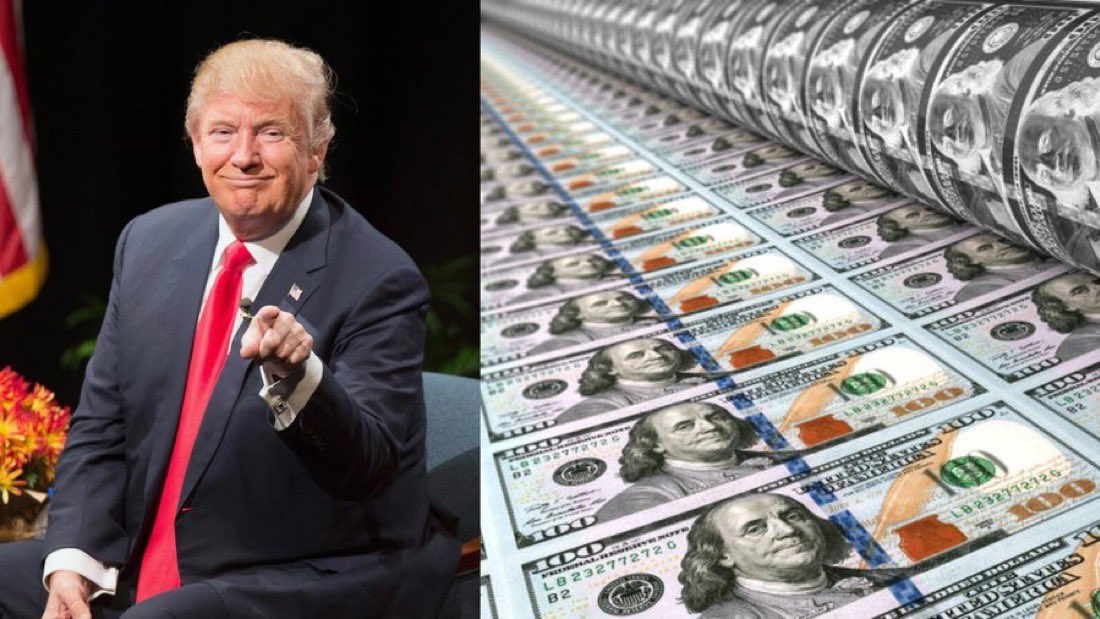
BREAKING: 🇺🇸 President Trump now says the $5,000 “Trump Dividend” would go to EVERY U.S. citizen if Republicans win the midterms.
With ~316M citizens, that could total ~$1.58 TRILLION.
The crypto market will go parabolic!
September payrolls rose just 29K versus 90K expected, while unemployment moved to 4.2%.
Stocks still rallied, with the S&P 500 up 0.73%, because the weak report reduced expectations for another near-term rate hike.
The dollar index is near 102 and heading for a third straight weekly gain.
Gold is around $4,184 and under pressure from the stronger dollar and elevated Treasury yields.
Two classic “safe” assets, moving in opposite directions.
A lot of people say they’re “long-term investors.”
Then one ugly week happens and suddenly they’re checking their portfolio 12 times a day.
Be honest: when markets get scary, do you check MORE or LESS?
@pamilerin_07 Thats probably the healthiest way to separate it. Long-term portfolio = thesis-driven, not price-driven.
If the business hasnt changed, checking the price every hour usually just creates noise.
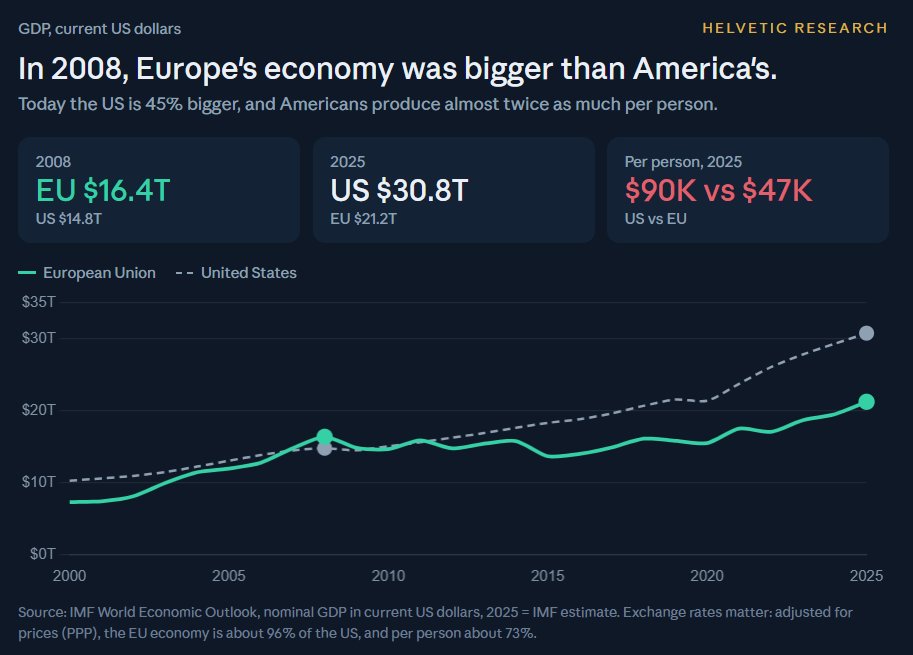
In 2008, the EU's economy was bigger than America's.
Today the US is 45% bigger, and Americans produce almost twice as much per person.
What hurt Europe most: energy, regulation, or missing big tech?