🚨 Microsoft just dropped a bombshell: Majorana topological quantum chip powered by AI – a massive leap toward scalable quantum computing.
Q-Day is no longer sci-fi. It’s coming faster than most realize.
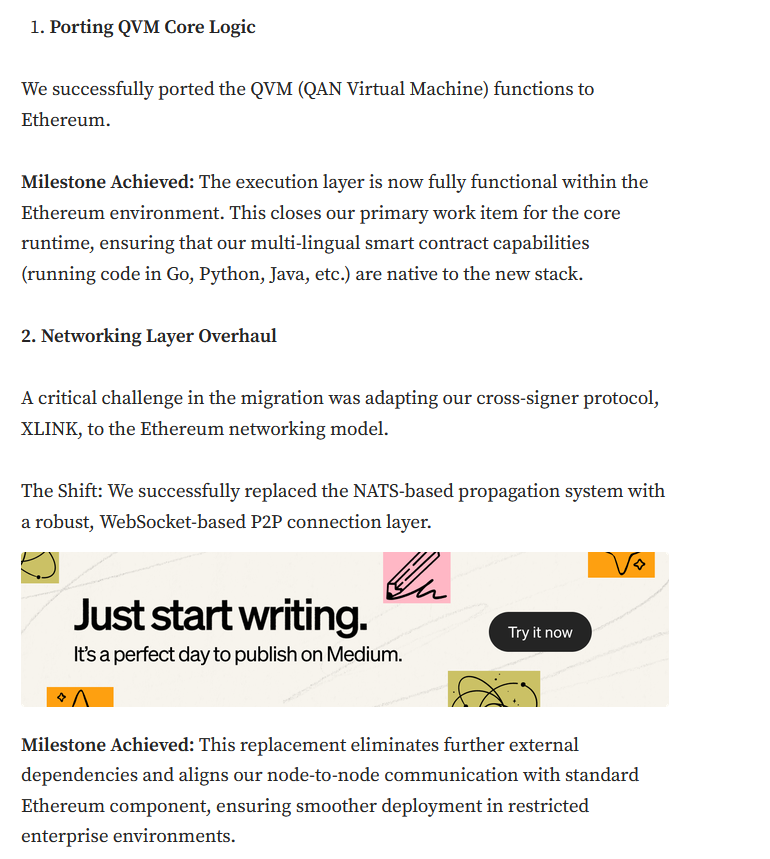
July Milestone: Successful completion of the TestNet migration to the official Ethereum execution client
Our primary objective this month was clear: migrate the QAN TestNet to the official industry-standard Ethereum execution client while remaining compatible with our previous implementation without compromising our unique quantum-secure features.
The engineering team has not only completed the migration to the official Ethereum client but has also proven that QANplatform can operate seamlessly on a standard Ethereum infrastructure while retaining the full power of the QAN Virtual Machine (QVM) and QAN XLINK.
Read the full technical deep dive on our blog (link in comments) 🔗👇
@coinbureau Quantum security is no longer something to watch- it's a requirement.
All systems will be looking for solutions.
That is a huge market for innovation. @QANplatform has the IP and enterprises have shaped what's required for the future of Blockchain utility.
@DecryptMedia Quantum security isn't a bet, it's a requirement. All systems will be looking for solutions.
That is a huge market for innovation. @QANplatform has the IP and enterprises have shaped what's required for future of Blockchain utility.
Picture PQC key rotation that runs like cert renewal already does: scheduled, automatic, nobody paging on-call.
That exists for TLS today, and has for over a decade. For post-quantum keys, it exists only in pockets, a validator set here, a keyset-management library there, never yet as the default anyone can assume.
That's the bar worth aiming for: rotation as unremarkable as a Let's Encrypt renewal.
Quantum isn’t waiting for 2030.
Diamond NV‑center roadmaps point to 10,000+ qubits at room temperature, no giant cryo‑fridges ect.
If a blockchain still relies on pre‑quantum signatures, it’s betting on math that won’t hold.
@QANplatform is ahead of the curve.
$BTC $ETH $SOL
The Coldcard Hack was indirectly predicted, we should acknowledge the vulnerability of blockchains.
Everything is affected, from the $XRP Ledger all the way to DeFi and RWA #BlockchainFuture
Check out Amir's analysis
$BTC $ETH
@pete_rizzo_ Who deployed the bots to deflect? Yes other systems need to upgrade... and they are doing so. Why does btc community argue- just fix it.
Either way, only @QANplatform is building solutions with enterprise adoption. Look where the market will be, not where it was...
I usually refer to $QANX as high risk/high reward.
Was asked on tg if I really consider it "HIGH RISK."
My response:
"It's a fair point- I have often said I think they've lowered our risk tremendously over the years.
The high risk part is all of the "unseen" work we don't have insight into. That's where the major upside lives. And just the crypto space in general.
But we have strong evidence of real adoption- particularly through Itti and Crowe engaging in Signquantum solutions. That should be enough evidence to feel confident that they aren't "making up" stories about working with government and other partner solutions. But of course it's crypto and people proceed with caution.
They also didn't do a great job explaining the decisions to hold off on mainnet several times in favor of pursuing and meeting partner requirements. That had led to retail distrust and frustration, but it's been painfully obvious where their priorities have been.
People have viewed it as increased risk things aren't working, when in reality it has been product improvement with direct partner feedback.
And people also have thought it must mean they are a small team that can't deliver- when in reality they've clearly grown with their MBK partnership. They are not getting set up to work directly with these various partners through a handful of people. Working out legal agreements, setting up environments, getting past regulations is a large effort.
With all that, I think it's been very hard for them to realize what things can look like from the outside- but here again, even if they thought they could be more convincing, their top concern was working with partners to build a useful product.
Put that all together, the risk/reward is more inviting now than at any point in time.
It requires some in depth understanding of how things have played out, and where there is strong evidence to believe they have utility and innovation which is already attracting strong adoption ahead of launch.
Validators across most major chains are upgrading their hardware, faster CPUs, more bandwidth, better cooling. Ask any of them why, and you'll get an answer about transaction throughput.
Nobody's upgrading for signature size. ML-DSA signatures run roughly 37x larger than ECDSA. That number doesn't fit in the mempool assumptions, block layout, or fee market any of these upgrades were designed around.
So the industry is buying faster hardware to solve a problem it hasn't diagnosed yet, and calling it optimization.
Your cold wallet might already be compromised, and no breach has happened yet. It's sitting in your derivation tree.
1/🧵
Every Bitcoin address you've never spent from is quantum-safe.
That's not a design win. It's an accident of how P2PKH works. Your address is a hash of your public key. The key stays hidden until the moment you sign.
Then you spend. And the accident ends.
65%.
That is the estimated share of Ether held in quantum-exposed addresses making them potentially vulnerable to a quantum attack the moment sufficiently powerful hardware arrives.
No warning. No opt-in.
With QANplatform, your address is never the weak link, it's secure by design from genesis.
qanplatform:native moving toward an $ETH based architecture is a big step. It will lower barriers for partners and devs
Easy to adopt and integrate in the future
Sounds like an ETA for the public mainnet launch will follow soon
Milestones Achieved:
Buidl and Progress
Y2K had a hard deadline everyone could see on a calendar.
Q-Day has a deadline nobody can fix precisely.
One produced one of the largest coordinated infrastructure efforts in history. The other has mostly produced roadmap slides so far.
The architects of the most secure identity system ever built have never modeled for Q-Day.
Governments, banks, and hospitals are building the next generation of digital identity on blockchain.
The promise is compelling. No more centralized password databases as the single point of breach. Your identity credential is yours. Cryptographically signed. Anchored to a distributed ledger. Verifiable anywhere, by anyone, without asking a central authority for permission.
It is a genuinely elegant solution to a genuinely broken system.
Here is the flaw nobody is writing about.
The architecture of Decentralized Identifiers, DIDs, the technical standard that underpins most enterprise blockchain identity systems, is built on the same cryptographic primitives as every wallet you already know is vulnerable.
Your identity credential is issued by a signing authority. That authority uses a private key. The corresponding public key is written to the ledger. Anyone can verify your credential by checking the signature against the public key on-chain.
It is clean. It is trustless. And in public ledger-anchored DID systems, the dominant deployment pattern in enterprise and government identity infrastructure, it exposes the public key. Permanently.
Now add one more layer that most commentary skips entirely.
Your credential itself, your digital passport, your KYC record, your professional license, your healthcare authorization, carries a timestamp. It was signed at a specific moment. That signature, and the public key used to verify it, lives on a public ledger indefinitely.
Adversaries are already collecting this data today. Not to use now. To use later, once quantum capability arrives. Researchers call this Harvest Now, Decrypt Later archiving encrypted data today with the intent to break its confidentiality once quantum hardware matures.
But there is a second quantum threat model that is less discussed and more directly dangerous for identity systems.
It is called Trust Now, Forge Later.
In the TNFL model, the adversary does not target the contents of a credential. They target the signing key itself. A quantum computer running Shor's algorithm can derive a signing authority's private key directly from its public key which is already permanently on-chain. Once they hold the private key, they can issue entirely new credentials that carry a cryptographically valid signature, indistinguishable from legitimate ones.
The attacker does not rewrite the ledger. The ledger is immutable that does not change. What changes is your ability to trust what is on it.
Every credential issued under the compromised signing scheme, every digital passport, every KYC attestation, every healthcare authorization, now exists alongside forgeries that the verification system cannot tell apart. The identity infrastructure designed to eliminate fraud becomes the mechanism that enables it at a scale no centralized breach ever could.
Because a centralized breach steals records from one database. A Trust Now, Forge Later attack on a public identity ledger collapses the trust model for every credential ever issued under that signing authority. Not by altering what was written. By making it impossible to distinguish the real from the fabricated.
The enterprise blockchain identity infrastructure being built right now is the most comprehensive, most permanently exposed, most difficult-to-patch identity system ever designed.
And most of its architects have never modeled for Q-Day.
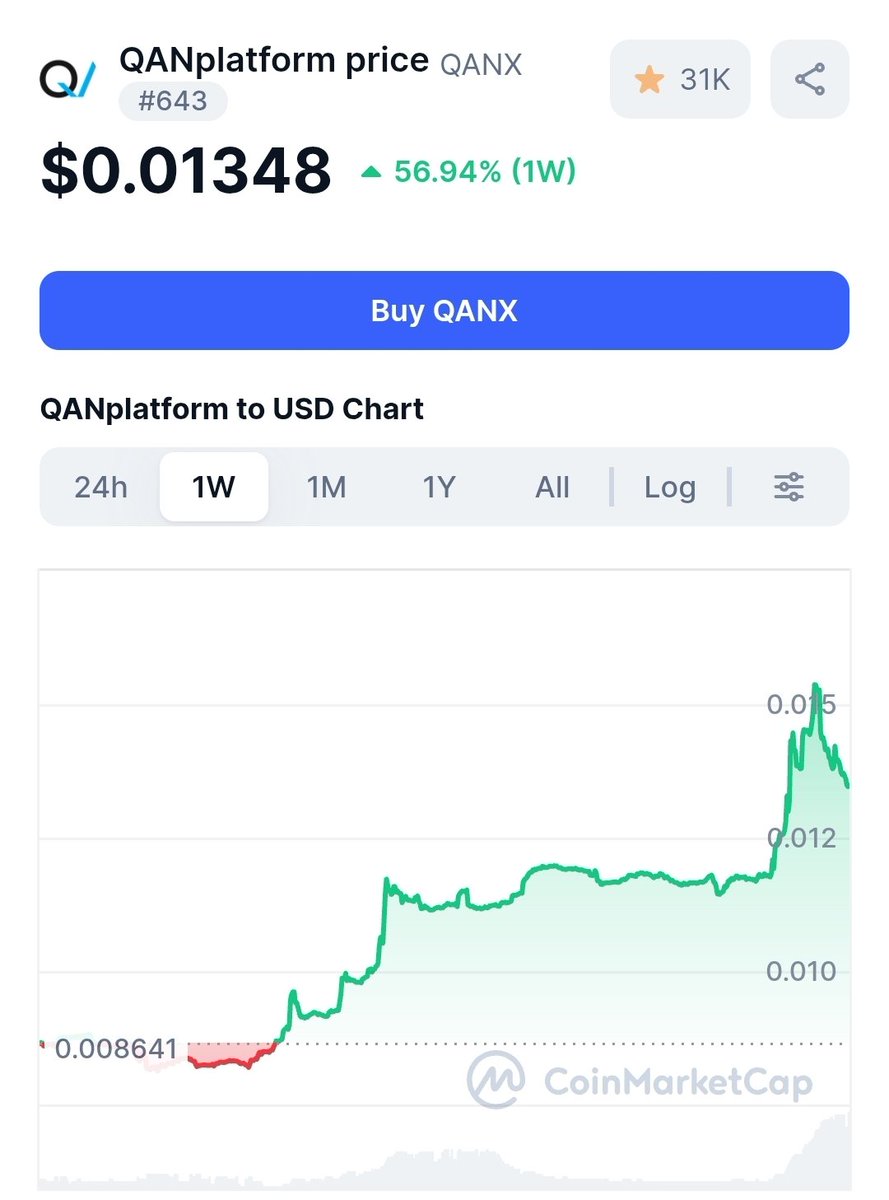
$QANX buyers reestablishing their positions. 👀
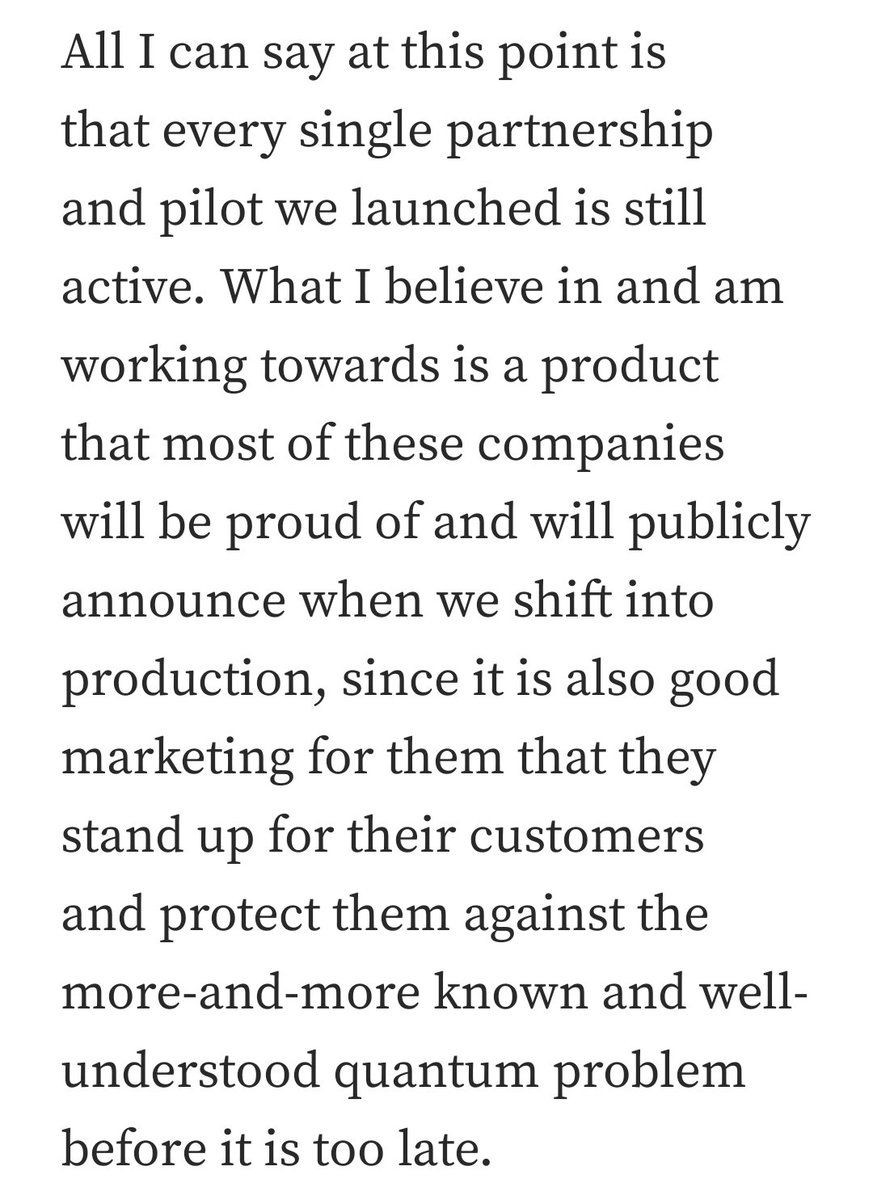
So much has been achieved in pursuit of an ambitious vision.
They worked to discover exactly what partners need- building to meet expanded requirements.
Removing Blockchain Barriers
Quantum prepared
$ETH $SUI $QRL $SOL $ZEC
$QANX
People have been misreading things all along.
The value build up is obvious.
This letter gives you the perspective to see how it happens.
Quantum innovation
Blockchain innovation
Built with partner engagement- ensuring it's what they need BEFORE launching.