🚨 PhD opportunity!
We’re recruiting for a 4-year Manchester–Tsinghua dual-award PhD, spanning research in both Manchester and Beijing.
If you’re excited by inorganic chemistry, unusual bonding, small-molecule activation and catalysis, take a look!
🔗 https://t.co/S8IN3LHmBE
Paper just out in @angew_chem!
A new project exploring how photocatalysis can easily 'turbocharge' PM-like reactivity at a MG centre. RE is accelerated x100 at 140 degC lower temp.
Thanks to our collaborators & congrats to first author Matt!
https://t.co/KAmJt67YuR
Great to see this work out in @DaltonTrans , some lovely structures from back when Ollie was an MChem in the Hill group. Thanks as always to @clairemcmullin and Jacob for the calculations😊
https://t.co/MxbZj7kZkL
Triple bond formed between boron and oxygen! True oxoboranes have finally been synthesized. Check out Lukas and Christian's work, now online in @NatureChemistry
https://t.co/FYno1jOCGE
Thanks to everyone for their contributions!
@SFBBoronPRO@ICBWuerzburg@Uni_WUE#chemtwitter
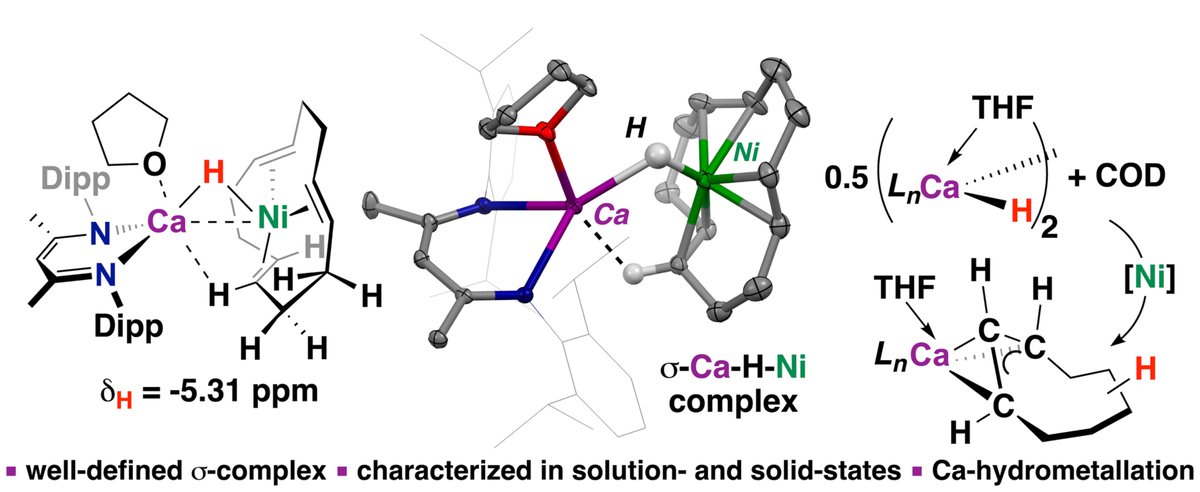
🎇 Excited to share this one: "A Nickel-Capped Calcium Hydride: Implications for Diene Hydrometallation" now posted on ChemRxiv: https://t.co/f86bSkkKV7 Here, we report the synthesis and comprehensive characterization of a molecular complex featuring a σ–[Ca–H–Ni] interaction!
🧪 We’re hiring! 🚀
Interested in low-valent Group 13 & first-row transition-metal chemistry? Join us at TU Chemnitz for a postdoc position in our @ERC_Research CoG project #AGILE!
🔗 https://t.co/FHUhXw55gf
Please repost and spread the word! 📢
#ChemistryJobs#Postdoc
STRONTIUM POWER: Although this series follows the octet rule, only neutral Ph3N is stable. Ph3B is very resistant to double reduction. Only Ar3B.- radical anions are known. However, it had to surrender to strontium. @angew_chem https://t.co/9SZ2Fap58D
A single-source precursor for mixed fuel gases!🔥Meet Mg[(CH₃)ZnH₃]—a hydride-rich organometallic that releases a mixture of #Hydrogen & #methane, at just 80 °C. A fundamental discovery that could open up practical applications! #energy#chemistry
https://t.co/pcsEO8GPYa
We have an open 2-year research associate position in the group to work on heterometallic complexes and their applications in catalysis. Details here: https://t.co/2vmNhOoe1N
Our latest cooperative Ca/Zn venture: ether activation and alkyl migration. Some fun labelling experiments and stellar DFT by @Morales_Chem and @clairemcmullin disclosed within (@angew_chem).
https://t.co/oVnUvFvtrD
📢 We’re hiring! The Stanford Chemistry Department is now actively conducting faculty searches (open area) - term to start on 9/1/2027:
- Assistant Professor in Chemistry
- Senior Faculty Position in Chemistry (Associate Professor or Professor)
Learn more: https://t.co/D7Ndqq5xBE
A couple of new pre-prints just out from the group.
If you're interested in main group chemistry or the mechanisms of photoredox catalysis at least one of these should be of interest!
https://t.co/IG86AKBCrM
https://t.co/em5b7SBaaE
Today we report on the mechanism of intermolecular deprotonation and decomposition of tin(II) amides, and highlight that this mechanism is thermally accessible for the well-known Sn(HMDS)2. Variation of the amide enables access to C(sp2)–H and C(sp3)–H activated products.
Our latest paper investigating Calcium-Zinc cooperativity is just out in @Orgmet_ACS. Pleasure to see @MarcosLopezAg get stuck into this during his time at @BathChem, Vamos!
https://t.co/DBCQgemhma