DeFi is growing up and needs interest rate derivatives.
That's why we're proud to back Exponent, the leading yield exchange on Solana, built by a team of veteran builders.
When we met @SimkinStepan and team in November 2022 they told us they don't use banking rails. Now, with @altitude, your business doesn't have to either. Congrats!
again a lot of big words to describe what's happening on Ethereum (PeerDAS, BPO, Gaslimit) - so here's a quick & simple blob recap to add context to the data and coming upgrade:
> march 2024: "Dencun" upgrade goes live, introduces blobs as (temporary) data storage for L2s
> this makes L2 trx fees cheaper, increasing their margins (less paid to the L1)
> blob adoption stabilizes, fees for L2s go so low that ETH becomes inflationary again (less fees to L1 also means less ETH burned)
> may 2025: "Pectra" upgrade goes live, doubles number of blobs on L1
> this (again) makes L2 trx fees cheaper
> so while utilization of blobs goes up, ETH L1 gets even less fees now
> december 2025: "Fusaka" upgrade (should) go live, finally addressing value accrual to L1
> fusaka: sets floor on blob price + ties it to L1 gas, more aggressive pricing that hopefully generates more income to L1 and burns more ETH
This article is an incredibly long winded way to say that the author grew up in the US during a golden age.
Bitcoin is not about brute forcing the government into anything. It’s about the ability to opt out, the ability to bet against a fiat hegemony.
If a macro fund disagrees with the US govts decision, what are their options?
They can’t go into the Euro, Euro success is highly correlated to US success. The same is true for many fiat systems in a global economy.
They can’t go into RMB, China has strict capital controls, especially for foreigners.
They can’t go into gold or other commodities, they are hard to hold and easy to confiscate at gun point.
And no, they can’t go into RWAs. These assets, as much as any, rely on the benevolence of a country.
There is but one option. Bitcoin.
The reason Bitcoin is a multi trillion dollar asset class is simple, the value of the dollar has gone down and Bitcoin has not changed.
Bitcoin isn’t perfect, to cite the little known but highly respected 2011 essay by Gwern (of gwern dot net), Bitcoin is worse is better.
h/t @nadahalli
The value of Bitcoin is the value of opting out.
The gap between demoralized crypto natives and interested institutions is the widest I've ever seen. Pension funds and mega-investors are showing deep interest like never before, I've got a call with a huge one soon, 9 execs on the line. Very price sensitive though, the lower prices drop, the more excited they get. We'll see how it plays out...
“You can only have one value accrual mechanism in our view. In 99% of cases an asset is worth the discounted value of cash flows that come to that asset…
Regulators now agree that we need more mention of value accrual, not less.”
@TheiaResearch at the L1D summit
“This industry is one of the most perfectly competitive industries ever because it is built on a permissionless open source substrate.
The 2 places we like to invest: the layer closest to the customer and the layer at the deepest level.”
@tushar_jain at the L1D Summit
“Solana has distribution and tech. The former is great, and after Alpenglow the latter will be too.”
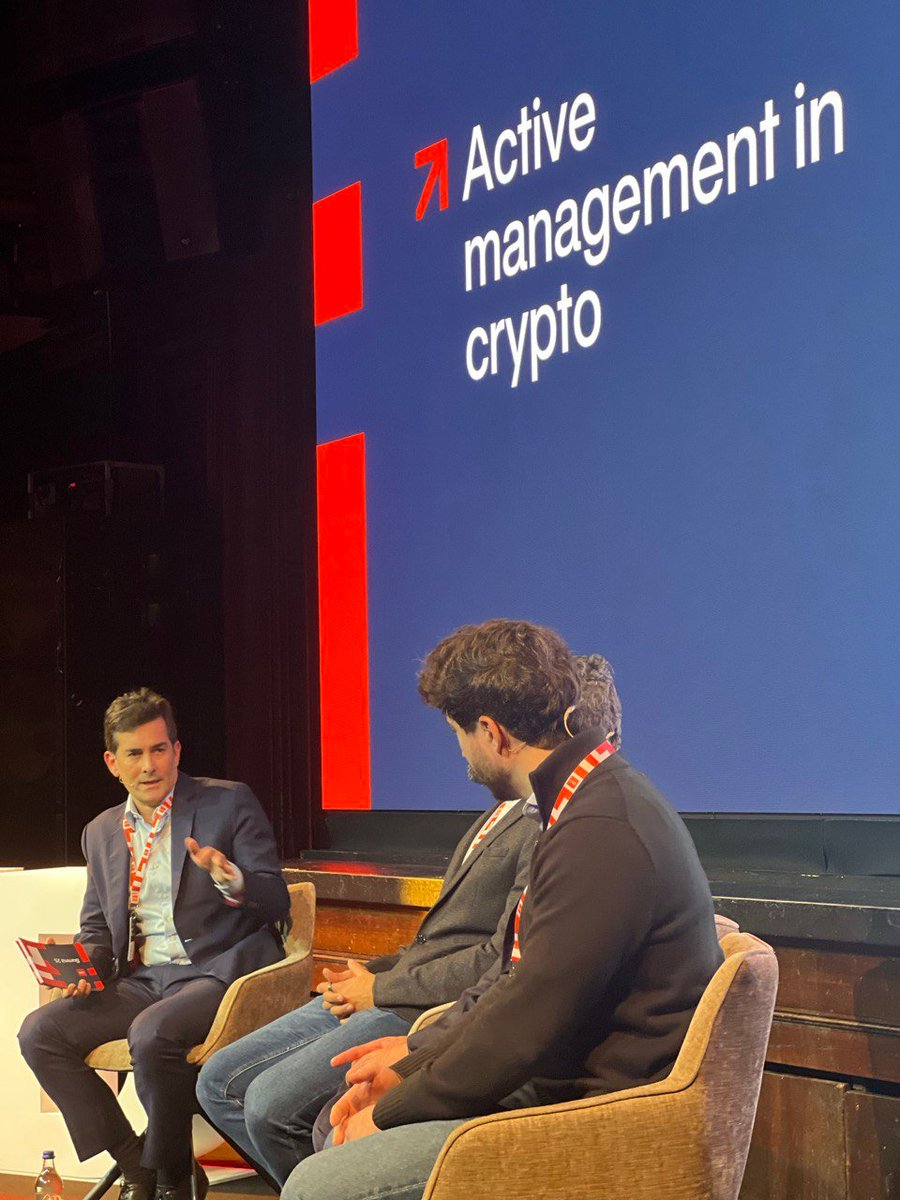
@TheWattenhofer - Head of Research @anza_xyz speaks with @danielfsy on stage at the L1D Summit
“The biggest risk in crypto is when things go 1 to 0. In those moments, transparency and continuity are key”
@akuchinad - CEO @CopperHQ speaks with @0xLouisT about crypto's challenges at the L1D Summit.
"There are only 3 things a stable can do:
(1) Be pegged - if it doesn't hold you're out of business
(2) Be liquid - that's where most startups can't compete
(3) Give yield
This drives margin compression."
@gdog97_ joins @jakelynch to talk about stablecoins at the L1D summit.
this is the level of skin in the game founders should aim for: "we've been building and operating our business for 4 years without touching traditional rails, using everything we built ourselves" @SimkinStepan
Putting things in perspective: at current prices, NEAR spends around $150m per year to secure its network.
What exactly is it securing?
- $225m in stablecoins
- $93m in TVL
- $2.7M in annualized fees
I studied physics, so I'm no economist but that looks a lot like overspending to me.
Reducing that amount seems more than reasonable: I'm FOR the proposal.
"The Talent Bottleneck in Crypto" was a big topic at @blockworksDAS this year, both among VCs (looking to invest) and founders (looking to hire). The EF post also triggered a lot of debates, but instead of arguing about methodology let's look at some broader, qualitative points about tech talent in the space:
1. Developer inflow slowed down. One doesn't need GH data for that, talk to teams and founders. The #1 ask of every portco is good devs. The most painful losses are not BD leads but senior engineers. Sure, EVM & SVM fulltime devs both grew in relative numbers (especially SVM), but overall monthly developer activity is clearly down. Looking at the chart, we effectively didn't onboard new, sticky talent since 2024.
2. Only talent sources are: internal, fintech and AI. Most talent these days grows up internally. It's juniors learning the ropes with existing projects and then switching or spinning out. Second sizeable inflow is from fintech: thanks to stables becoming a mainstream narrative and players like Robinhood, Stripe and Revolut lending credibility, more devs now see crypto as new financial rails vs. speculative magic internet money and that's great. The last source, which hasn't even really materialized yet, is AI - the biggest talent blackhole we've seen in a while. However, similar to fintech, we now have OpenAI, Google and Anthropic all releasing agent protocols supporting crypto rails. This drives attention to the space, moves the tech stacks closer and will hopefully lead to more spillover in the future. Worth monitoring.
3. Onboarding above ground floor is key. Getting beginners in is important, and something that Solana does incredibly well today (shoutout @zCase_ & @SuperteamDE). But to accelerate the pace, it's equally if not more important to bring in senior operators (think L6-L8 in SV terms) that can hit the ground running with well-managed processes over complexity, build and lead engineering teams and manage large-scale, production-ready systems. They also accelerate the growth curve for newcomers. Of the 3 points listed here, this one might be the most important one to track closely.
Cycles are not just relevant for prices, but even with short term fluctuations the trend is moving the right way.
given that I had to decide whether to OTC my monad cards I put AGI on figuring out when exactly the airdrop will happen using the @intern leaks and pm estimates - here are the results (let's see who'll win):