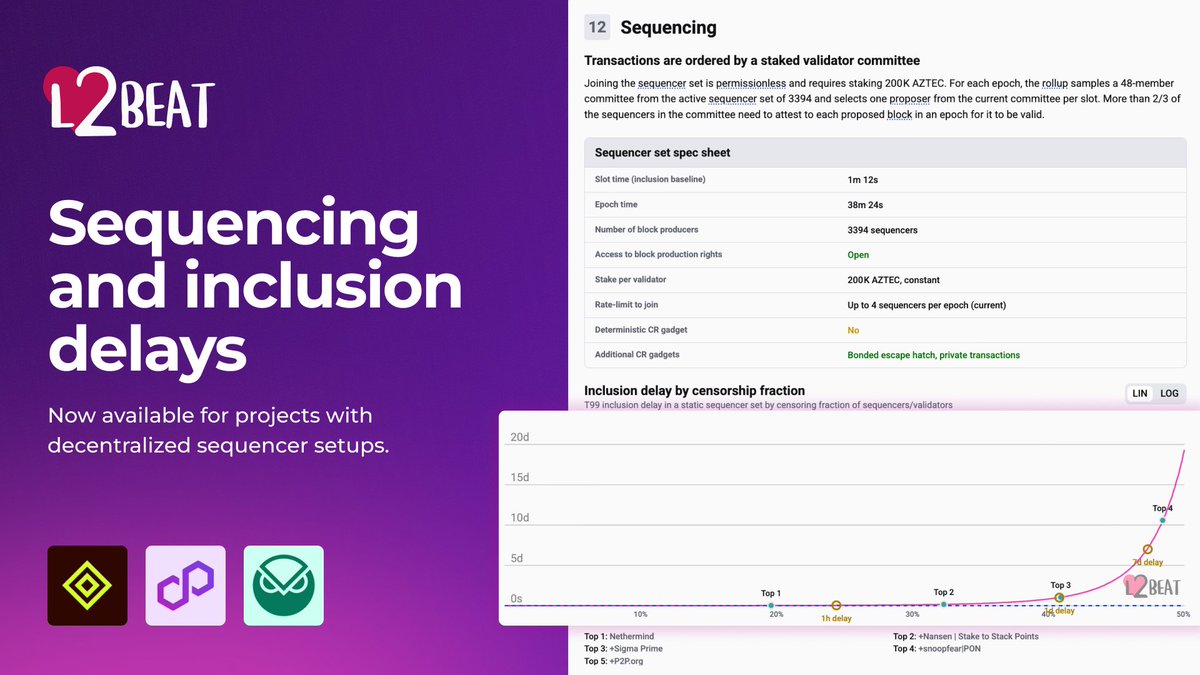
@0xPolygon PoS: The validator set is capped at 105 and effectively closed if nobody leaves voluntarily. There are no censorship resistance gadgets like forced transactions or an escape hatch that would help users transact or exit in emergencies.
Furthermore, a recent decision to delegate block building to centralised builders during long ‘spans’ added significantly to the simulated inclusion delay under censorship.
Learn more here: https://t.co/9VspmnTfLX
Why even decentralise the sequencer?
We just shipped some additions to the Sequencing sections of the projects that have decentralised sequencer setups to answer the question: if part of the sequencer set is censoring you, how long until your tx actually gets in?
Live for @gnosischain, @aztecnetwork & @0xPolygon. 🧵
@aztecnetwork (committee-based ZK rollup): Each proposal is gated by randomly sampled, small committees who must attest to it. This increases inclusion delay under censorship but protects the young proof system from rogue proposals.
If the committees censor, the escape hatch lets a proposer publish without attestations every ~3d for a very large bond. Inclusion delay is between minutes and days under censorship but Aztec’s in-protocol privacy can resist some censorship completely.
Learn more here: https://t.co/YzONh273Ql
News from @cartesiproject:
➡️ Rollups Contracts v3.0.0-alpha expands emergency withdrawal support and simplifies deployments
➡️ Fraud-Proof System v3.0.0-alpha updates integration with the Cartesi Machine architecture
➡️ DeFi-on-Linux releases launch Uniswap liquidity vault demos and Python bonding curve modules
➡️ New MCP server and 'cartesi-skills' repo provide AI tools with native developer workflow access
See more here 👇
https://t.co/wjWrBtMRNc
After the @KelpDAO hack, many projects decided to migrate their cross-chain infrastructure from @LayerZero_Core to @chainlink's CCIP, hoping to improve security for their users.
We decided to study if this is indeed a significant upgrade 👇
In conclusion, @chainlink's CCIP validating set (remember: a 6/16) might be considered somewhat better compared to the average @LayerZero_Core token. However, we believe that the protocol’s overall complexity remains very high, and in practice this can prevent projects from doing proper due diligence on CCIP-integrated tokens.