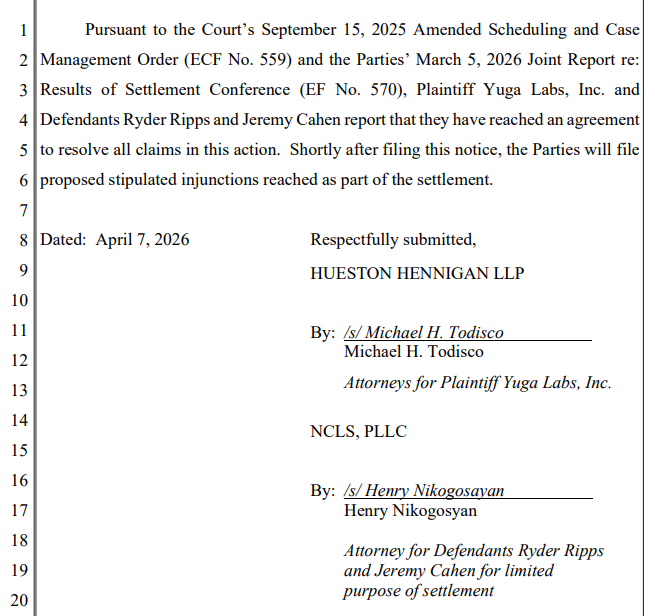
The long-running lawsuit between YugaLabs and Ryder Ripps/Jeremy Cahen is finally (almost) at an end. The parties notified the court that they settled, and the court just needs to enter the order.
Unclear if there were monetary terms, but Ryder and Jeremy agreed to an injunction:
- Prohibited from using the BAYC marks in any way
- Yuga retains control of rr/bayc smart contract, domain, and other related collateral
- Must transfer to Yuga any BAYC and rr/BAYC NFTs still in their possession
The USPTO just announced the "McConaughey Agentic Tasking Technology Helping Examiner Workload." MATTHEW will help examiners determine if an invention is eligible under Section 101.
The director of the USPTO, John Squires, also announced that he will "suspend all applicable precedent, including Desjardins, Alice, and Mayo. Basically, in terms of eligibility, if MATTHEW says your invention is ‘Alright, Alright, Alright,’ then it’s ‘Alright, Alright, Alright’ with the USPTO.”
Just kidding. Well, not really. The USPTO really did send out a press release with that April Fool's gag (see link in reply). In all seriousness...having an AI system make eligibility determinations--both at the USPTO and in court--would probably be an improvement over the mess we have now.
@dieworkwear Are you really comparing Trump to someone whose most recent crime against humanity was murdering over 30,000 of his own citizens?
Insulting as the son of Iranian refugees and as an American.
NEW: The Supreme Court reverses a $1 billion verdict for Sony Music against Cox, the internet provider.
Lower courts held that Cox was liable for contributory copyright infringement because it knew that its users were using its internet service to infringe copyrights.
SCOTUS reversed. A service provider, like Cox, is contributory liable for a user's infringement only if it intended that the provided service be used for infringement, which can be shown in two ways: if the service provider induced infringement (like Grokster did with its file-sharing service) or if the service is tailored to that infringement.
Cox neither induced its users' infringement through active encouragement (e.g., through ads) nor provided a service that was tailored to infringement (since the internet can be used for much more than copyright infringement).
Why this case matters:
- For ISPs and platforms: this limits exposure based on notice alone and avoids turning service providers into copyright police
- For rightsholders: raises the bar--enforcement will continue to focus more on direct infringers (or clearer inducement cases)
- Reinforces that knowledge + inaction is not enough, standing alone, for contributory liability
@SinaiLawFirm@GregWasik Is the clip short? Are you making fun of it? Offering other 1A commentary? To what extent is watching the clip serving as a substitute for paying for the real thing?
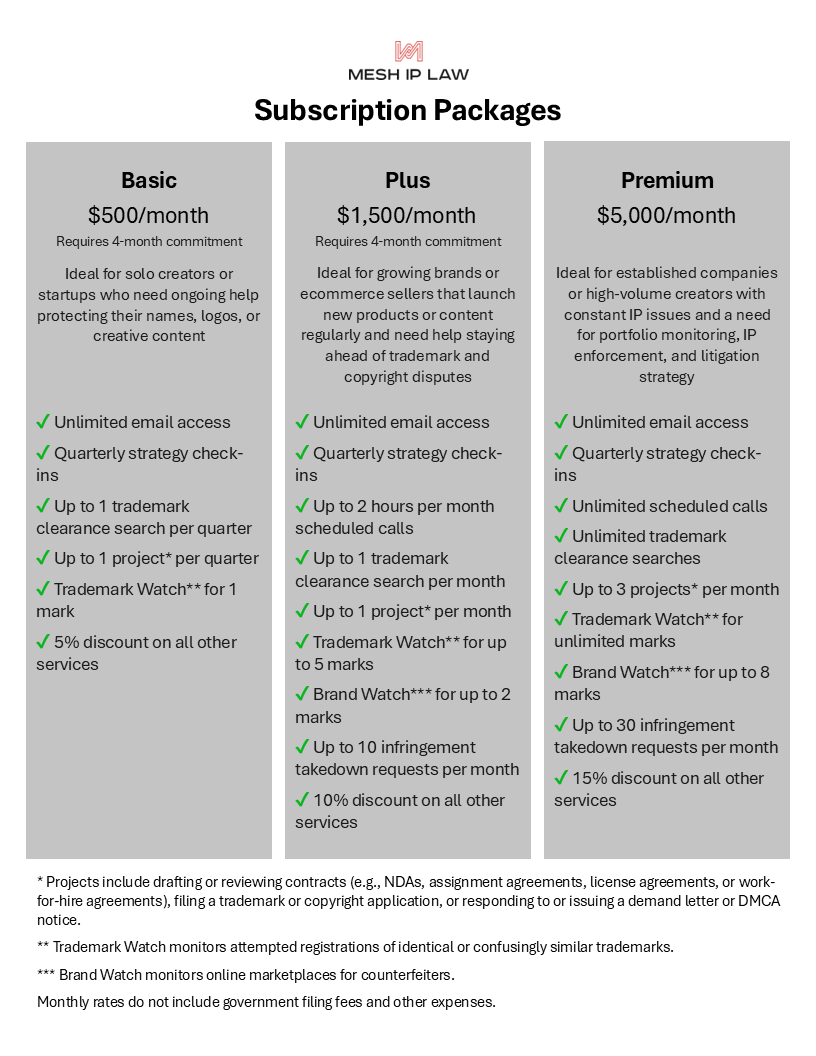
My law firm just launched subscription-based pricing.
I wanted something to address a common fear of startups, creators, and small businesses: unpredictable legal fees that make planning for the future much harder.
If you’re building something worth protecting and want cost certainty along the way, take a look at our new subscription offerings.
As always, reach out if you have questions.
Your AI conversations aren't privileged. Yesterday, Judge Jed Rakoff ruled that 31 documents a defendant generated using an AI tool and later shared with his defense attorneys are not protected by attorney-client privilege or work product doctrine.
The logic is simple: an AI tool is not an attorney. It has no law license, owes no duty of loyalty, and its terms of service explicitly disclaim any attorney-client relationship. Sharing case details with an AI platform is legally no different from talking through your legal situation with a friend (which is not privileged).
You can't fix it after the fact, either. Sending unprivileged documents to your lawyer doesn't retroactively make them privileged. That's been settled law for years. It just hadn't been tested with AI until now.
And here's what really hurt the defendant: the AI provider's privacy policy (Claude), in effect when he used the tool, expressly permits disclosure of user prompts and outputs to governmental authorities. There was no reasonable expectation of confidentiality.
The core problem is the gap between how people experience AI and what's actually happening. The conversational interface feels private. It feels like talking to an advisor. But unless you negotiate for an enterprise agreement that says otherwise, you're inputting information into a third-party commercial platform that retains your data and reserves broad rights to disclose it.
Judge Rakoff also flagged an interesting wrinkle: the defendant reportedly fed information from his attorneys into the AI tool. If prosecutors try to use these documents at trial, defense counsel could become a fact witness, potentially forcing a mistrial. Winning on privilege doesn't make the evidentiary picture simple.
For anyone advising clients or managing legal risk, this is a wake-up call. AI tools are not a safe space for clients to process their counsel's advice and to regurgitate their legal strategy. Every prompt is a potential disclosure. Every output is a potentially discoverable document.
So what do we do about it?
First, attorneys need to be proactive. Advise clients explicitly that anything they put into an AI tool may be discoverable and is almost certainly not privileged. Put it in your engagement letters. Make it part of onboarding. Don't assume clients understand this, because most don't.
Second, if clients want to use AI to help process legal issues (and they clearly will, increasingly), then let's give them a way to do it inside the privilege. Collaborative AI workspaces shared between attorney and client, where the AI interaction happens under counsel's direction and within the attorney-client relationship, can change the analysis entirely. I'm excited to be planning this kind of approach, and I think it's where the industry needs to head.
https://t.co/NFqsznVdXh
@SinaiLawFirm > A great criminal or IP lawyer will struggle against an average eviction lawyer.
As a great intellectual property lawyer, I can confirm.
About 10 years ago, my cousin and I had this idea for a mobile game--a turn-based capture the flag game played on a hex map, with power-ups.
Once we learned the art and development would cost hundreds of thousands of dollars, we shelved it. There was no way we were paying that much for what was basically a fun side project.
Fast forward to the age of generative AI.
A few months ago I remembered the idea and decided to see if I could actually build it myself, using AI for the coding and the art.
A few hundred hours later (probably, I didn't keep track), Flag Frenzy is done (link in first reply).
The game is free to play, with optional small in-game purchases if you enjoy it. If you run into bugs or have feedback about gameplay, UI, or anything else, I'd love to hear it. It's best played on desktop, but it's playable on mobile.
It's not as polished as it would be if a professional studio had built it, but it also cost $60 instead of 5000x that. There is no way I would have done this project without AI. It's incredible what it can do today. I can't imagine what it will be like 5 years from now.
For those curious about the tools:
Figma Make for coding and art prompts
ChatGPT 5.2 for generating art
Gemini 3 for help debugging
Matthew McConaughey just trademarked himself.
McConaughey has secured multiple U.S. trademark approvals covering elements of his voice, likeness, and short audio/video clips to deter unauthorized AI and deepfake use.
For years, trademarks have protected names, logos, and slogans. What we’re now seeing is the next evolution:
Using trademark law as a frontline defense against AI misuse of identity.
Anyone with recognizable voices, catchphrases, or visual personas should be paying close attention, and shouldn’t rely solely on NIL or right-of-publicity laws for protection.
"Such incompetence and malevolence on both sides led to forty discovery orders, many of them omnibus orders, filed by Special Master McElhinny. As Special Master McElhinny described the proceedings when partway through: 'Most lawyers would have died in shame.' We went to trial."
Oof.