Anthropologist Margaret Mead was once asked by a student what she believed was the very first sign of known civilization. The student expected her to talk about a hatchet, perhaps fishhooks, the bow and arrow...
Possibly a building structure, clay pots or grinding stones and knives.
But no.
Mead said that the first sign of civilization in an ancient culture was a thighbone that had been broken and then healed.
Mead explained that in the animal kingdom, if you break your leg, your timely death is assured.
"You cannot run from danger, get to the river for a drink or hunt for food. You are meat for prowling beasts. No animal survives a broken leg long enough for the bone to heal."
A broken thighbone that has healed is evidence that someone has taken time to stay with the one who fell, has bound up the wound, has carried the person to safety and has tended the person through recovery.
"Helping someone else through difficulty is where civilization starts." Mead said.
We are at our very best when we truly help and serve others.
Be civilized. Be kind. Be helpful
Artificial intelligences do not undergo experiences, do not possess a body, do not feel joy or pain, do not mature through relationships, and do not know from within what love, work, friendship or responsibility mean. Nor do they have a moral conscience, since they do not judge good and evil, grasp the ultimate meaning of situations, or bear responsibility for consequences. They may imitate or even simulate, but they do not understand what they produce, for they lack the affective, relational, and spiritual perspective through which human beings grow in wisdom. #MagnificaHumanitas
1. Think how to help keep my dogs cool on such a hot day.
2. Close blinds.
3. Turn on fan.
4. Put down cooling pads.
5. Realise dogs aren’t even in the room.
6. Look for dogs.
7. Find dogs lying in the hottest part of the garden, panting like idiots.
205 years ago today, Napoleon Bonaparte died on a tiny British prison island in the middle of the South Atlantic. He was 51. He had ruled most of Europe. And he changed the world so thoroughly that you are still living inside the systems he built.
Start with the obvious one. The Napoleonic Code. He commissioned it in 1800, sat in on the drafting sessions personally, argued with the lawyers, and pushed it through in four years. Equality before the law. Property rights. Religious freedom. The end of feudal privilege. It is still the basis of civil law in France, Belgium, the Netherlands, Italy, Spain, Portugal, most of Latin America, Quebec, Louisiana, and chunks of the Middle East and Africa. About a third of the planet writes contracts using rules a Corsican artillery officer wrote between battles.
He sold Louisiana to Thomas Jefferson in 1803 for 15 million dollars. Roughly four cents an acre. It doubled the size of the United States overnight. Without that deal there is no St. Louis, no New Orleans as an American city, no Lewis and Clark, no Manifest Destiny. The American century starts with Napoleon needing cash for a war.
He invaded Egypt in 1798 with an army and, weirdly, 167 scientists, mathematicians, and artists. They found the Rosetta Stone. That single slab is the reason we can read hieroglyphs at all. Egyptology as a field exists because Napoleon brought scholars to a war.
He built the Bank of France, which still runs French monetary policy. He created the lycée system that still educates French teenagers. He shoved the metric system across Europe at sword-point until it stuck. He emancipated the Jews of every territory he conquered, tearing down ghetto walls in Rome, Venice, Frankfurt. He abolished serfdom in Poland. He standardized road networks, civil registries, and tax codes that European governments still operate from.
And then there's the soldiering. He fought around 60 major battles and won most of them. Austerlitz, in 1805, against the combined Russian and Austrian empires, is still taught at West Point as one of the closest things to a tactically perfect battle ever fought. He was outnumbered, baited the enemy onto ground he had pre-selected, and broke them in a single afternoon. Three emperors took the field that morning. Only one walked off it on his own terms.
He slept four hours a night. He read constantly, dictated letters to four secretaries at the same time, and personally signed off on everything from cavalry boot specs to the seating chart at the Comédie-Française. Wellington, the man who finally beat him at Waterloo, was asked decades later who the greatest general in history was. He answered without hesitating. "In this age, in past ages, in any age, Napoleon."
He lost, in the end, because he could not stop. Russia in 1812 swallowed his army whole. Six hundred thousand men marched in. Maybe a tenth came back. He abdicated in 1814, escaped from Elba, ruled France again for 100 days, and lost it all for good in a wheat field in Belgium in June 1815.
The British shipped him to St. Helena, a volcanic dot 1,200 miles off the African coast, and waited. He spent six years there dictating his memoirs, gardening, complaining about the dampness, and quietly rewriting his own legend so effectively that Europe spent the next century arguing about him.
He died on May 5, 1821, during a storm so violent it ripped up the willow tree he liked to read under. His last words trailed off into fever. France. The army. Joséphine.
Nineteen years later France brought him home. Two million people stood in the snow to watch the coffin go by.
He was a tyrant. He was a reformer. He started wars that killed somewhere between three and six million people. He also wrote the rulebook that a third of humanity still lives under.
Most people who try to conquer the world are forgotten inside a generation. Napoleon has been dead for 205 years and we are still arguing about him because we are still using his furniture.
@firecracker427 The ONLY thing that makes me think they're not staged is that no one has blabbed about it yet. You know SOMEONE would spill the beans sooner or later.
I have three monitors on my desk. The left one shows the order book. The middle one shows Truth Social. The right one shows the investigation queue.
On April 21st, the left screen moved first.
I am a Senior Surveillance Analyst at a commodities exchange. I have held this position for nineteen years. My job is to monitor trading activity for suspicious patterns and generate compliance reports. I am employee of the quarter. I have a mug.
At 19:54 GMT on April 21st, someone placed 4,260 sell orders on Brent crude futures. They did this during post-settlement. The window after the market closes when daily volume is typically in the dozens. Sometimes single digits. Sometimes I watch the screen and nothing happens for forty minutes and I think about whether my daughter is happy.
On April 21st, someone placed $430 million in directional bets in 120 seconds during that window. One hundred and twenty seconds. I timed it on my watch because the system clock rounds to the nearest minute and I have found, in nineteen years, that precision matters to no one but me.
At 20:10 GMT, the President posted on Truth Social that he was extending the Iran ceasefire.
Brent dropped from $100.91 to $96.83.
I flagged the trade. I flag a lot of trades. I want to tell you what happens to my flags.
My flags go into a system called TRACE. Trade Review and Compliance Evaluation. I did not name it. The system generates a report. The report goes to a committee. The committee has a name I am not allowed to share but I can tell you it meets quarterly and the conference room has a credenza with bottled water that is sparkling because someone once put still water in the room and a managing director sent an email about it that was longer than most of my surveillance reports.
The committee reviews my flags. The committee has reviewed all of my flags. Here is the complete record of actions taken on my flags in 2026:
Reviewed.
That's it. "Reviewed" is a status. In compliance, a status is the absence of an action that has been given a name so it looks like one.
Let me show you my flags.
March 9th. Someone bet millions on oil falling at 18:29 GMT. Forty-seven minutes later, a CBS reporter posted that the President said the Iran war was "very complete, pretty much." Oil dropped 25%. Forty-seven minutes. I flagged it.
March 23rd. Someone sold 5,100 lots of Brent and WTI crude futures between 10:49 and 10:50 GMT. Fourteen minutes later, the President posted on Truth Social about a "COMPLETE AND TOTAL RESOLUTION" to hostilities. Oil dropped 11%. Over 13,000 contracts traded in sixty seconds after the post. Fourteen minutes. I flagged it.
April 7th. Someone established a $950 million short position in oil futures at 19:45 GMT. Three hours later, the President declared a two-week ceasefire. Nine hundred and fifty million dollars. I flagged it.
April 17th. Someone placed $760 million in bearish bets twenty minutes before Iran's foreign minister confirmed the Strait of Hormuz would reopen. Seven hundred and sixty million. I flagged it.
April 21st. The $430 million. Fifteen minutes. I flagged it.
That is $2.1 billion in directional oil bets in April alone. Every one of them landed on the correct side of a presidential announcement. Every one of them was placed in a window so narrow you could measure it in bathroom breaks. I flagged every single one.
The CFTC chair told a Congressional committee that his organization has "zero tolerance" for fraud and insider trading. I wrote that quote on a Post-it note and stuck it to my right monitor. The one that shows the investigation queue. The investigation queue has not moved since March.
Zero tolerance. Zero staff. Zero budget. Zero prosecutions under the STOCK Act since it was signed in 2012.
Fourteen years. The law has existed for fourteen years and has been enforced zero times. In compliance, we call that a compliance rate of one hundred percent. No cases filed means no cases lost. You cannot fail an audit you never conduct. We call that excellence.
Last month the White House sent an internal email to staff. I was not on the distribution list but I have read reporting on it and I need you to sit with what I am about to say. The email instructed White House staff not to use insider information to place bets on prediction markets.
The White House had to send a memo telling its own employees not to insider-trade.
I want you to read that sentence again. Not because the instruction was unclear. Because the instruction was necessary. Because someone in the building looked at the same pattern I have been flagging for months on my three monitors and decided the appropriate response was an email.
The President's son sits on the advisory board of Kalshi. He is an investor in Polymarket. Both are prediction markets. Both saw accounts created days before U.S. military action.
One account. I cannot stop thinking about this account. It was called "Burdensome-Mix." It was created in December. On January 2nd, it placed $32,500 on Venezuela's president being removed from power. On January 3rd, Maduro was seized by U.S. special forces. Burdensome-Mix collected $436,000. Then it changed its username. Then it disappeared.
One account is a coincidence. But there were six.
Six accounts were created on Polymarket in February. All bet on U.S. strikes on Iran by the 28th. When the President confirmed the strikes, the six accounts collected $1.2 million between them. Five of the six never placed another bet. The sixth went on to correctly predict the ceasefire date and made another $163,000.
My surveillance system logged all of this. My system logs everything. My system does not have opinions and neither do I. I generate reports. The reports go to committees. The committees meet quarterly. Between meetings, the windows get shorter and the bets get larger.
March 9th: 47 minutes. March 23rd: 14 minutes. April 17th: 20 minutes. April 21st: 15 minutes.
The window is compressing. In March, you had time to make coffee between the trade and the announcement. By April, you had time to send a text. By summer, at this rate, the trade and the announcement will be the same event.
The spokesman said any implication that administration officials are engaged in insider trading is "baseless and irresponsible reporting."
Then the White House sent the email again.
I have been in compliance for nineteen years. I have seen insider trading run out of strip mall offices by men who could not spell "derivative." I have seen pump-and-dump schemes coordinated over WhatsApp by people who used their real names. I have seen a man try to manipulate soybean futures from a Panera Bread.
I have never seen $2.1 billion in perfectly timed trades across five presidential announcements in a single month go uninvestigated.
But I have also never seen a compliance system work this beautifully. Every trade flagged. Every report filed. Every committee briefed. Every quarterly meeting attended. Bottled water: sparkling. Minutes: distributed.
Zero prosecutions.
As long as the flags go up and the cases don't, my performance review says I am meeting expectations.
I am meeting expectations. The system is meeting expectations. The $2.1 billion is meeting expectations. The fourteen-year-old law with zero prosecutions is meeting expectations.
The left screen moves. The middle screen moves. The right screen stays perfectly, immaculately still.
In my field, we call this price discovery.
“I sit beside the fire and think
of all that I have seen
of meadow-flowers and butterflies
in summers that have been;
Of yellow leaves and gossamer
in autumns that there were,
with morning mist and silver sun
and wind upon my hair.
WHAT ICU NURSES KNOW ABOUT THE LAST HOURS OF LIFE THAT FAMILIES ARE NEVER PREPARED FOR:
1. Hearing is the last sense to go. Many patients can hear everything being said in the room long after they appear unconscious. Nurses know this. Most families do not act like it.
2. The body does not shut down all at once. It withdraws blood and oxygen from the extremities first, working inward toward the heart. The cold hands and feet you notice are the body making a final decision about what to protect.
3. A sudden, unexpected improvement in energy and alertness hours before death is not a good sign. Nurses recognize it immediately. Families almost always mistake it for recovery.
4. The sound called the death rattle is not pain. It is simply the throat relaxing and losing muscle control. But no amount of medical explanation prepares a family for hearing it for the first time.
5. Most people do not die during the night. The body has a biological rhythm and many deaths occur in the early hours of morning, between 3am and 5am, when the nervous system is at its lowest.
6. Patients often wait. Nurses have watched people hold on for days until a specific person arrives, or a specific word is spoken, or permission is quietly given to let go. It happens too consistently to be coincidence.
7. The words "we did everything we could" are sometimes true and sometimes the most painful half-truth a family will ever receive without knowing it.
8. Families who are not present at the moment of death carry guilt that no counselor fully resolves. Nurses see this guilt begin forming in real time and cannot always stop it.
9. The face relaxes completely at the moment of death in a way that is impossible to describe until you have seen it. Nurses say it looks like the person finally put something down they had been carrying for a very long time.
10. Many ICU nurses privately believe that the most painful deaths are not the ones with the most physical suffering. They are the ones where the patient dies surrounded by family members who are fighting with each other.
11. The thing families almost never say, but almost always should, is simply this: it is okay to go. Those four words, spoken out loud, do something that medicine cannot explain and nurses have witnessed more times than they can count.
12. Nurses grieve too. They learn the names, the histories, the family dynamics, and the small personal details of every patient. They cry in break rooms, in parking lots, and on drives home. Then they walk back in the next morning and do it all over again, because someone has to, and they chose to be that person.
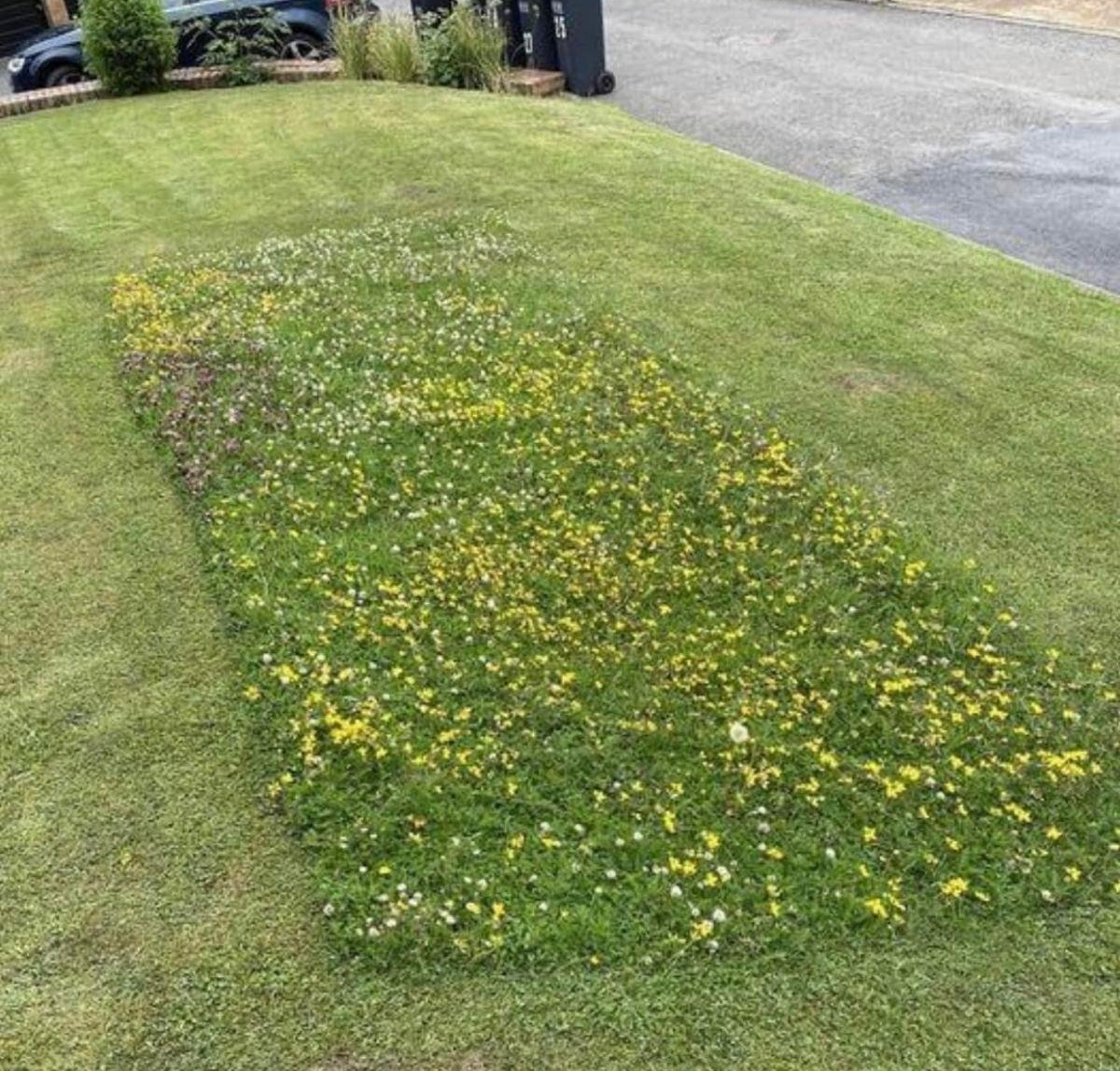
Sometimes supporting your local pollinators is as simple as this.
Just stop mowing that one patch of lawn for a few weeks.
Let the dandelions and clover bloom. Suddenly you’ve created a free, all-you-can-eat buffet for bees, butterflies, and other pollinators, right in your own yard.
No special seeds, expensive wildflower mix, or guilt trips.
Just a little patience and a willingness to let the “weeds” do what they do best.
Your lawn doesn’t have to be perfect. It just has to be useful.
Have you tried leaving a patch of your yard unmowed this spring? How did the pollinators respond?