Attention of “policymakers,” clinicians, and families:
The use of VIMAIN D (also C) as a PREVENTIVE tool for improving the quality of life, reducing morbidity and mortality, and reducing healthcare costs.
✅ Ensure vitamin sufficiency before conception, throughout pregnancy, and in early childhood.
✅ Make routine screening of vitamin D and C in pregnant women and young children a public health priority.
✅ Use Holistic and Orthomolecular Medicine as a science-based framework for early, safe, and effective prevention.
https://t.co/8iF3bb6alE
Enhancing the Design of Nutrient Clinical Trials for Disease Prevention—Focus on Vitamin D: A Systematic Review
Nutr Rev. 2025 Jul 1;83(7):e1740-e1781. https://t.co/uE0Dsd03bw PDF
Edit here to read detailed analysis of the paper:
https://t.co/sodPLxgnMn
Blueprint on “How to Design a Nutrient Clinical Trial”—by Sunil J. Wimalawansa
"Enhancing the Design of Nutrient Clinical Trials for Disease Prevention���A Focus on Vitamin D: A Systematic Review"
The study emphasizes the importance of focused, hypothesis-driven, well-designed, statistically powered clinical studies to explore and test diverse benefits of nutrients in index nutrient-deficient participants, and the avoidance of study design errors.
Findings from such studies should be incorporated into clinical practice, policymaking, and public health guidelines, improving the health of the nation and reducing healthcare costs.
However, this is yet to happen, even though most nutrient guidelines are misleading, grossly outdated, and may even harm people.
https://t.co/sfLiVJh98s
https://t.co/ycDlmdo8RD
My latest review on Vitamin D and the Immune System - a COVID-19 perspective, with an emphasis on mechanisms of #vitaminD action. Part of the 2024 @Vit_D_Workshop. https://t.co/xATvzGCmcq
"Maximizing the Benefits of Vitamin D in the Community."
Theory, clinical studies, and real-world practices often differ in clinical outcomes, requirements, and costs. Without an initial loading dose of 100,000–200,000 IU (using 50,000 IU capsules), a daily intake of 5,000 IU typically takes over 120 days to achieve serum 25(OH)D levels of 40–50 ng/mL. In contrast, 10,000 IU/day reaches >50 ng/mL within 60–80 days, except in obese individuals (https://t.co/QWj2aehg9t).
Vitamin D dosage can be estimated using BMI, body weight, or baseline serum 25(OH)D levels (Wimalawansa, SJ, Nutrients, 2022). However, testing is often inaccessible or too costly. An alternative is a body-weight-based calculation, which we published three years ago (https://t.co/9YodhubjK6):
1. Not obese (BMI <29): 70–90 IU/kg
2. Moderately obese (BMI 30–39): 100–130 IU/kg
3. Morbidly obese (BMI >40): 140–180 IU/kg
Factors such as age, BMI, diet, sun exposure, supplementation, health status, and genetics affect vitamin D levels, emphasizing the need for personalized dosing. One size does not fit all, especially for VA recipients.
For non-pregnant women, 4,000 IU/day generally maintains 30–50 ng/mL, while pregnant and breastfeeding women require 6,000–8,000 IU/day to achieve >50 ng/mL for optimal mother and infant health. Serum levels up to 100 ng/mL are safe, with toxicity rarely occurring below 150 ng/mL (https://t.co/gCXSCCt42Q). When taking high doses, concurrent vitamin K₂ is recommended.
In cases of severe deficiency (<12 ng/mL), 5,000 IU/day is inadequate due to the substantial body deficit of over one million IU. Even at 10,000 IU/day, it takes over two months to reach meaningful serum levels. This underscores the need for clinicians and researchers to understand the biology of vitamin D. For acute infections or ICU settings, doses of 5,000 IU are insufficient to reach therapeutic levels, contradicting assumptions in many failed clinical trials.
Cost is minimal: Costco sells 500 capsules of 5,000 IU for $20, while 100-capsule bottles of 50,000 IU are only slightly more. A 50,000 IU capsule weekly, combined with 800–1000 mcg of K₂, is cost-effective and convenient.
If implemented by a system like VA, costs become negligible. A year's supply of vitamin D for VA members should not exceed $12 ($20). This is trivial compared to treating complications from deficiency, with one day of hospitalization costing more than a year of supplements and vitamin D testing.
Physiology of Vitamin D—Focusing on Disease Prevention: by Sunil J. Wimalawansa
Nutrients 2024, 16(11), 1666; May 2024
https://t.co/gSICWqqoTT
This review presents novel findings related to the physiology of vitamin D that have significant implications for disease prevention.
Overcoming Chronic Disease:
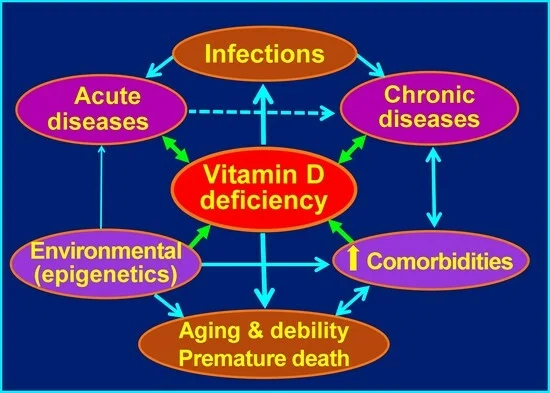
Maintaining vitamin D sufficiency reduces chronic disease burden, hospitalizations, and mortality. Vulnerable communities, such as ethnic minorities living in temperate countries, older people, those with co-morbidities, routine night workers, and institutionalized persons, have the highest prevalence of vitamin D deficiency—they would significantly benefit from vitamin D and targeted micronutrient supplementation.
At least now, health departments, regulators, and health insurance companies should understand the value of prioritizing and encouraging this highly economical, non-prescription, and safe micronutrient to prevent and overcome diseases. This approach will significantly reduce morbidity, mortality, and healthcare costs and ensure healthy aging.
https://t.co/ZSolPYhXbg
“Vitamin D Deficiency Fulfills Hill’s Criteria for Causation in SARS-CoV-2 Infections, Severity and Deaths.”
Promoting safe sun exposure and adequate vitamin D₃ supplementation within communities to maintain 25(OH)D levels above 40 ng/mL (therapeutic range: 40–80 ng/mL) strengthens the immune system, reduces hospitalizations and deaths, and significantly lowers healthcare costs.
This systematic review confirmed that extensive evidence (including over 300 clinical trials) demonstrated that “low” vitamin D levels significantly increase the incidence, severity, complications, and mortality from infections—including tuberculosis and viral respiratory illnesses, particularly SARS-CoV-2.
Current guidelines are outdated—they focus solely on bone health and are not helpful in clinical practice or trials. Urgent revisions are needed to enhance public health, reduce absenteeism, increase productivity, and lower healthcare costs globally.
https://t.co/AEvcezMM1L
Title: Vitamin D: Evidence-Based Health Benefits and Recommendations for Population Guidelines
Overview:
The 2024 Endocrine Society (Endo Soc) Guidelines represent a step backward in advancing public health. Similar to the flawed approach taken by the Institute of Medicine (IOM) in the past, the guidelines narrowly focus on the skeletal effects of vitamin D and rely heavily (and inappropriately) on randomized controlled trials (RCTs). This limited perspective is fundamentally inappropriate for evaluating the broader roles of micronutrients, including vitamin D.
The above review addresses the myths propagated by the IOM and Endo Soc recommendations, emphasizing the need to shift from outdated paradigms to evidence-based population guidelines that reflect vitamin D's comprehensive health benefits.
It underscores the importance of recognizing vitamin D's role beyond bone health, particularly in immunity, chronic disease prevention, and overall well-being, supported by ecological/ observational studies and meta-analyses.
https://t.co/yczWwl6HCq
https://t.co/pLere5QU9g
#mdpinutrients via @Nutrients_MDPI
Physiology of Vitamin D—Focusing on Disease Prevention, Wimalawansa, Sunil, J.
Vitamin D is the most cost-effective agent that can be used to improve human health.
“Given its broader positive impact on human health with minimal cost and little or no adverse effects, proactively integrating vitamin D assessment and supplementation into clinical practice promises significant benefits, including reduced healthcare costs.”
Nutrients 2024, 16(11), 1666; https://t.co/gCXSCCtBSo
Integrating Endocrine, Genomic, and Extra-Skeletal Benefits of Vitamin D into “National and Regional Clinical Guidelines” by Sunil J. Wimalawansa, Scott T. Weiss, & Bruce W. Hollis.
Published vitamin D guidelines are based on bone-focused RCTs, which generate misleading public health and disease prevention information. Guidelines should emphasize extra-skeletal benefits, requiring higher doses and serum25(OH)D levels for better health.
This review recommends region-specific RCTs and vitamin D clinical practice guidelines to avoid relying on flawed North American or European standards.
https://t.co/baMKGnRqK4
Vitamin D and ACE-2 Molecular Interactions in Mitigating Complications and Deaths from SARS-CoV-2
SARS-CoV-2 through multiple mechanisms including widespread inflammation, causes lung damage impaired tissue oxygenation and death. In addition to enhancing the immune system, vitamin D increases ACE-2 that neutralizes viruses the bloodstream and breaks down angiotensin-II and reduces SARS-CoV-2-induced inflammation. This manuscript discusses how vitamin D mitigates the harmful effects of COVID-19.
https://t.co/sR6SDFn7zv
Biology 2024, 13(10), 831; https://t.co/MCzqp4u4gP
No scientific evidence supporting that COVID-19 vaccines offer more benefits than harm.
In contrast, widely available highly economical, generic agents, like vitamin D and ivermectin, demonstrate not ony safety but also highly cost-effective profiles.
https://t.co/PyO1UuaK3H
Most cost-effective way to prevent diseases:
"Infections and Autoimmunity—The Immune System and Vitamin D: A Systematic Review"
Website: https://t.co/GXeHQCpVNQ
Unveiling Interplay—Vitamin D and ACE-2 Molecular Interactions in Mitigating Complications & Deaths from SARS-CoV-2
Biology, 13(10), 831, 2024
https://t.co/igl1g4xSv1
https://t.co/g1Go4qfOWk