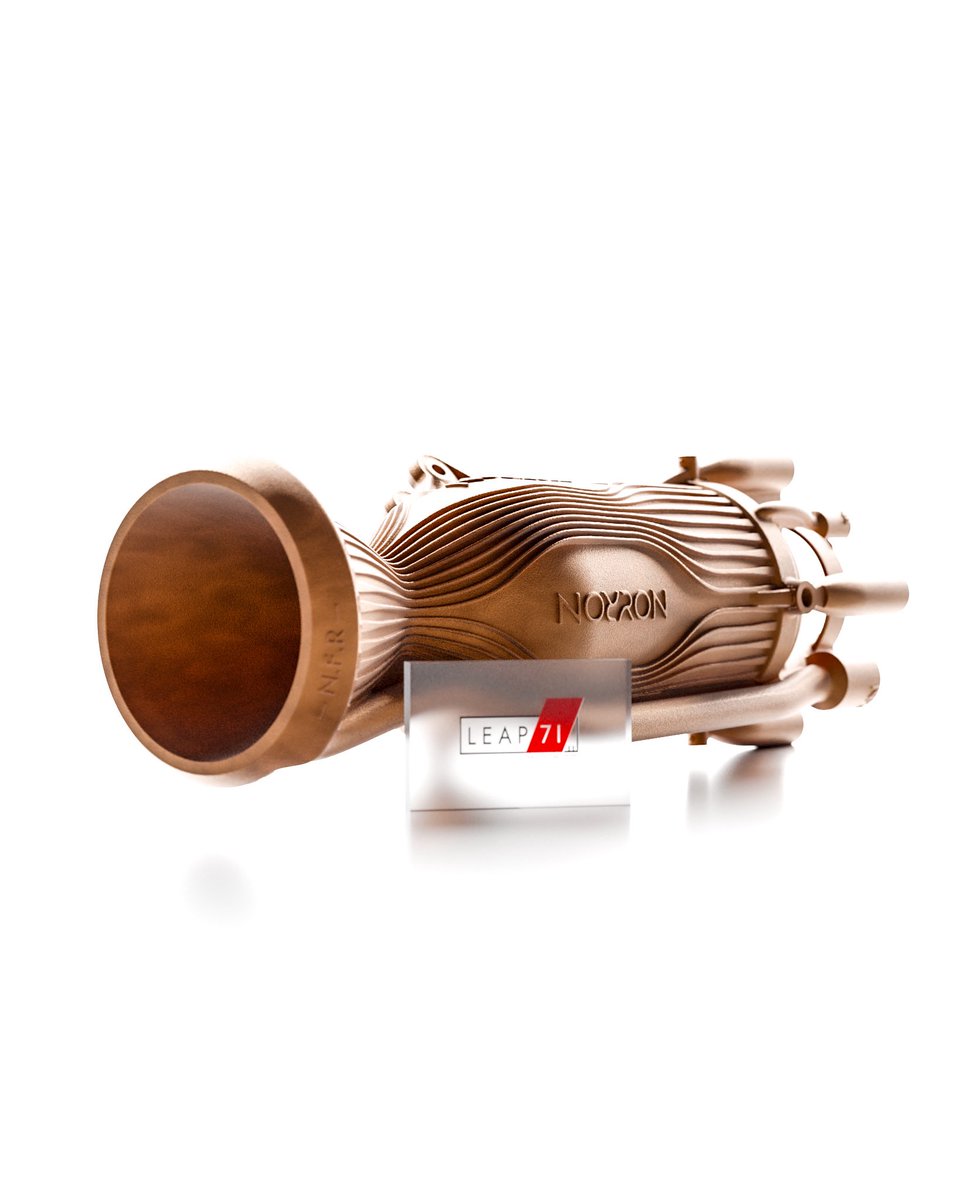
The 5 kN (1,125 lbf) aerospike rocket thruster from our previous post may look simple from the outside. But a glimpse inside reveals the intricate structure of its cooling system.
Liquid oxygen is routed through the central spike, where it makes a 180° turn before entering the spiraling channels that regeneratively cool the spike. The oxygen absorbs heat that would otherwise cause the spike to melt. This turns the oxygen gaseous and gives the pressure-fed engine a useful Isp boost.
The kerosene follows a separate path. It enters through the ring-shaped fuel manifold at the engine outlet, then flows through another swirling pattern of regenerative-cooling channels along the hot side of the outer toroidal shroud.
From there, it reaches the monolithically integrated injector head.
The injector uses two opposing simplex swirlers to combine the gaseous oxygen with the liquid kerosene for optimal mixing.
@FractrCosmology@mcdroidgame The upper stage would also benefit from aerospikes. More compact and you don’t need to carry two types of engines. It is an open question whether aerospikes make sense at that high thrust level, though.
Our first aerospike rocket thruster. 5 kN (1,125 lbf) kerolox.
Aerospikes are among the hardest rocket engines to develop. Few teams have successfully hot-fired liquid-propellant versions, and none has yet flown to space.
Although the geometry is radically different from a conventional bell nozzle, the governing physics are the same. That makes aerospikes an ideal fit for Noyron, which generates engines from underlying physical principles rather than from CAD drawings.
An aerospike turns the conventional nozzle inside out. Its toroidal geometry eliminates the fixed outer bell wall, which forces a conventional thruster to choose one atmospheric regime.
A sea-level bell nozzle sacrifices performance at high altitude. A vacuum-optimized nozzle cannot be operated safely at sea level.
Aerospikes are efficient under all atmospheric conditions, making them highly relevant for reusable upper stages that fly back from space to the launch site.
Cooling them is the biggest challenge. Our engine uses liquid oxygen to regeneratively cool the inner spike and kerosene fuel to cool the outer shroud. The resulting warm LOX gives the engine a nice Isp boost.
We hot-fired this engine in December 2024. Its early success encouraged us to pursue aerospikes as a parallel track across our engine programs.
@sofiskye4 25 bar - for more you need copper, other engines we tested with kerolox went up to 40 bar. Our 20 kN methalox engine was 50 bar. Beyond that our test stand supply pressure maxes out and you need to go turbo pump fed which we are doing now.
Clean startup and shutdown. Two things that matter in engine testing.
The 6 kN (1,350 lbf) kerolox thruster from our previous post, during a nominal run.
Noyron now generates first-time-right kerolox thrusters across a broad range of thrust classes, chamber pressures, materials, and nozzle architectures — from bell nozzles to aerospikes.
We are getting close with methane and much larger engines.
So much fun.
This 6 kN (1,350 lbf) kerolox thruster was 3D-printed in Inconel 718, a high-temperature nickel-based superalloy.
Inconel is considerably stronger and more heat-resistant than the copper alloys we usually use, but it is also far less forgiving because of its much lower conductivity.
That makes it a demanding test of Noyron’s thermal models. Copper can spread local hot spots through the chamber wall. Inconel doesn't. If the predicted heat flux is wrong, the wall burns through immediately.
Good news: it worked.
@MPuckett_OK Multiple, but frankly you don’t learn anything after 10-20 seconds. Longer tests are for qualifying purposes, as part of a customer requirements.
One underappreciated aspect of Noyron is the depth of manufacturing knowledge it relies on whenever it generates a new object.
Together with our global partners, we constantly explore what is possible in Additive Manufacturing and throughout the production chain, from heat treatment to post-machining. What we learn is fed back into Noyron.
By now, Noyron generates designs that can be manufactured successfully on the first attempt, even when they rank among the most complex objects ever attempted in industrial 3D printing.
For this 20 kN (4,500 lbf) methalox engine, printed in CuCrZr, we once again relied on Germany’s Aconity3D, a pioneer in metal Additive Manufacturing.
It is always a proud moment when a Noyron-engineered design becomes reality.
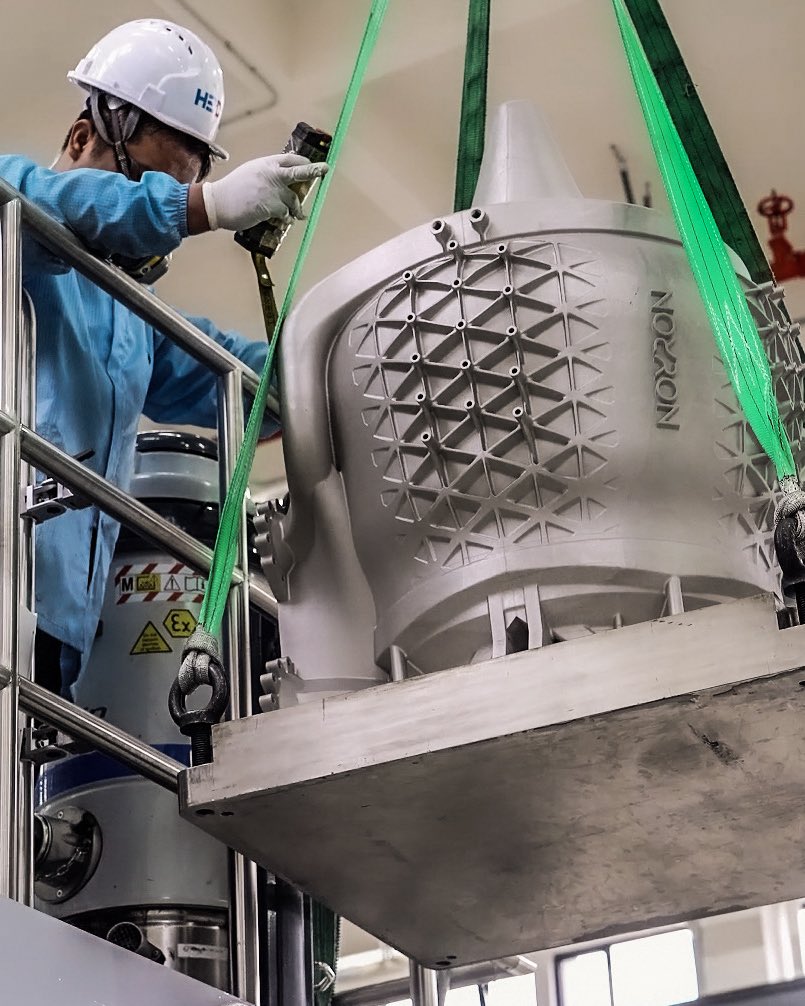
Standing 1 m (3.3 ft) tall, our massive 200 kN (45,000 lbf) methalox aerospike was manufactured by HBD as a single monolithic part in Inconel 718, a high-strength, high-temperature nickel-based superalloy.
This first manufacturing iteration allowed us to validate the production process and demonstrate that such a complex object could actually be built monolithically. The version intended for hot-fire testing will use an evolved design combining additive manufacturing with other production methods.
Encoding the manufacturing chain end to end is one of the key challenges of building a Large Computational Engineering Model.
Screenshots and renders are great. Reality feels different.
Hero shot of our 20 kN methalox engine firing – the engine reached its nominal 50 bar chamber pressure on the first attempt. Lots of data to crunch for Noyron.
This 75 kN (16,900 lbf) open-cycle kerolox rocket engine is a Noyron-generated reference design. It is suitable for the first stage of a microlauncher or the upper stage of a larger orbital vehicle.
We create reference engines across a wide range of configurations to test the robustness and versatility of Noyron’s models.
Most of our work today focuses on staged-combustion methalox systems. But when time to market is critical, open-cycle kerolox remains a pragmatic choice.
The combustion chamber and injector are designed for additive manufacturing in CuCrZr, a widely available high-temperature copper alloy.
All of our work is built on PicoGK (“peacock”), a compact and robust geometry kernel designed specifically for Computational Engineering.
We open-sourced PicoGK to give the broader engineering community a solid foundation for automated engineering.
Traditional CAD kernels use boundary representations developed around interactive, human-driven modeling. PicoGK represents geometry on a high-resolution voxel grid. This provides one coherent geometric source of truth and avoids many of the failure modes that can make conventional CAD automation brittle and ultimately unsuitable for this new engineering paradigm.