I am hiring a 4y postdoc for my Leverhulme-funded project on the role of beliefs about what in/outgroup members believe/do about climate change in shaping pro-climate behaviours🌏
Start date: May 2026 at latest
Deadline: Feb 8
Please share it widely!
https://t.co/5yY5WJ7QKZ
We think this adds nuance to the relationship between social perception + hierarchy regulation, showing shared imagery of resource possession exists across ideological lines. Co-led with @wnmerrell , alongside
Jennifer Sheehy-Skeffington and Lotte Thomsen.
https://t.co/aONt5UuySI
New work on resource possession + hierarchy regulation!
Do the faces on the left and right look different to you?
They were generated using a reverse correlation task by UK ps asked to visualize “poor people”:
🟩 by egalitarians (low SDO)
🟥 by anti-egalitarians (high SDO)
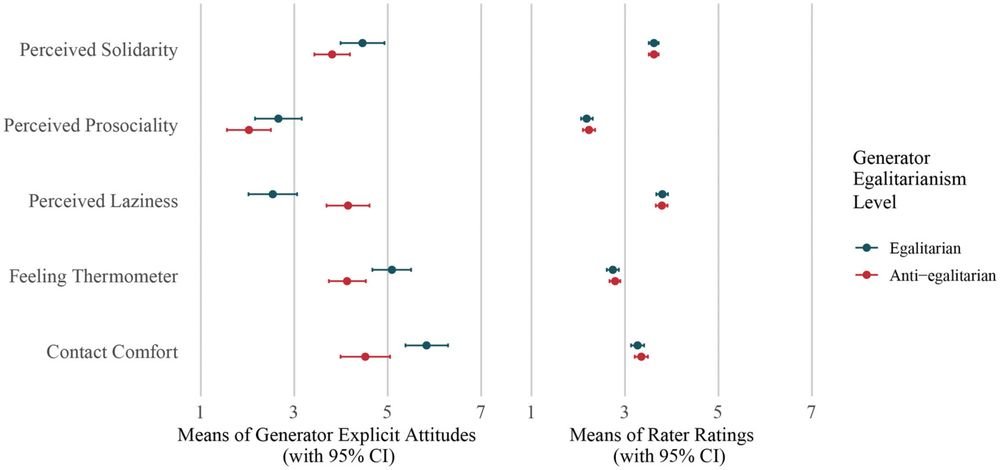
Despite clear ideological differences in stated attitudes toward poor people (left panel), egalitarians and anti-egalitarians generated strikingly similar mental images.
• Objectively: high pixel-wise similarity
• Subjectively: no difference rated by others (right panel)
It's been a really wonderful collaboration with @florianvl@Hiro_IMADA Catherine Molho and @joshtybur — super grateful for the teamwork!
This is Paper #1 of our series on moral emotions and aggression from a cultural lens.
Stay tuned for the next one! 🌍 [7/7]
🚨New paper🚨 We’ve repeatedly seen anger fuels confrontation and disgust fuels exclusion—at least in the West. But what about the East, where anger is taboo and harmony valued? We tested this in Japan 🇯🇵.
Check our new paper in Cognition & Emotion: https://t.co/OivTpAFlLy [1/7]
In sum, moral emotions divide labor in moral punishment. Anger fuels direct confrontation, while disgust mobilizes indirect, relational sanctions. Their consistent linkage across contexts and cultures reveals a universal functional grammar of moral emotion. 🌍 [6/7]
New paper out in Evolution and Human Behavior with Hongyu Sun (first author) and @LFanPsych:
Comfort with microbe-sharing contact across the COVID-19 pandemic: Testing behavioral immune system predictions
https://t.co/vjvMYTGn8y
A🧵(1/X)
I am hiring a PhD student to study the relation between disgust and moral cognition. Master's degree required. A background in evolutionary psychology is a big plus. Please circulate!
https://t.co/hExEHN8qCc
🚨Excited that our meta-analysis is out in JPSP @APA_Journals. We synthesized 6 decades (1958-2017) of empirical evidence on social dilemmas and tested which structural features (most strongly) promote cooperation:
📄https://t.co/ZviSQyZPWZ
1/10
📢 JOB ALERT: Post-Doc position 📢
Please join our group, and explore human social behavior on a fully funded 3y Post-Doc position at https://t.co/NosfK6Iqzf.
The position is open for people doing lab experiments or modeling. Details: https://t.co/ktOuPdLZOP
Please share! 🚨
@stephenjwild Well, sometimes money matters, especially when you don't even know how many waves will be there. Actually I took power thing pretty seriously so that I did the analysis in a (pretty naive) Bayesian way. However, reviewers don't like it so it is now resting in the SOM in the end.
Special thanks to @VUSocialPsych for hosting my PhD and the project, and also to @CEPDISCresearch for the ongoing further investigation on this topic - new results coming soon! [7/7]
🚨New Paper📄Salience of Infectious Diseases Did Not Increase Xenophobia During the COVID-19 Pandemic. Check out what @joshtybur@PaulvanLange and I found through a 4-wave longitudinal study in the Netherlands. Now online @Journal_EHS https://t.co/ICy8vrJ2IW [1/7]
Linking back to our previous work showing null links between ethnic outgroups and pathogen-related xenophobia, these results call for a reconsideration of how BIS shapes intergroup interactions in real-world contexts. [6/7] https://t.co/Tu5ZVVQLMy