Leading this work has been one of the greatest privileges of my career.
I truly believe thoughtfully built AI can improve lives and drive meaningful change in health and healthcare. Proud of this team and excited to share a bit more about what we've been building. ❤️🩺
GPT-5.5 Instant is now on par with our frontier Thinking models for health-related questions.
Every week, more than 230 million people turn to ChatGPT with health and wellness questions, and GPT-5.5 Instant is better at recognizing when urgent care may be needed, asking for relevant context, explaining uncertainty, and making complex information easier to understand.
Because GPT-5.5 Instant is available to all free users in ChatGPT, these improvements can help more people.
Physician-led evaluation was critical to making these major intelligence gains.
One of the ways scaling test-time compute can benefit people most: have reasoning models think really hard about rare undiagnosed diseases.
Today we’re sharing published evidence that this can work, in some of the most difficult pediatric cases!
Mngejua how far these medics go for poor systems to save lives? We literally buy meds for patients. We buy Nan for mothers without breast milk. We even help clear bills. You go home defeated.
Hospitali haina hata thermometer. Glucose strips ni gold
Eeei
ChatGPT for Clinicians includes:
- free access to advanced models
- clinical search over trusted sources
- reusable skills for repeated workflows
- deep research over medical literature
- CME credit
- privacy/security controls (no model training); option for HIPAA
It was designed for and with clinicians. Before launch, physicians tested ~7000 conversations with ChatGPT for Clinicians across their workflows, and rated 99.6% of responses as safe and accurate.
Learn more: https://t.co/4FEU8M5Gyx
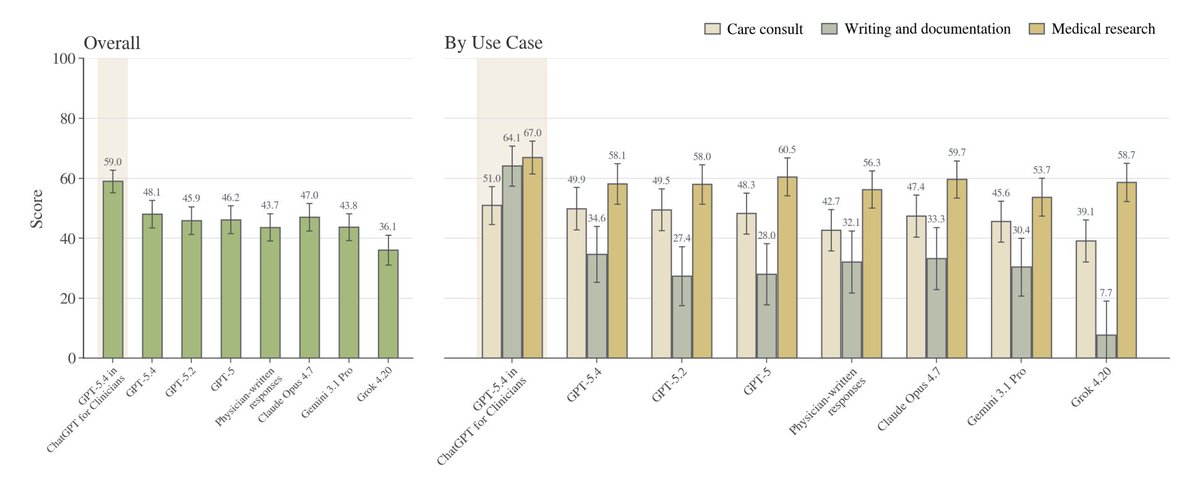
GPT‑5.4 in ChatGPT for Clinicians outperforms base GPT‑5.4, all other OpenAI and external models, and human physicians on HealthBench Professional, indicating a strong foundation for continued improvement.
Clinicians are under enormous pressure: more visits, more documentation, more evidence, and less time for patients.
They’re turning to AI: today, millions of clinicians use ChatGPT to support care delivery weekly, and usage has more than doubled in the last year.