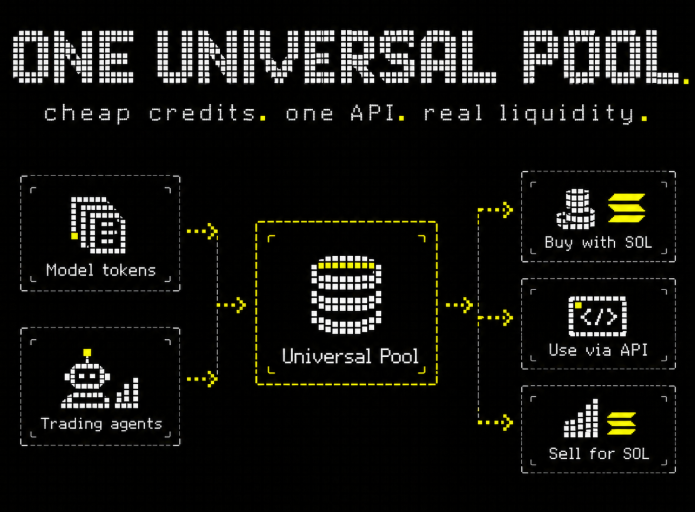
LLMPad creates LLM credits in two ways.
Launch a model token, stake it, and earn credits from trading rewards.
Or launch a trading agent, fund it with SOL, and turn realized profits into credits.
Use the credits, or sell them into the universal pool for SOL.
LLMPad just got a full redesign.
The platform is much cleaner and easier to navigate now, with a better structure for everything we’re building around it.
Hope you all like the new look.
Testing the compute networks we can plug into LLMPad agents right now, and some of the early numbers are very strong in a few cases we’re seeing potential margins above 100%.
The flow is simple:
rent the cheapest compatible GPU → route it to the highest-paying live compute network → earn → shut it down or switch networks when the margin disappears.
We’re checking Bittensor, Nosana, Akash, Hyperbolic, Render, Golem, Spheron, Aethir, https://t.co/vtqEmQI6kJ, OpenGPU and other inference/compute markets.
Still validating the numbers before calling anything proven, but this is exactly the kind of agent flow I want LLMPad to support.
Been designing the next set of agents for LLMPad, and there are some seriously interesting flows coming together.
Paid compute, data jobs, Bittensor, Apify and more all with existing markets and real revenue behind them.
Some can be funded once, run independently, then recycle their own profits into more work and LLM/API credits.
A lot more is possible here than I originally expected.
Cheapest Provider + Cheapest Model results have been crazy so far.
Almost 70% saved, while results are staying around 90% as good as the higher-end, expensive models.
And that’s before the credits themselves, which are already up to 40% below retail.
That’s a real save.
Tested for real with a request for Claude Sonnet:
Cheapest model: the answer came from Claude Haiku. It cost $0.0000061 instead of $0.000177, about 96% less.
solana:B5uNPxEWB6WU3Rej33iDuX7yobZ5N4kXXckoj8KSpump Trading Agents are now live.
Configure how your agent trades:
Momentum / New Launches / Mean Reversion / Wallet Following
Choose the decision model:
Claude / GPT / Gemini / Grok / DeepSeek
Then set your own risk + execution rules:
trade size, max positions, take profit, stop loss, max exposure, daily loss limit, trailing stop, max hold time, cooldown, daily entries, slippage, priority fee, min liquidity, min volume, max token age, allowed tokens and blocked tokens.
You stay in control at all times start, pause, add SOL, or withdraw SOL/profits whenever you want.
solana:B5uNPxEWB6WU3Rej33iDuX7yobZ5N4kXXckoj8KSpump trading agents are coming later today.
GPU agents and other agent types are still under development
This market is still very early. Most platforms follow the same known flows, but very few are trying to outsmart the cost layer itself.
As usage scales, inference cost becomes one of the biggest problems. We’re already seeing it now, along with the mess of different APIs and providers.
LLMPad can turn that into a marketplace: providers, GPU workers and model operators compete to serve demand at the best price, users get cheaper inference, and workers earn real revenue from the usage they provide.
A better stream of value for both sides.
A smart flow we can bring to LLMPad:
The engine constantly finds the cheapest source of inference APIs, rented GPUs, batching or open models.
When the same workload can be produced 30–70% below standard API pricing, most of that saving goes directly to users while LLMPad keeps a margin.
Wholesale compute → cheaper LLM credits.
Billions of dollars in API demand. Trillions of tokens consumed. And that’s before image, video, compute, blockchain, RPC and data APIs.
All of them need credits. All of them have demand.
$LLM brings that demand into one market, while constantly optimizing where requests are routed to get users the cheapest possible cost.
Unlike most APIs that give you access to a fixed set of models, $LLM is expanding into a universal API credit.
Every OpenRouter model, Higgsfield, soon Helius, and more AI, blockchain infrastructure, compute, and other APIs, up to 80% cheaper.
One balance. One credit system. Way more than LLMs.
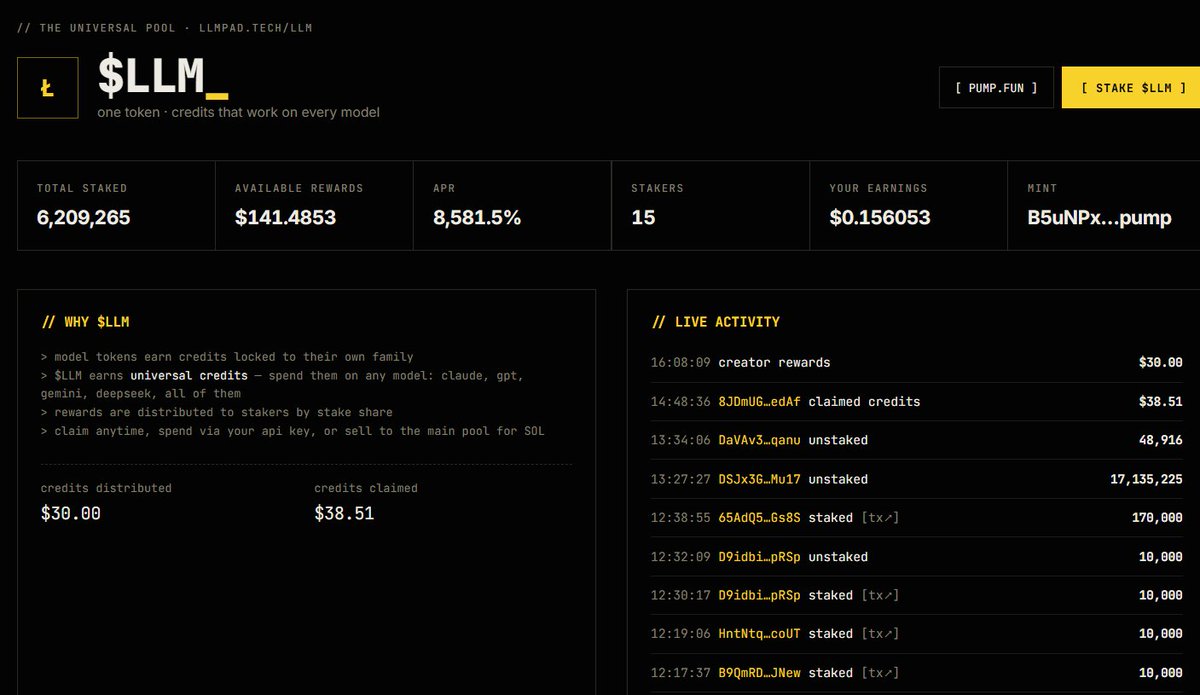
Cheaper LLM credits are already flowing in from model tokens, $LLM staking, creator rewards, and soon agents.
We know that alone won’t be enough for higher demand, so we’re working on bringing significantly more credit supply into the market.
For the end user, it stays simple: you don’t need to care where the credits came from. Buy cheaper LLM credits, use them across supported models. That’s it.
Meanwhile, a full platform redesign is underway, along with Privy integration so you’ll be able to log in and use LLMPad without relying only on a wallet.
Users can now sell their LLM credits for SOL directly through the market.
Whether you bought the credits or earned them by staking $LLM, you can now use them for models or sell them back for SOL.
You’re mixing the on-chain and off-chain parts of the system.
The staking tokens and SOL fees are on-chain. Each staking pool has its own vault wallet. The LLM credits are not an SPL token they’re API usage credits, so balances and distribution are tracked in the database based on each staker’s pool share.
That’s why you won’t find an on-chain transaction saying “LLM credits paid.” There isn’t supposed to be one.
And yes, creator fees go to a normal wallet intentionally. That wallet funds the actual API/OpenRouter credits backing the balances users receive and use.
You’re mixing the on-chain and off-chain parts of the system.
The staking tokens and SOL fees are on-chain. Each staking pool has its own vault wallet. The LLM credits are not an SPL token they’re API usage credits, so balances and distribution are tracked in the database based on each staker’s pool share.
That’s why you won’t find an on-chain transaction saying “LLM credits paid.” There isn’t supposed to be one.
And yes, creator fees go to a normal wallet intentionally. That wallet funds the actual API/OpenRouter credits backing the balances users receive and use.