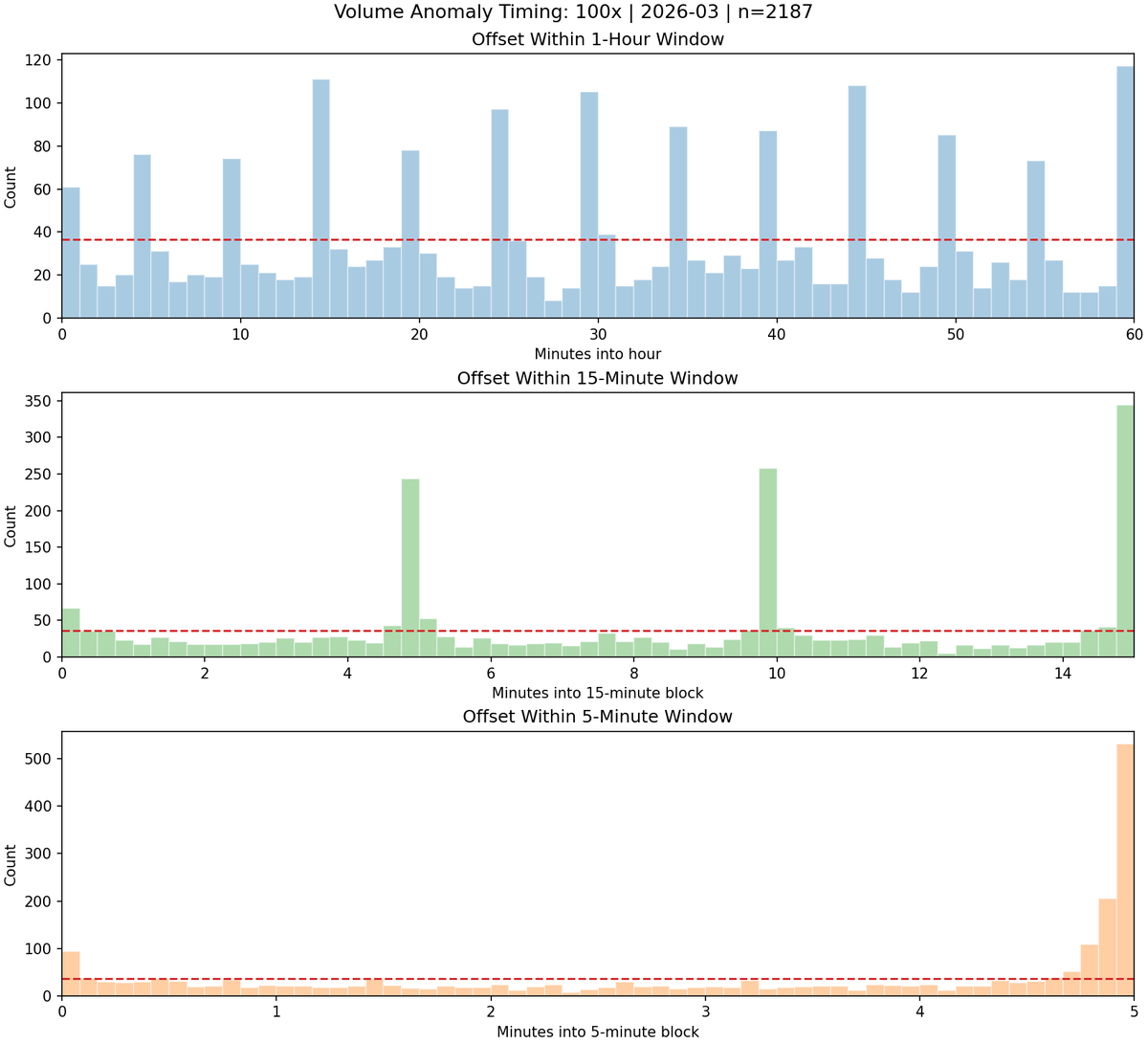
Just want to show this plot. Starting in March, anomalously-sized orders on CEXs spike at the end of 5-min windows. Before March, the distributions are mostly uniform and random. And, usually, this comes with a side flip on PM. @devjoshstevens@mustafap0ly@kakujain
Polymarket fixed ghost fills which is good.
But the market is still getting farmed in one of the most obvious ways possible.
Settlement manipulation on short-term markets (especially BTC 5min) is still wide open.
If you’re actually trading these markets, you’ve seen it:
- Traders build large positions
- Then move BTC (usually via Binance) in the final seconds
- Settlement follows that move
- They cash out, liquidity providers get run over
This isn’t edge-case behavior, it’s consistent and repeatable.
And at this point, more money has been made by manipulators running this play than by actual traders providing real liquidity. They are extracting well above 50k a day in btc 5min alone.
The result:
- Liquidity disappears near settlement
- Serious market makers turn off during these windows
- Retail sees random last-second flips and loses trust
- Market quality degrades
Weekends and low-liquidity periods are especially bad, sometimes borderline untradeable.
One important point here:
Polymarket already uses Chainlink for settlement, which aggregates multiple price feeds.
But in practice, that aggregation is still heavily dominated by Binance, and Binance leads most venues. If you can move Binance a few bips at the right moment, the rest follows. That’s exactly what’s being exploited.
So while the oracle design sounds robust in theory, in reality it’s still very gameable in short time windows.
To be clear: this is a hard problem.
But it’s also a very visible one, and there’s been little real acknowledgment or discussion around it.
There are ways to mitigate it:
- Investigate and ban clearly linked manipulation clusters (many are trackable on-chain)
- Work with active traders already monitoring this behavior
- Adjust settlement (e.g. short time-weighted averages instead of single-tick pricing)
- Reduce reliance on any single venue dominating price feeds
On time-weighted averages specifically:
Retail often pushes back on this, but I haven’t heard a strong argument for why a short averaging window (e.g. last 30–60s) would be worse than a system that can be flipped in the final seconds.
Right now, the current design is clearly exploitable.
None of these fixes are perfect, but doing nothing isn’t neutral, it actively pushes liquidity out.
And that’s the real issue:
You can’t build durable markets if the participants providing liquidity are structurally at a disadvantage.
I’ve personally tracked multiple large clusters of accounts running this strategy, including linked funding, coordinated behavior, and PnL data.
Happy to share data, examples, and work through potential solutions if the team is open to engaging on this.
@devjoshstevens@mustafap0ly@kakujain@PolymarketDevs@Polymarket