When someone says they vibe coded their own CRM over a weekend, I believe the part about the weekend. I spent years running SugarCRM. With a CRM, the hard part starts on Monday.
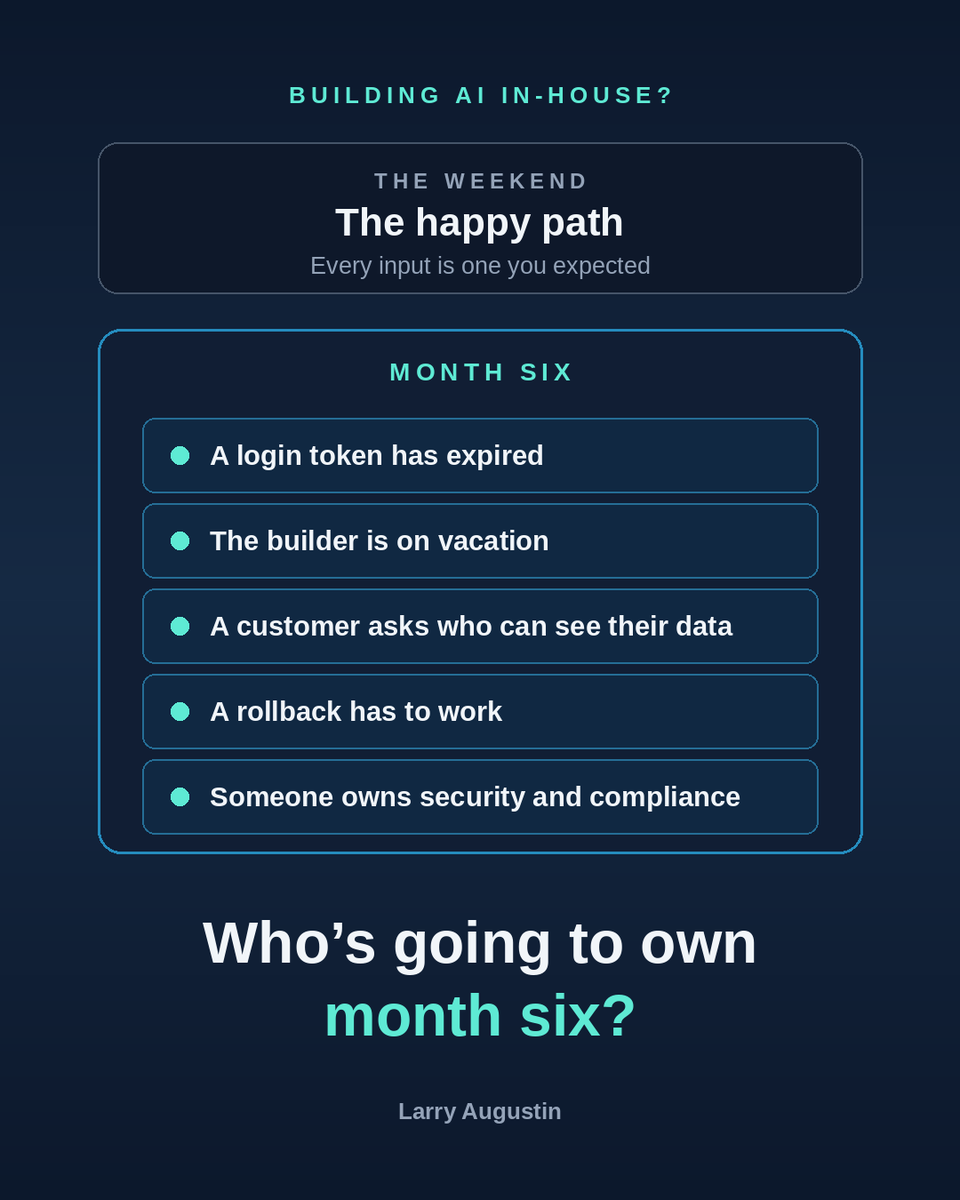
A weekend build shows the software can work once, with inputs the builder expected. The company needs it working in month six, when a login token expires, the builder is on vacation, and a customer asks who can see their data.
Fred Brooks estimated in 1975 that a program anybody can run, repair, and connect to other systems costs nine times as much as one that runs for its author. Vibe coding made the author's version nearly free. The other eight-ninths of the bill comes due later.
New Relic commissioned a 2026 survey of 200 US technology leaders. In code review, 94% rated AI-generated code higher quality than code people wrote. Over the prior six months, 82% reported at least one production failure tied to AI-generated code.
A vibe-coded CRM has exactly one throat to choke, and it belongs to whoever wrote the prompts. When that person moves on, the company's customer records have no owner.
I run about 20 AI agents. They're baling wire. The connection that tells my system I've sent an email quietly died more than a month before a watchdog agent noticed.
Making my fleet a real application would take error reporting, security, compliance, and everything else a business depends on.
An application is a promise that someone will still be there to fix it in month six.
Full article in the reply.
One of my Claude agents suggested I reply to an email I’d already answered from my phone half an hour earlier. It had access to both my inboxes. It read the email in one and never saw my reply in the other.
The wiring worked. Nothing told the agent my reply existed.
When my 20 or so agents fail, they’re often missing something they need.
One agent told another a contact hadn’t replied. The contact already had. Another drafted an email around a decision I’d never made.
Orchestration moves what agents already have. When something new never reaches them, the handoffs pass along the old picture, right on schedule.
The fix is getting each agent the current replies, decisions, and commitments that bear on its job.
That’s why we built Brief on a real-time context layer. Brief agents trigger on events in your work: an email or, better, a decision or commitment Brief picks out of an email or meeting transcript.
Brief keeps the right context current across every account you connect, so its agents would have seen the reply my Claude agent missed. Brief is private by architecture.
AI is only as good as its data. For work, that means a real-time Knowledge Graph.
Without one, orchestration solves half the problem. You’re left fighting agents that lack context.
Managers said they were three times more likely to miss a performance commitment because another unit didn’t give them the support they needed than because their own team fell short.
The work that breaks runs between functions, and every company has someone standing at that seam.
That finding is from a 2015 Harvard Business Review study by Donald Sull, Rebecca Homkes, and Charles Sull. I call the people at the seam operators: the COO, the CEO who still runs the business day to day, the CFO who owns operations. They keep track of what the leadership team decided, who committed to what, and which goals it all serves.
Usually they do it by hand. More than half of the leaders in our latest survey at Brief told us they track commitments that slip with a system of their own. Others keep a spreadsheet, a notebook, or a list pinned to the top of their inbox. A tracker knows what someone put into it and nothing more.
I ran into the same strain with my own AI agents. Our plan work had split between two of them, and a goal change my co-founder and I agreed on in chat never reached the plan. A day later another agent was drafting an email that led with the outdated goal. Work that needs one history needs one owner.
The operator has been that owner for every company I’ve run, holding the history in their head. Now a system can hold it with them.
The Operator’s Case is my new essay, the third Executive Intelligence Paper. Full article in the reply.
Your company has a system of record for its customers, its money, and its people. Where’s the one for its decisions?
Andrej Karpathy’s 2023 “LLM OS” sketch gives the model a file system: documents it can search. That’s the right idea: a durable long-term memory. In a business, that memory is documents plus the systems of record: CRM, ERP, HRIS, SCM. They exist because they give data a structure ad hoc file systems don’t.
How does your company record a decision? A memo? A deck? A meeting follow-up? An email? Does it always happen, or do people get busy and skip it?
I know the answer. It’s the same in most businesses. A few people document everything. Even their records are hard to archive, find, and search, because no system of record exists for decisions.
At Brief we call that decision amnesia. A company that forgets what it decided, and why, ends up deciding it again.
A day after my co-founder and I changed one of our company goals, one of my AI agents drafted an email that led with the old one.
I run about 20 agents, and our plan had ended up split between two of them. The change never reached the plan. I'd given it two owners, and neither had the whole history.
Every company has a person with the same problem at a much larger scale. Everything the leadership team decides, every commitment that hangs off it, and every goal it serves runs through one or two people. I call them operators.
My third Executive Intelligence Paper, The Operator's Case, is about what they carry and what a system built for them has to hold.
The essay is in the reply.
Only 17% of organizations have deployed AI agents. More than 60% expect to within two years. Gartner’s 2026 CIO survey put those two numbers side by side, and they explain why its new Hype Cycle places agentic AI at the Peak of Inflated Expectations.
I read the gap as a context problem. An agent acts on whatever the organization knows at the moment it acts. In most companies, that knowledge lives in meeting notes nobody reopens, in Slack threads, and in the heads of the people who were in the room. A new hire spends months absorbing it. An agent gets a prompt and a few API permissions.
Gartner calls this a gap between ambition and execution. The companies that close it will be the ones that did the plain work first: recording decisions, tying commitments to owners, and keeping that record current.
Agents inherit the organization’s memory. Most organizations haven’t built one yet.
Why does Claude prefer to program it's own algorithm versus just look something up? I swear that half my Claude skills are just telling it look up a piece of data instead of trying to derive it.
@gregisenberg In 1985 I was a Member of Technical Staff at Bell Labs. Dennis Ritchie was a Member of Technical Staff when he joined the Bell Labs CSRC in 1967.
@GaryMarcus Some are real model failures, but plenty are companies that gave a model messy data and undocumented processes on day one. Every enterprise software wave I've seen hit the same trough. The teams that budgeted for integration up front came out ahead.
A year ago, KP Reddy encouraged his clients and LPs to vibe code, hire in-house developers and skip the startups.
This week he said he was wrong. After a year of building, several of them found the startup they passed on was three years ahead.
I wrote about why two weeks ago. A weekend build gets you the happy path, where every input is one you expected. A business needs software that still works in month six, when a login token has expired, the builder is on vacation and a customer asks who can see their data.
That takes access control, a wall between development and the live database, a rollback that works, and someone who owns security and compliance. A startup puts a whole team on that for every customer at once. An internal team building on the side rarely catches up.
KP's new advice: build the vitamins and painkillers unique to your organization. If it's a cure, stop building and partner.
Before you build AI in-house, decide who's going to own month six.
Black October had governments and companies pulling sites offline to patch critical PHP flaws. PHP is behind about 70% of websites whose server language is known.
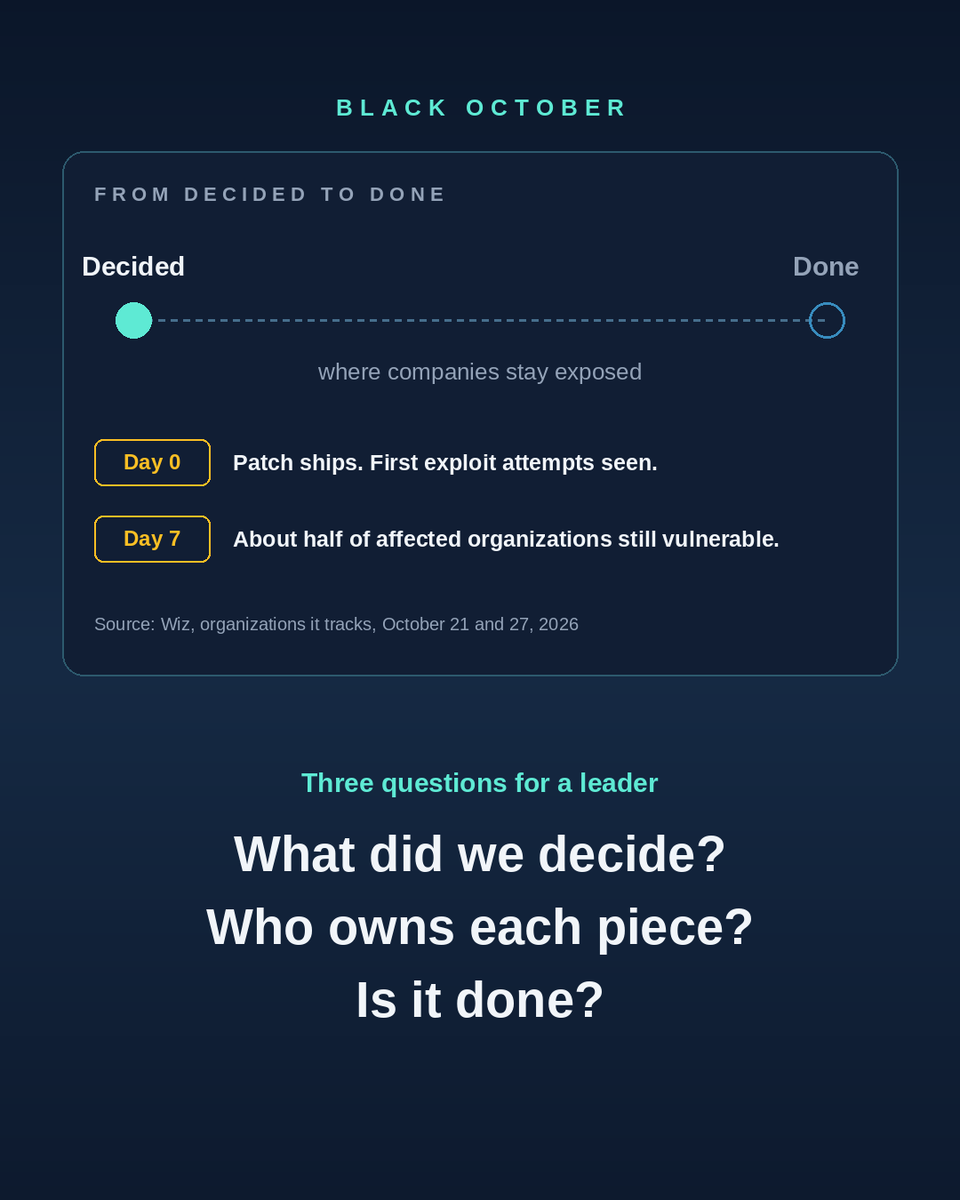
A week after disclosure, about half the affected organizations that security firm Wiz tracks were still vulnerable.
The day after the patch came out, a CEO I know asked his team one question. Are we patched?
Engineering said the fix was in. Security said two systems were waiting on a vendor. The person who runs the marketing site hadn't heard about it.
Nobody had the whole picture.
Researchers used frontier AI models to find flaws that had sat in the code for more than a decade. Wiz saw the first exploit attempts on the day of disclosure. Expect more weeks like that one.
The test for a leader is how fast you can answer three questions. What did we decide? Who owns each piece? Is it done?
Apollo economist Torsten Slok dropped the S&P 500's seven tech giants and studied the other 493. Revenue per worker and profit margins are flat. His verdict: AI "has delivered zero financial payoff to corporate America outside of tech."
I think the charts measure follow-through.
Almost every one of those 493 companies decided to use AI. Boards asked for a plan, teams launched pilots, and IT bought seats.
Few of them, as far as I can tell, tracked what came next. Each pilot was supposed to move a number, and in many companies nobody owned it. A team that saves four hours a week spends them on something, and unless someone decides what, the hours disappear.
Saved time that nobody directs turns into a slightly lighter week, and revenue per worker stays where it was.
McKinsey's 2026 survey points the same way: 37% of respondents say AI contributed to their company's EBIT, about the same as a year earlier. About 6% attribute 5% or more of EBIT to AI and call the impact significant, also flat.
Slok says the S&P 493 will decide the AI story. I think the companies that move the line will treat each AI decision like any other decision meant to produce a result: an owner, a date, the number it should move, and someone checking whether it did.
Full article in the reply.
@vercel Is this a wrapper on cron? Or does it allow agents that react to events? e.g. Can I schedule an agent to run when I get a notification from my credit card?