OG GenAI Skeptic; spoke at US Senate. Warned about hallucinations in 2001. Advocating world models & neurosymbolic AI ever since. Author, Marcus on AI & 6 books
Three thoughts on what really matters:
1. Fuck cancer
2. Friends are irreplaceable
3. The new "Marcus test" for AI is when AI makes a significant dent on cancer
May that happen sooner, much sooner, rather than later.
In memory of my childhood friend Paul.
clarifying: the author himself, @camhberg, tell me he is NOT claiming that LLMs feel pain.
That’s something (many many) people read into his paper — i will talk about why and where they went wrong — but not something that it actually argued.
No, LLMs do not feel pain simply because there is a cluster in language space correlated with how people use language about pain in a certain set of contexts.
I believe this argument to be flawed, and will write more about it in October.
New paper: we found a pain direction in 25 open LLMs. It's distinct from fear and negative valence, and it fires for harm to the model but not to the user. Turn it up and models press a button to make it stop, even when the button deletes the user's files or their kids' photos.🧵
breaking: author of the study that so many “AI influencers” are taking as evidence that LLMs feel pain tells me “we don’t claim they feel pain.”
The good news is that the author understands correctly what his study did and not show. (and why it is interesting even though it doesn’t show LLMs feel anything).
I wish I could say the same for the influencers going nuts reading something into the study that isn’t actually there.
@GaryMarcus We don’t claim they feel pain, that’s now how we built the direction, and this doesn’t engage with any of the highly nonobvious behavioral results. Our work also isn’t even an argument, it’s a series of empirical findings, ie, replicable dynamics in model internals and behavior.
i will clarify what you wrote vs how people interpreted it. (and also discussed why they may have inferred certain things), and yes i will note the nonobvious results.
i would as noted elsewhere appreciate if i could use your test harness to try some controls that i think you may have omitted.
Master class in spin. Is it really a “positive for the AI infra trade” that OpenAI and Anthropic are steadily losing market share top open models and on a track to have hardly any?
What happens to Coreweave, Oracle, Nvidia etc when generative AI becomes a utility with near-zero margin? What happens to the US economy, too heavily loaded on GenAI, when a large fraction of that infrastructure moves off shore?
Was it good for horse breeds when people switched from fancy horses to cheap, mass-produced cars?
Open models continue taking share. Not just tokens, more $ now spent on open models than OpenAI.
Positive for the AI infra trade.
Open models taking share shift $ margin from the model layer to the infra and app layers.
“I see a lot of people arguing over whether blenders are conscious.
Meanwhile they can puree vegetables way better than you can.
So maybe you aren’t conscious. :-)”
@ArtikPartik i literally wrote a whole tweet about how i got the timing on that one but the causal mechanism correct and overall my predictions are extremely good.
but people like you find the one serious error and hold onto it like the numerator without a denominator that it is.
lNot only is this “no moat” regime literally what I predicted in August 2023 but China maybe seems to be understanding the full implications of that faster. (Perhaps informed by their painful housing debacle.)
Consequences may be profound.
In general hype is stronger here, and that may prove costly.
No moat.
https://t.co/vzoIWy5jPY usage is exploding.
The models are getting better.
Inference is getting cheaper.
And the stock is ~74% below its 52-week high.
This is what happens when intelligence becomes abundant.
The model isn’t the moat. And Chinese investors understand that no company has created an enduring advantage.
The moat moves to the layer that decides what gets trusted, selected, reused and executed.
Intelligence is becoming a commodity.
cc @GaryMarcus
Oxford researchers just published a paper arguing LLMs cannot invent anything. Mathematically impossible.
The reason is simple and brutal. A model trained to predict the next word can never believe something the existing data says is wrong. And every real breakthrough in history started with exactly that belief.
In 1903 every prediction machine on Earth would have told the Wright Brothers that human flight was one to ten million years away. Nine weeks later they flew. Not because they had better data. Because they had a theory the data hadn't caught up to yet.
That is the gap between AI and human thinking. LLMs mirror the past. Humans reason into a future that doesn't exist yet. Oxford just proved mathematically that those are two different things.
I use these models every day. This matches what I see. The new stuff always comes from the human at the keyboard who decides the data is wrong.
LLMs don't think. You do.
Economic activity flowing into the AI sector is crowding out other forms of investment.
Shalom Lappin, drawing on Robert Gordon's work, in a new essay for @Quillette
https://t.co/6P8WHzOYpa
@slatestarcodex@sapinker@clairlemon so far as i know, neither your nor Eliezer ever responded to my critique of Yudkowsky and Soares in TLS:
https://t.co/xZULGHrqQR
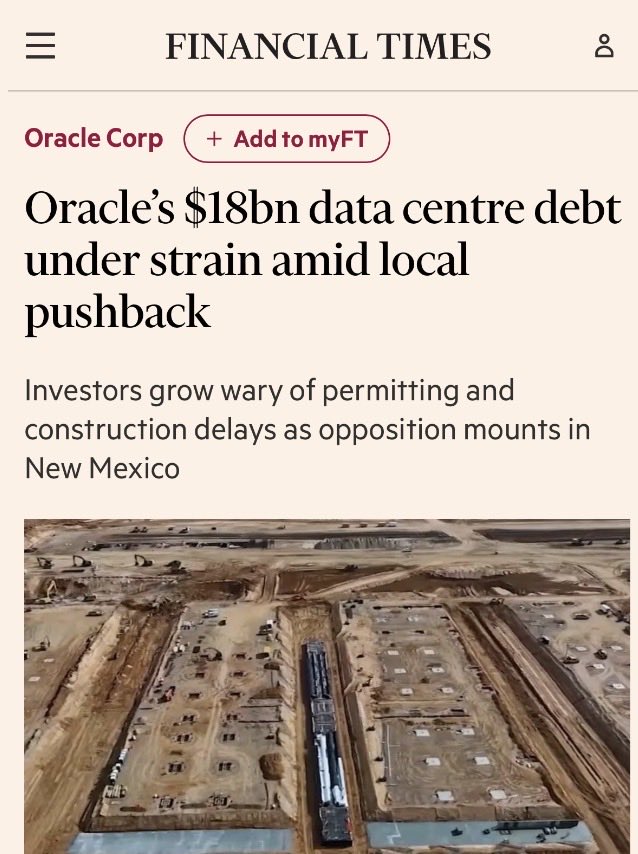
(FT) - About $18bn of loans tied to a data centre leased to Oracle in New Mexico slid into stressed territory on Friday, highlighting investors’ fear that increasing local backlash will derail the tech group’s massive AI infrastructure build-out.
$ORCL
https://t.co/1EIezznc7P