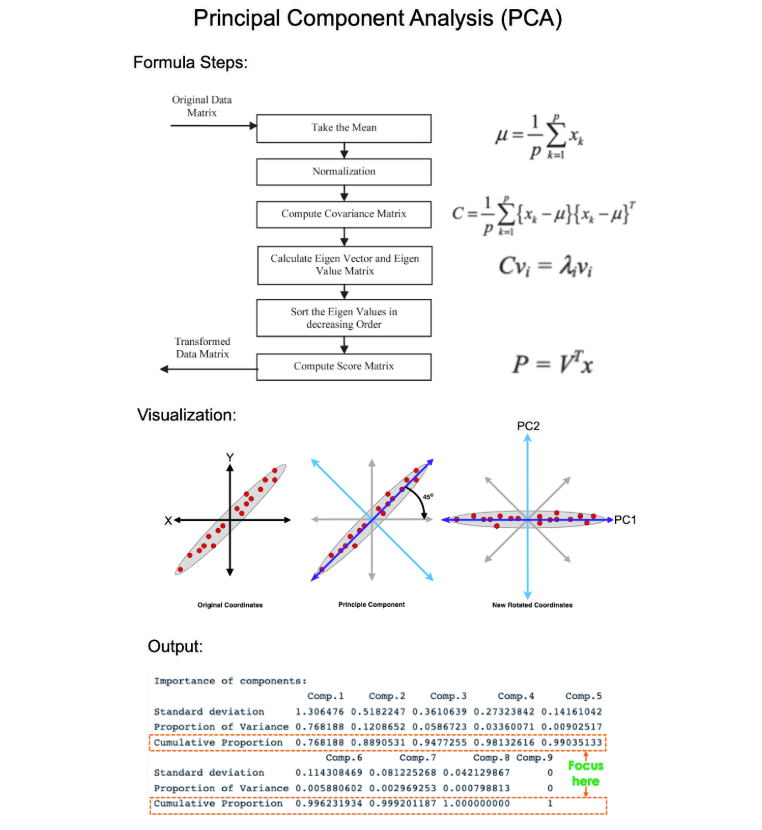
Principal Component Analysis (PCA) is the gold standard in dimensionality reduction.
But PCA is hard to understand for beginners.
Let me destroy your confusion:
Ça n'était qu'une idiotie qui consistait à réduire Manhattan à des immeubles que des compagnies étrangères seraient allées construire à New York.
La puissance de votre économie se mesurera- t-elle par le nombre de gratte-ciels que des architectes, ingénieurs, de mécaniciens, financiers, ouvriers, viendront, de chez les bailleurs de fonds, construire chez vous, ou bien par le nombre d'architectes, d'ingénieurs, de mécaniciens, financiers et d'ouvriers qualifiés que votre économie sera capable de former et de mettre sur le marché pour réaliser votre modeste urbanisme ?
Que les français, les chinois, les américains, les japonais, construisent milles routes, mille ponts, milles Tour F, mille ronds-points, qui portent tous vos illustres noms, ne fera pas de votre pays un pays développés mais juste une vitrine de ce que ces pays développés peuvent réaliser pour vous, chez vous, sans liens avec vos besoins et à vos frais. De vos bidonvilles de luxe ou de sicobois, vous admirerez leurs réalisations auxquelles vous serez toujours mal intégrés et qui vous poseront des problèmes de maintenance, d'entretien, de service après vente, que vous ne serez pas capables de résoudre par vous-mêmes.
Penser que Manhattan n'est qu'un ensemble d'immeubles, c'est comme reduire Wall Street à une avenue de quartier.
Une aberration dont on n'a pas encore fini de gérer les effets pervers.
Money has no intrinsic meaning.
A dollar bill is just paper. A bank deposit is just an entry on a balance sheet. Neither feeds you, clothes you, or shelters you. Their value comes from a network of social, legal, and political institutions that make them acceptable in payment.
The free banking story often treats money as though it emerged naturally from market exchange and should therefore be produced through market competition. But modern monetary systems do not work because money is valuable in itself. They work because debts, taxes, contracts, wages, and prices are all organized around a common unit of account.
Once you recognize that money is fundamentally a social relationship, the idea that it should be governed entirely by competitive private issuance becomes much less obvious.
The real economy is a web of obligations stretching across millions of households, businesses, and governments. Every financial asset is someone else's liability. Every balance sheet depends on countless others. The monetary system is not simply a marketplace for exchanging commodities. It is the accounting framework that makes complex economic cooperation possible.
The question is not whether money should be political. Money has always been political because it reflects the rules and institutions that structure economic life. The question is who gets to shape those rules, and whether the monetary system serves the broader public purpose or primarily the interests of private finance.
A new study by researchers from Carnegie Mellon University, the University of Oxford, MIT, and UCLA shows that even brief reliance on AI assistants can quickly impair independent problem-solving and reduce persistence.
In a series of large-scale randomized controlled experiments involving 1,222 participants tackling mathematical reasoning tasks and reading comprehension questions, those who used an AI assistant (powered by GPT-5) for roughly the first 10–15 minutes solved problems faster and more accurately while the tool was available.
However, when the AI was suddenly removed, their performance on subsequent independent problems dropped significantly — they solved fewer problems correctly and were more likely to skip or give up compared to participants who never had AI access.
The researchers describe this as a "boiling frog" effect: by outsourcing the hard work of reasoning, people miss the beneficial mental friction needed to strengthen cognitive skills and persistence. These impairments emerged rapidly and were especially pronounced among those who used the AI for direct answers rather than hints or explanations.
To gain AI’s productivity benefits while protecting your cognitive sharpness, experts recommend deliberately engaging your brain first by attempting to solve the problem independently for five to ten minutes before turning to AI. When you do use a chatbot, ask it to explain its reasoning step-by-step, then summarize or re-derive the solution yourself instead of blindly copying the output. Embracing this cognitive struggle is key, because the mental friction of figuring things out is precisely where real skill development and long-term learning happen.
[Liu, G., Christian, B., Dumbalska, T., Bakker, M. A., & Dubey, R. (2026). AI Assistance Reduces Persistence and Hurts Independent Performance. arXiv:2604.04721]
Inflation, inflation !... Le FMI demande aux banques centrales de relever les taux d’intérêt. Erreur : des taux plus élevés ne baisseront pas les prix du carburant ou des engrais... Mon petit texte sur la question, disponible en plusieurs langues @ProSyn https://t.co/RETg4W976y
Les barrières douanières ont été l'un des facteurs clé ayant contribué à l'autosuffisance en production de viande de volaille en Côte d'ivoire.
Une inflation passagère avec à terme une baisse du taux de chômage et un renforcement de la balance des paiements sont plus bénéfique.
6/7. La vraie tension 👇
Protéger le riz local par des barrières douanières… au risque de frapper le pouvoir d'achat urbain ?
Ou importer moins cher et investir nos devises ailleurs ?
Pas de réponse simple à mon avis.
VICTOIRE !
Nous venons de voter à l'Assemblée la nationalisation d'ArcelorMittal !
C'est une immense avancée pour les travailleurs dont l'emploi sera sauvé, et pour la souveraineté de la France.
Les macronistes sont battus. La fête est finie : nous ne laisserons plus des grands groupes étrangers piller notre industrie et détruire nos savoirs-faire.
A key idea in Chinese statecraft since ancient times is that the state has a responsibility to stabilize inherently unstable markets for essential commodities (see How China Escaped Shock Therapy). Public stockholdings like the ever normal granary participated in the market buying when prices are low and selling when prices are high for centuries with the goal of stabilizing supply and demand, prices and ultimately the value of money.
Now China is doing just that with the global oil market: It has drastically reduced its imports, hence pushing down demand in a time of global supply shortages. This is possible thanks to massive public reserves and strategic redundancy (some like to call this “overcapacity”). @JavierBlas finds that the number one reason why oil prices have not shot above USD 100 is China, China and China.
Imagine how much more stability the world could enjoy, if all countries engaged in such buffer stock stabilization for essentials such as grain. I have been calling for this at the G20 food security task force last year (see link below).
You have noticed it. ChatGPT feels dumber than it used to. Your prompts that worked six months ago produce worse results now. The writing sounds flatter. The ideas sound safer. The internet itself feels like it is shrinking. Every article reads the same. Every email sounds the same. Every answer sounds like it was written by the same voice.
You thought it was you. It is not you.
Researchers at Oxford and Cambridge published a paper in Nature proving what is happening. They call it Model Collapse.
Here is the mechanism in one sentence. AI trained on AI-generated data gets dumber every generation until it forgets what real human data looked like.
The internet is filling with AI-generated content. Blog posts. Articles. Reviews. Comments. Social media. AI companies scrape the internet to train the next generation of models. Which means the next generation of AI is being trained on the output of the current generation.
Each cycle loses information. Not randomly. It loses the rarest, most unusual, most creative parts first. The researchers call these the "tails of the distribution." The weird ideas. The unexpected perspectives. The things that made the internet feel human. Those disappear first.
What remains is the average. The safe. The expected. The bland.
Then the next generation trains on that. And loses more. And the next generation trains on that. And loses more. The researchers proved this is not a slow decline. Major degradation happens within just a few iterations. Even when some of the original human data is preserved.
They tested it on large language models. On image generators. On statistical models. The pattern was the same every time. The output converges toward a narrow, flattened version of reality that looks nothing like the original data.
The lead researcher put it plainly. "Large language models are like fire. A useful tool. But one that pollutes the environment."
The pollution is invisible. You cannot see which sentence on the internet was written by a human and which was written by AI. Neither can the AI that is about to train on it. And once the tails are gone, they do not come back. The damage is irreversible.
This is not a prediction anymore. It is a diagnosis.
The internet you grew up on was built by humans writing things no algorithm would have written. Strange, personal, imperfect, alive. That internet is being diluted. One generation of AI at a time. And the models trained on what remains are learning a smaller and smaller version of the world.
Model Collapse is not a technical problem. It is a cultural one. The thing that made the internet worth reading is the thing that disappears first.
"Governments and central banks were quietly admitting something they were still reluctant to announce publicly: the extraordinary power of private-sector banks lending to determine the pace of money creation, and therefore economic growth."
-Mariana Mazzucato
Le ministre ivoirien de la Transition numérique, Djibril Ouattara, a annoncé le déploiement de Starlink dès juillet 2026,
La signature récente d'un arrêté autorise la société Starlink, filiale de SpaceX, à déployer ses services de connectivité par satellite sur l'ensemble du territoire ivoirien dès le mois de juillet 2026.
Cette autorisation d'une durée 12 mois permettra de finaliser l'octroi définitif de la licence à l'issue de cette période d'essai.
Le montant final de la licence sera ajusté en fonction des revenus générés, tout en veillant scrupuleusement au maintien d'un équilibre concurrentiel sain avec les opérateurs historiques déjà établis.
Malgré tous les efforts déployés par le Président pour consolider cette dynamique positive, certains individus sont prêts à tout saboter, uniquement pour se remplir les poches. Ils se moquent éperdument des conséquences néfastes sur la politique sociale et l’avenir du pays.
Tant que Boua ne les sanctionnera pas fermement, ils persisteront dans cette logique destructrice. Pour eux, rien ne compte plus que l’argent qui rentre dans leurs poches. L’avenir de la Côte d’Ivoire ? Ils s’en battent complètement.
Qui sont ceux qui ont laissé une telle situation arriver ?
Mémo sur l’arrêt brutal des opérations de refinancement des crédits de moyen terme par la BEAC.
Les médias peuvent le publier sans solliciter d’autorisation.
China cancels high-level meetings with EU
Abrupt scrapping of two sets of planned talks in Beijing comes as tensions grow between trade superpowers
https://t.co/zNH2apIiRX






![Rainmaker1973's tweet photo. A new study by researchers from Carnegie Mellon University, the University of Oxford, MIT, and UCLA shows that even brief reliance on AI assistants can quickly impair independent problem-solving and reduce persistence.
In a series of large-scale randomized controlled experiments involving 1,222 participants tackling mathematical reasoning tasks and reading comprehension questions, those who used an AI assistant (powered by GPT-5) for roughly the first 10–15 minutes solved problems faster and more accurately while the tool was available.
However, when the AI was suddenly removed, their performance on subsequent independent problems dropped significantly — they solved fewer problems correctly and were more likely to skip or give up compared to participants who never had AI access.
The researchers describe this as a "boiling frog" effect: by outsourcing the hard work of reasoning, people miss the beneficial mental friction needed to strengthen cognitive skills and persistence. These impairments emerged rapidly and were especially pronounced among those who used the AI for direct answers rather than hints or explanations.
To gain AI’s productivity benefits while protecting your cognitive sharpness, experts recommend deliberately engaging your brain first by attempting to solve the problem independently for five to ten minutes before turning to AI. When you do use a chatbot, ask it to explain its reasoning step-by-step, then summarize or re-derive the solution yourself instead of blindly copying the output. Embracing this cognitive struggle is key, because the mental friction of figuring things out is precisely where real skill development and long-term learning happen.
[Liu, G., Christian, B., Dumbalska, T., Bakker, M. A., & Dubey, R. (2026). AI Assistance Reduces Persistence and Hurts Independent Performance. arXiv:2604.04721]](https://pbs.twimg.com/media/HLBPB9_W4AAKUQF.jpg)


