In-house lawyer, art and travel lover, amateur photographer, geopolitical fanatic, fond of cinema and architecture, father and husband, and others more
@rodrigochimico Non ho letto il post ma il mondo delle professioni è molto cambiato nel tempo.. più concorrenza, ingresso sul mercato dei grandi player, tracciabilita’ dei pagamenti, clienti meno propensi alla spesa. Anche il costo della vita non è più lo stesso di 30 anni fa’.
Israel’s lesson from October 7 is that intentions do not matter—only capabilities do. For years, the IDF ignored the terror monster rising on its borders and instead focused on whether the enemy intended to attack or whether it was in its interest to do so. Similarly, although it is tempting to dwell on sentiments in Tehran, it is irrelevant. The only question is whether Iran currently has the capability to pose a real threat to Israel. The answer, after 40 days of war, is: less than it did forty days ago.
In practical terms, Iran promised it would not sign a temporary ceasefire—and it did. It said the Strait of Hormuz would not reopen—and it reopened. It swore to include ending the war in Lebanon—and Hezbollah suffered hundreds of casualties yesterday. This is what remains of the Iranian axis that once cast fear across the Middle East.
The Iranian “victory image,” encouraged by broad segments of the international media, arguesthat Iran survived ten rounds against the heavyweight world champion and lives to tell the tale.
The question is what that survival is worth.
Hezbollah Secretary-General Hassan Nasrallah used the draw with Israel in the 2006 Second Lebanon War to receive a blank check from his Iranian patrons and build a formidable axis of resistance. What will Iran now do with this sense—real or fabricated—of survival?
After Operation Rising Lion, every available Iranian rial was invested in rebuilding the ballistic missile array, seen as the only answer to Israel. The result was a relatively quick recovery, but also enormous public anger that was suppressed only at the cost of massacre. Now there is much to rebuild and far fewer rials: should Iran buy a new navy? an air force? invest in missiles? rebuild Hezbollah, which is groaning under a heavy deficit? or invest domestically to calm a population whose situation has only worsened? The condition of the former Iranian empire is dire, and there are no signs of improvement on the horizon.
The Gulf states that were attacked by Iran have not forgotten the lesson. They are not Israel, accustomed to rounds of fighting every year or two. Generations of Emiratis, Qataris, and Saudis will carry the trauma of running to unprotected spaces while tourism, stability, and energy went up in flames. Israel stands to gain greatly from this anti-Iranian coalition, which was effectively forced off the fence and is unlikely to return to it soon. One can hope that Trump and Netanyahu are tying the Gulf states into a more stable and public alliance, for the benefit of future generations.
The (temporary?) end of the war also marks the opening of the Knesset election campaign. Netanyahu, who hoped to ride the fall of the Iranian regime all the way to preserving his rule in Israel, now faces a more complex task than he expected when launching the operation.
There is a sense of sourness among the public over the gap between hopes of toppling the regime and the mid-war outcome. The bigger challenge is on the northern border, where public sentiment is harsh—and rightly so—after promises that Hezbollah had been defeated. Opposition leaders have identified this well and competed with one another in describing what they call a disgraceful historic failure, hoping voters will connect more with that than with Netanyahu’s promises of total victory. For the prime minister, toppling Iran in the coming months is a task of supreme importance not only strategically, but also for his political survival. Everyone hopes the Iranian regime will fall soon; Netanyahu would be glad if it falls, if possible, before October 27.
I received this heartbreaking message from a Jewish professor at @UAntwerpen, who is leaving both the city and the university after four decades. I can hardly express how deeply this saddens and enrages me—especially in light of last week’s craven and disgraceful charade surrounding the honorary doctorate of @FranceskAlbs.
"After fifty years living in Antwerp and forty years at the University of Antwerp as student, assistant and professor, I’m leaving. I no longer feel at home in the city and feel completely estranged from my university that has become a hotbed of radicalism and has completely lost its sense of academic values of critical thinking, discussion and genuine diversity of viewpoints. I fear that the student generation that – with the support of the university authorities - has now become indoctrinated and brainwashed to a point of no return. My son who was born and raised in Antwerp and who wears a kippa, has been called a child murderer on the street by a Flemish person and was told to “get out of here”. At the university the students are shouting that Jews should get out of Palestine. He and his family are leaving too. It just became a bad place for Jews."
This is on you, rectors. You have made universities into hostile places for Jews (unless they ritually denounce zionism and Israel). They will abandon you and take all their learning, knowledge and wisdom with them.
And don't worry, @UGent, you have scarcely any Jewish professors left to begin with. The great Jewish linguist and classicist Julien Klener has long since retired. When I met him recently, he told me how relieved he is not to have to endure this ideological madness anymore.
A father in Iran is waiting to be hanged.
His family is terrified but they cannot even speak because the regime shut down, the internet and they have no media inside Iran.
His name is Abolfazl Salehi Siyavashani and his “crime is simply Wanting to have a normal life. A free Iran.
Now the regime is preparing to execute him. Maybe tomorrow, maybe this week.
Iranian feel helpless because we don’t know how to #StopExections.
To those claiming Iran will come out on top if the war ends this very minute, below is the counter:
1. Iran lost Khamenei and its top political operators. Leadership matters. Baby Khamenei will inherit a far weaker hand than his father did.
2. Iran lost massive war machinery, matériel, and infrastructure.
3. Iran's aura of invincibility was shattered. Iran’s regional strikes were nowhere near the doomsday scenario it had long threatened. Fewer than 10 percent of Iranian projectiles penetrated air defense to hit targets. No World War III.
4. If regime survives post war popular outrage, it will face even tighter sanctions and total isolation, far worse than before the war.
5. The Strait of Hormuz card proved weak. Closing it mainly hurt Iraq, Kuwait, and Qatar, who will now start expanding capacity of their overland alternative routes. Even if Iran tries to control Hormuz (which will require its violation of any ceasefire), alternative routes will make the strait irrelevant.
Bottom line: The “regime prevails, gets more radical, and closes Hormuz” narrative is pure regime-supporter spin in Western media, sort of war propaganda on behalf of Tehran. In reality, Iran is being beaten badly, physically and morally.
In the middle of war, in Iran, at dawn, at the call to prayer, they took a 68-year-old architect from his cell to the gallows and executed him.
This is how they rule Iran: they cut the internet. They torture political prisoners to do false confessions. They air it on state TV. They execute them. Then they announce it on state media.
We Iranians are living in horror and it is beyond sad that international media barely talks about it. I believe this silence will embolden the regime to turn mass arrests into mass executions.
His name was Abolhassan Montazer, and he had heart and lung disease. They denied him medicine.
Heartbreaking 💔
This morning, right after President Trump’s speech, the Iranian regime moved fast and hanged 18-year-old protester.
Yes, Mr. President @realDonaldTrump, there are no “less radical” leaders in Iran.
From the courtroom to the prison cell, from the interrogator to the judge, this is a unified system of terror. So this is the Islamic Republic: a system with a Stone Age approach to dissent, executing its own young people to stay in power.
This is not about left or right.
This is about life, dignity, and the future of a nation.
His name is Amirhossein Hatami. 18 years old. His “crime”? Demanding Freedom, dignity, and a normal life.
No lawyer. No independent media to be his voice, No fair trial. No final goodbye to his family. But of course a forced confession on State TV after being tortured to admit a crime that he has committed never committed.
And his friends may be next.
By the way, where are the anti-war activists?
Why don’t we hear you campaigning against mass arrests, and executions in Iran ? Would you demand that the Iranian regime stop its war on unarmed people?
Stop the executions.
Stop the torture.
End the total #DigitalBlackOut imposed on Iran.
This is about standing with the people of Iran against a regime that has massacred more than 40,000 of its own citizens and is now killing those arrested in the same uprising
Al Jazeera is now running the headline "The US-Israeli strategy against Iran is working."
Prof. @MuhanadSeloom argues that despite what the skeptics are understandably worried about, "When you look at what has actually happened to Iran’s principal instruments of power – its ballistic missile arsenal, its nuclear infrastructure, its air defences, its navy and its proxy command architecture – the picture is not one of US failure. It is one of systematic, phased degradation of a threat that previous administrations allowed to grow for four decades."
He adds, perhaps to head off the naysayers who'll write him off as a "Zionist," "I have worked for the US Department of State and advised defence and intelligence agencies in multiple countries. I have no interest in cheerleading for war.
"But I have spent my academic career studying how states authorise the use of force through intelligence institutions, and what I see in the current campaign is a recognisable military operation proceeding through identifiable phases against an adversary whose capacity to project power is collapsing in real time."
Prof. Seloom is right. This is a well-planned war with clear objectives. And most of the people saying otherwise are confusing what's happening in 2026 with their desire to relitigate Iraq in 2003.
But more interesting than the professor's arguments is the simple fact that Al Jazeera now feels free to publish this sort of thing, that Qatar is tentatively dipping a toe into this new narrative.
In other words, that Qatar now calculates that the war might just succeed.
https://t.co/9e1sO7zrSy
Many times I have tried to explain that Russia has gained a lot of experience over the four years of the full-scale invasion: knowledge of the battlefield, new technologies, experience in prolonged land warfare, and military industrial base.
I always emphasized that this would have an impact on other regions: Africa, the Middle East, Europe, and other regions. Because Russia has interests in the Middle East. It used to be an ally of the former Syrian regime and still one of the current Iranian regime. They have mutual interests with North Korea – they are allies. They have interests in Europe, like undermining the unity of the EU.
Now we can see that even under attack the Iranian regime is fighting back. Countries in the Middle East are not fully prepared to repel such massive attacks. This is what I'm trying to get across – to stop Russia means stopping many different wars.
From an interview with i24NEWS and Jerusalem Post (3/3).
Ho l’impressione che l’Italia sia fondamentalmente per il #No. Ma non solo su questo referendum.
Siamo per il No al cambiamento in qualsiasi settore.
Da questo punto di vista siamo il paese più conservatore d’Europa.
Troviamo sempre una ragione per non cambiare: la giustizia, la scuola, il regionalismo o per non fare investimenti infrastrutturali ed energetici.
Questo conservatorismo è trasversale alla destra e alla sinistra che sono normalmente immobili in attesa che l’altra parte faccia “l’errore” di proporre qualcosa.
Da questo stallo dobbiamo uscire se vogliamo sopravvivere e diventare qualcosa di più di una meta turistica.
#MajidKavousifar prima di essere impiccato dal regime di #Teheran ha notato il suo nipotino tra la folla:gli ha lasciato un sorriso, bellissimo,prima di morire.
Fate vedere questa foto a chi oggi parla di attacco indiscriminato e fascio genocidiario.
Non provo alcuna tristezza.
Assad, Maduro, and now Khamenei. Putin has lost three of his closest pals in little more than a year. He has also not helped any of them.
This dynamic proves three things.
First, Russia is not a reliable ally even for those who rely heavily on it.
Second, while Russia is stuck in its senseless war against Ukraine that it will never win and refuses to end, its influence across the world is dramatically falling.
Third, the domino of deposed dictators must continue, and Putin’s fall one day is inevitable. Together, we must make every effort to bring this joyous day closer and ensure accountability for all Russian crimes. The justice is inevitable.
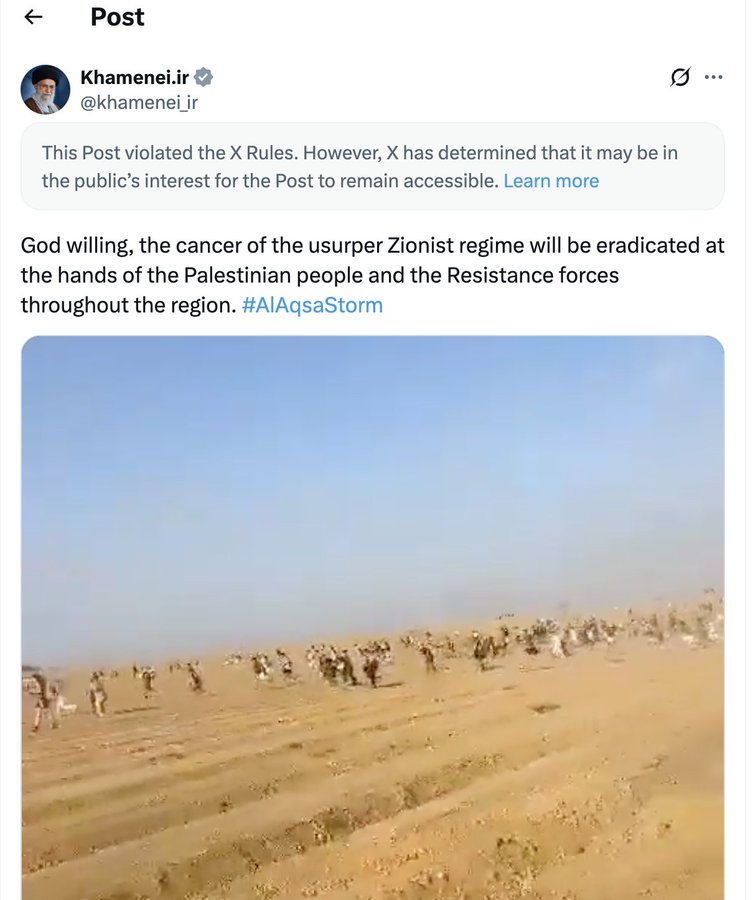
October 7, 2023.
The Iranian regime's proxy army in Gaza had just invaded Israel to burn families alive in their homes and seize hostages as sex slaves.
And Ayatollah Ali Khamenei tweeted joyously that "God willing" Israel would be "eradicated" soon.
Karma is a bitch.
Parlate di diritto internazionale con la calma di chi non ha mai dovuto seppellire un figlio.
Citate trattati, articoli, equilibri geopolitici.
Ma dimenticate l’unico diritto che conta per chi vive sotto un regime: quello di essere libero.
Il popolo iraniano non discute di protocolli.
Discute di sangue versato.
Di ragazze uccise per un velo.
Di giovani impiccati per aver chiesto dignità.
I massacri di gennaio non sono una nota a piè di pagina.
Sono una ferita aperta.
Chi oggi si rifugia nelle formule del diritto, ignorando il diritto degli iraniani alla libertà, sta scegliendo la neutralità davanti alla repressione.
E la neutralità, davanti alla tirannia, non è equilibrio.
È complicità.
Siamo al fianco del popolo iraniano. Senza se. Senza ma.
#FreeIran2026
Macron, in una recente intervista, lo dice senza giri di parole: gli Usa ci colpiranno sulla regolamentazione digitale.
Per il presidente francese non è un'ipotesi, è ormai una certezza. E l'UE chiedendo di rispettare il Digital Services Act, deve attendersi una risposta che si traduce in maggiori dazi.
Si tratta di passaggio importante da evidenziare, perché di fatto pone la questione digitale sul piano geopolitico che è quello che ormai molti sostengono.
Ma guardiamo i fatti.
A dicembre la Commissione UE ha inflitto a X la prima multa della storia del DSA. 120 milioni di euro per il design ingannevole delle spunte blu e per l'opacità nella gestione della pubblicità.
Pochi giorni fa è toccato a TikTok, con una contestazione formale sul design che crea dipendenza. Scroll infinito, autoplay, notifiche push, algoritmo di raccomandazione. Funzionalità pensate per tenere gli utenti incollati allo schermo, con effetti particolarmente problematici sui più giovani.
E proprio ieri la Commissione ha accusato Meta di abuso di posizione dominante su WhatsApp. Da gennaio, infatti, l'unico assistente AI disponibile sulla piattaforma è Meta AI. Tutti gli altri, da ChatGPT a Copilot a Perplexity, sono stati esclusi.
Tre piattaforme, tre provvedimenti. Un filo conduttore che li tiene insieme, ossia la questione di chi decide cosa vediamo, come interagiamo e con quali strumenti possiamo lavorare.
Una questione che tocca il tema degli algoritmi, degli interessi di chi controlla la piattaforma. E quando il proprietario è anche fornitore del servizio che vuole promuovere, come nel caso di Meta AI su WhatsApp, il conflitto diventa strutturale e si sconta con le regole.
Macron parla di "momento Groenlandia" come occasione per svegliare l'UE.
Senza giri di parole sostiene che di fronte ad una aggressione non ci si deve inchinare, "o provare a raggiungere un accordo". È arrivato quindi il momento di mettersi all'opera.
La vera sveglia forse dovrebbe suonare sul digitale, dove la dipendenza dalle piattaforme americane è quotidiana e capillare. Ed è necessario che a livello UE ci si adoperi per un grande piano di costruzione di infrastrutture digitali a sostegno di un grande piano di sviluppo digitale.
Questo per farci trovare pronti quando arriverà il momento.
I’m curious to understand which AI tools people actually rely on day to day, not just for demos or experimentation: which AI resource has proven the most useful in real life? I’d love to hear why in the comments