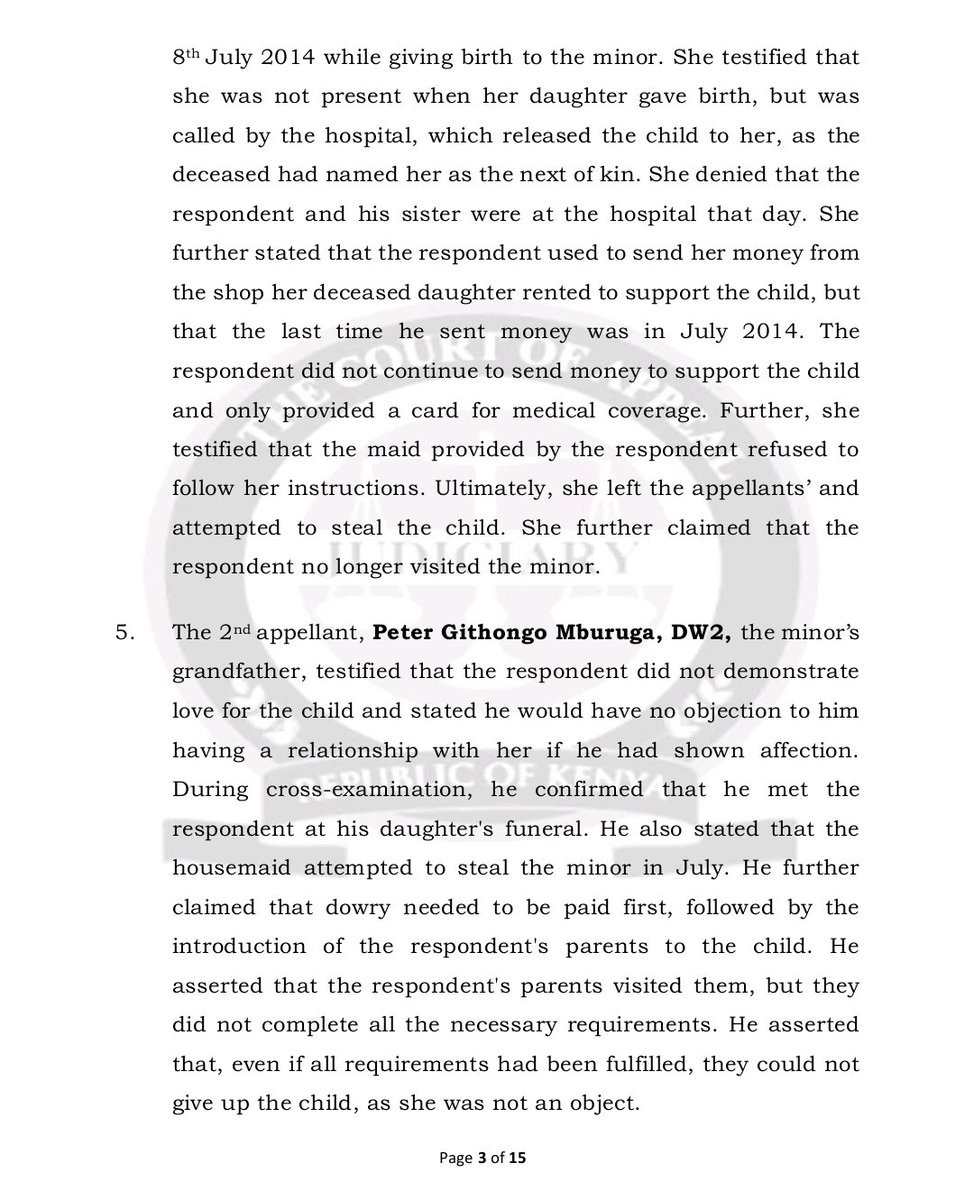
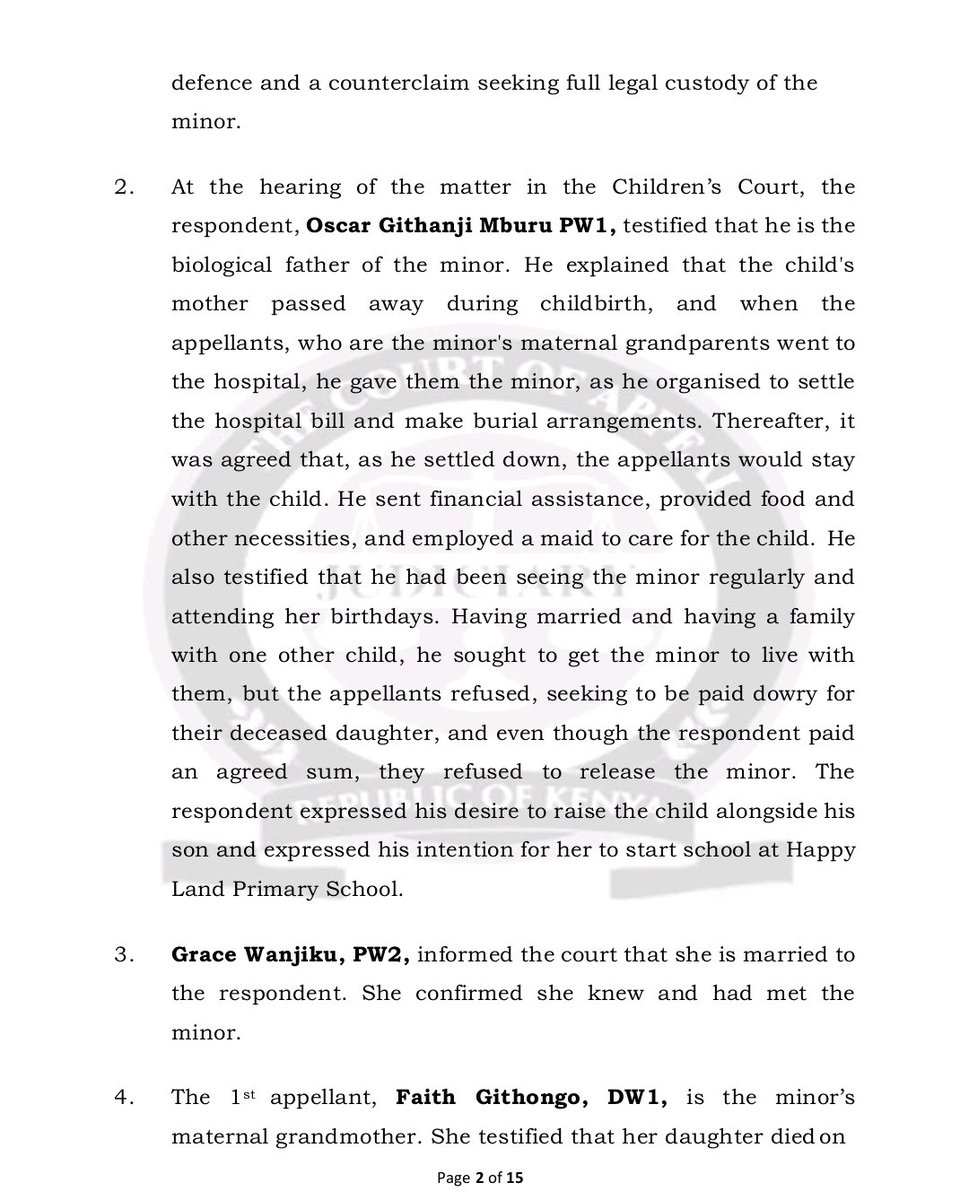
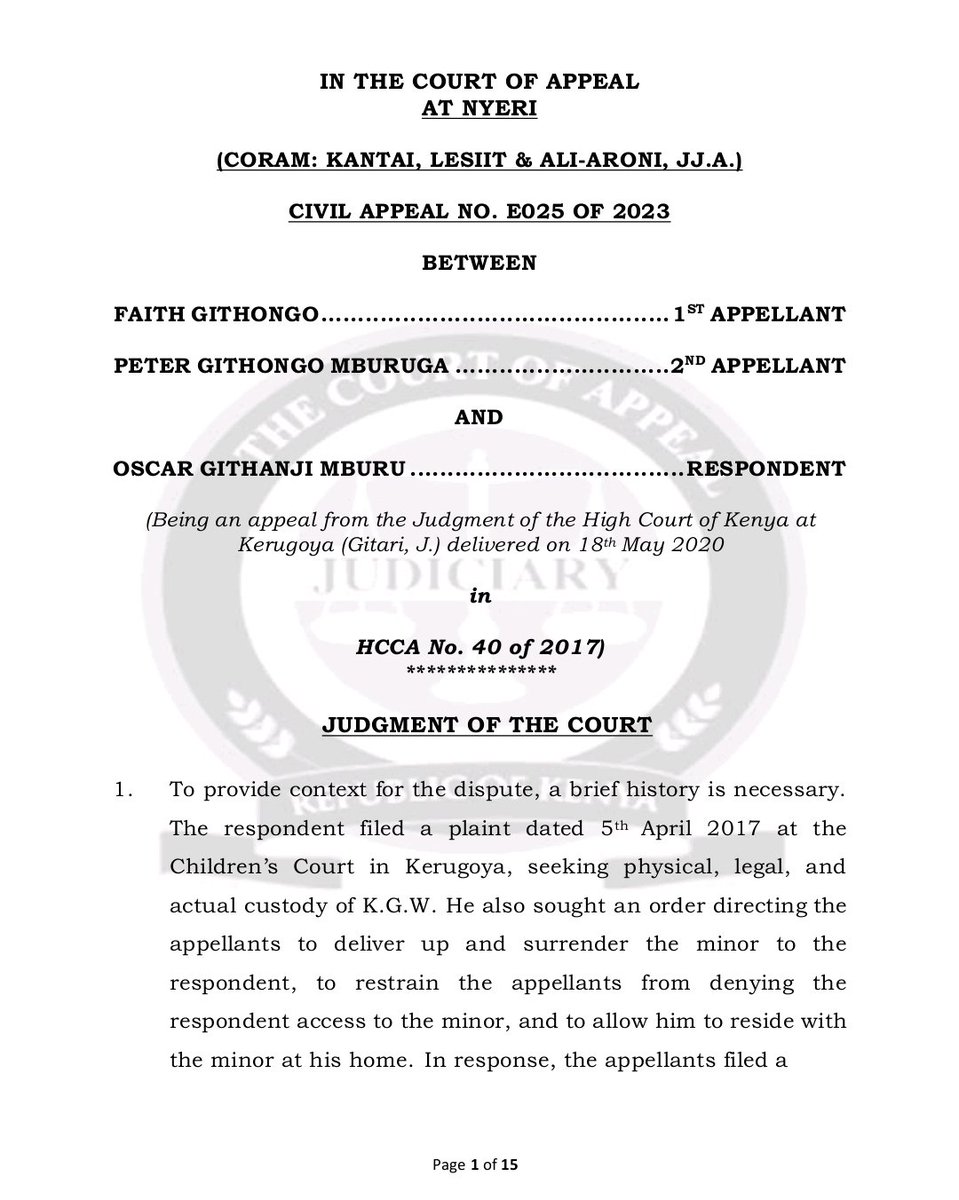
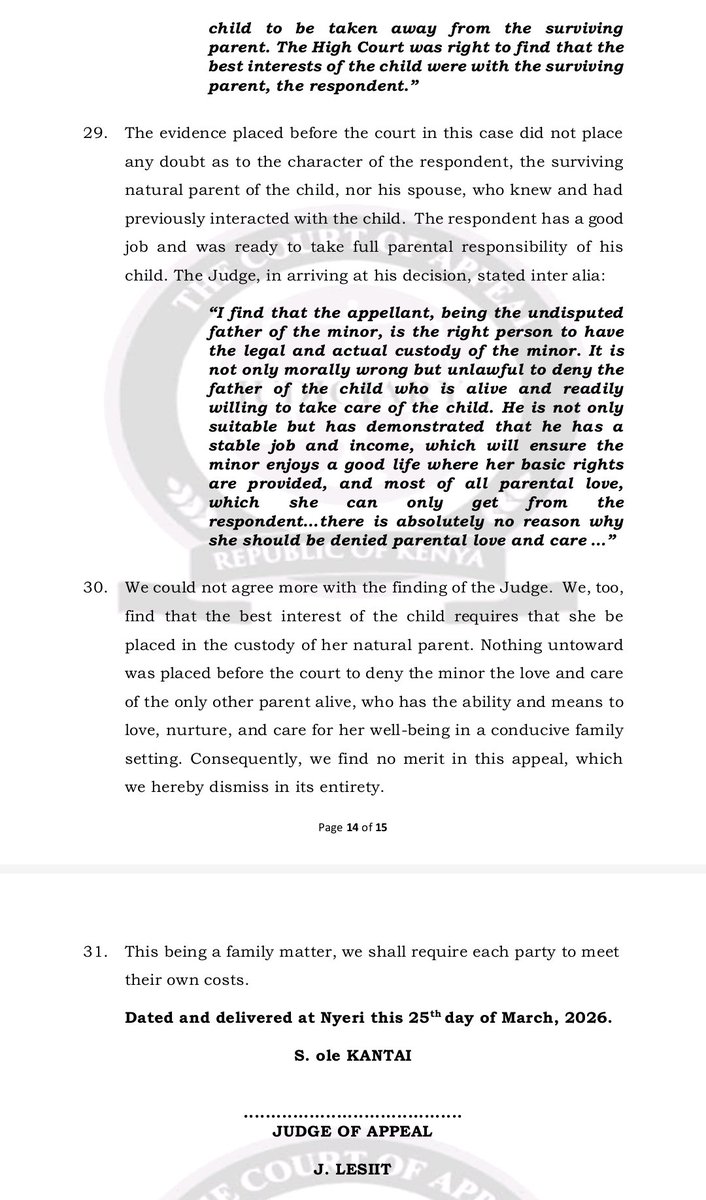
The Court of Appeal has held that you cannot keep a child away from their parent. In this case, the court made it clear that parental rights especially of a surviving biological parent cannot be overridden by customs. The father had shown willingness, ability, and commitment to raise his child and there was no evidence that he was unfit. The grandparents’ refusal to release the child, largely based on cultural demands like dowry, was found to be contrary to the child’s best interests.
Ultimately, the court emphasized that a child has a constitutional right to parental care, and that right takes priority over all other considerations. While the grandparents had cared for the child, the law is clear the natural parent comes first unless there are exceptional circumstances. Denying a child the love, care and upbringing of a capable parent is not just unfair, it is unlawful.
A registered land title is generally conclusive proof of ownership but not if obtained through fraud.
The Court ruled that protection is lost if the transferee is not a bona fide purchaser for value without notice.
Vivo’s title was cancelled. Original owners protected.✅
On adverse possession
...
One must prove non permissive, non consensual, actual, open, notorious, exclusive and adverse use of land within the prescribed statutory framework.
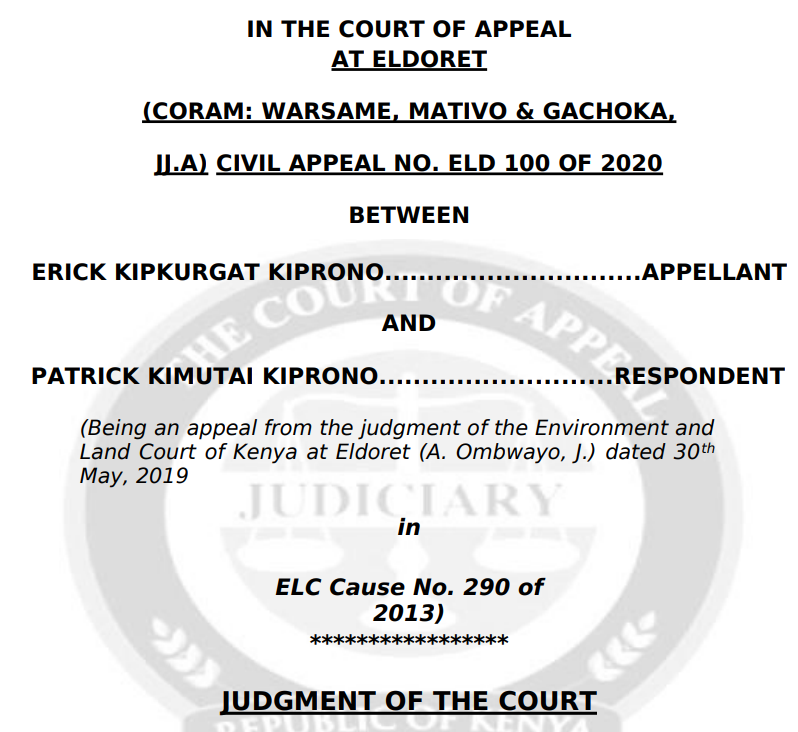
🚨🚨 BREAKING: COURT OF APPEAL DECLARES - A TITLE DEED CANNOT DEFEAT A PROVEN TRUST
In Erick Kipkurgat Kiprono v Patrick Kimutai Kiprono, the Court of Appeal has sent shockwaves through land ownership disputes after ordering a registered landowner to surrender half of land he held solely in his name. The dispute traces back to around 2000 when two parties allegedly agreed to jointly purchase 10 acres from Lonrho Agribusiness for KSh 350,000. Because one party worked in Nairobi, the other handled the transaction. The sale agreement expressly stated the purchaser was acting as agent for both and even allocated 5 acres each in the schedule. However, when the title was eventually issued, the entire land was registered in only one name. When the excluded party later demanded his share, the registered owner flatly denied any joint purchase, contribution, or trust.
The Court of Appeal was not convinced. After re-evaluating the evidence, the judges found the intention to jointly own the land was not speculative; it was written into the very sale agreement used to obtain Land Control Board consent. Testimony from the attesting advocate, the vendor’s lawyer, and the vendor’s representative all confirmed the joint purchase. The Court emphasized that a trust will be implied where parties’ intention is clearly established, and that equity will not allow a registered proprietor to approbate and reprobate by relying on the same agreement to obtain title while denying the beneficial interest recorded in it. Crucially, the Court held that the Land Control Act could not be used as an instrument of fraud where consent had already been obtained on the basis of a disclosed joint interest.
For the ordinary mwananchi, this decision is a serious reality check. Many people believe the name on the title deed is the end of the story, it is not. If evidence shows land was bought jointly or one party acted as agent for another, courts can and will slice through the register and enforce a trust. What many are not ready for is this: informal family arrangements, handshake land deals, and “weka kwa jina yako kwanza” transactions are legally dangerous. Going forward, anyone entering joint land purchases must document contributions clearly and align registration with the true intention; because in today’s Kenya, the courts are increasingly willing to look beyond the title and follow the money and the intention.
Kindly retweet widely.
@georgediano@Thuranira_1@DavisThuranira@joshuamalidzo@NelsonHavi Iran #NunuaGariUsijenge #MainaAndKingangi World Wildlife Day #UsalamaBarabarani Road Safety Reforms Trump Kuwait Wamuthende Dubai
Question - Can a third party be liable for contempt of court?
In Israr Ahmed Khan v. Amarnath Prasad (2026), the Court held that contempt is not confined to the parties on record. If a person or authority becomes aware of a judicial order and knowingly aids, enables, or contributes to its non-compliance, that conduct itself can attract contempt.
The test is simple:
• Knowledge of the order
• Deliberate inaction or assistance in disobedience
• Conduct that frustrates implementation
Party status is irrelevant.
What matters is whether your actions undermine the authority of the Court. The bench also reiterated that contempt jurisdiction is not a forum to question the correctness or feasibility of the original judgment. If an order is impracticable, the remedy is clarification, modification, or appeal and not non-compliance.
In this case, even senior officials who were not original parties but were aware of the order and part of the implementation chain were found prima facie liable.
Thus, once you know of a court order, you cannot stand aside and watch it being defeated 😬
BIG NEWS: The Court of Appeal is fully paperless - from filing to delivery of decisions. You can follow proceedings virtually from the comfort of your home. From today to Thursday, 12 courts have been mounted across the country to hear 406 appeals & applications - all virtually.
🔴🚨GROUNDBREAKING DECISION: EVER BEEN LOCKED OUT OF A JOB APPLICATION BECAUSE OF YOUR AGE? THE COURT CALLED IT ILLEGAL.
In Jared Juma v Kenya Broadcasting Corporation & Others [2014] KEIC 149, the Industrial Court confronted a recruitment practice many Kenyans quietly accept as normal. KBC advertised the position of Managing Director with a hard age cap: not more than 45 years old. No law required it. No regulation justified it. Still, the Board enforced it. The Court was clear. When a public body limits access to employment without a legal basis, it is not “policy”. It is discrimination. The Constitution does not tolerate silent exclusions disguised as job requirements.
The Court went further than merely condemning the age limit. It dismantled the excuse often given by public institutions that “the Board has discretion”. Discretion, the Court held, is not absolute. It must be reasonable, proportionate, and consistent with Article 27 of the Constitution. By fixing an arbitrary age ceiling, KBC excluded competent, qualified Kenyans without justification, failed the test of reasonableness, and violated the minimum core of equality. The recruitment was therefore declared unconstitutional and null and void. The message was blunt: public employers cannot invent barriers the law itself does not recognise.
This decision still matters today because the practice never stopped. Age caps, vague criteria, silent exclusions, and tailored adverts remain common across state corporations and public bodies. This case confirms that such practices are legally vulnerable. If a job requirement has no statutory backing and unfairly locks you out, courts will strike it down. Public offices are not private clubs. Merit must be real, competition must be fair, and discretion must bow to the Constitution. The law has already spoken. Many institutions just hope you don’t listen.
Reach us today via [email protected], for quick action.
Kindly repost widely.
For those joining KSL next year, lemme dump a few google drive folders we put together in our year:
DRIVE 1- (MKO): https://t.co/e8U4e1309R
DRIVE 2- https://t.co/89Ixxy1KW0
DRIVE 3- https://t.co/yhN7Ty1e2i
DRIVE 4- https://t.co/nQlv4g8ZKM
May 9Ps be with you.
#SeniorCounsel#KabarakPride
Today, we celebrate our Senior Lecturer, Elisha Z Ongoya, on his conferment as Senior Counsel—a mark of distinction in scholarship, principled leadership, and transformative litigation.👏
His impact & unwavering commitment to justice are unmatched.
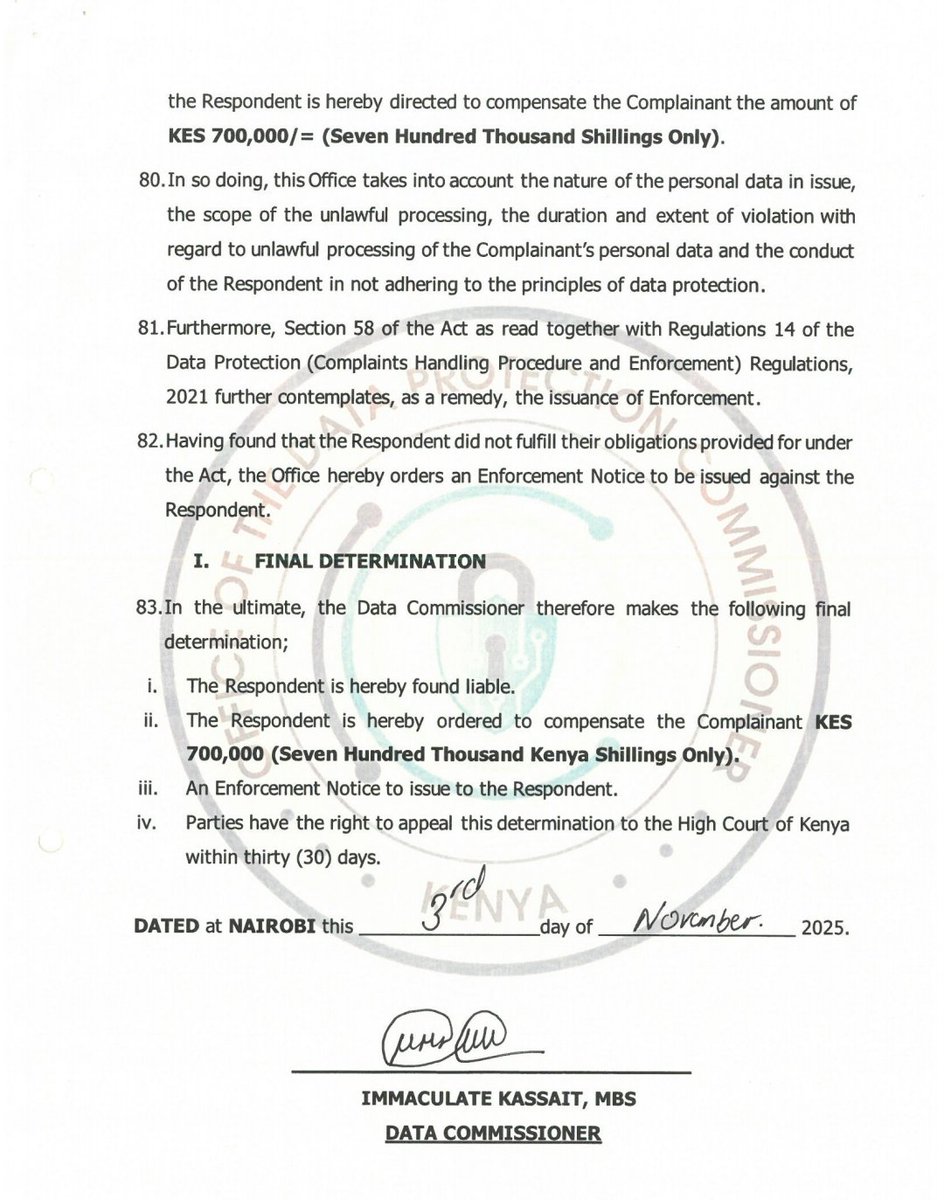
An employer has been ordered to pay Ksh 700,000 for recording an employee's phone call.The employee refused to consent and was promised the recording would be deleted, but it was kept for a year, shared with a sister company, and used in unrelated arbitration. The ODPC ruled this a clear violation of data protection laws.
Recording employees' phone calls without proper consent or using data for other purposes is illegal. Vague notices, broken deletion promises, and “just in case” recordings can now cost you dearly.
🚨🚨That Habit of Police Arresting Everyone at the Scene? Court Just Ruled It Can’t Stand in a Courtroom.🙌
The Court of Appeal in Asili v Republic [2025] KECA 2010 has just shaken a belief most Kenyans treat as gospel: that if police recover stolen items anywhere near you, you must be the thief. A man who had been sentenced to death for robbery with violence walked free after the Court found that the prosecution had built the entire case on assumptions disguised as evidence. The only link between him and the crime was that he happened to be inside a house where stolen goods were recovered. That’s it.
The Court did not mince words. You don’t convict a person simply because they were standing next to stolen property. For the doctrine of recent possession to nail you, the law requires exclusive possession: that the stolen items were under your control, in your space, or traced directly to you. In Asili’s case, the house belonged to his co-accused, other fugitives had just fled, and nothing showed Asili controlled or even knew of the goods. Once those facts appeared, the entire theory collapsed. Proximity is not possession. Presence is not guilt. Suspicion is not proof.
Legally, this judgment reinforces something many people ignore until it saves their life: the doctrine of recent possession is a precision tool, not a shortcut. Courts must see clear, exclusive, unexplained possession, not chaos packaged as certainty. Investigators who arrest everyone at a crime scene and hope the courts will sort it out are violating the constitutional demand for proof beyond reasonable doubt. The Court basically reminded the State that criminal liability cannot rest on guesses or convenience.
And the message to everyone out there? Simple. If the police want to take someone’s freedom for life, they must work for it. Shared houses, crowded compounds, group raids and “everyone was there so they’re all suspects” will not survive appellate scrutiny. The justice system is not a lottery where being in the wrong room costs you your life. After Asili, possession must be proven, not presumed.
#SHAMwalimuCover #JoinMbogiBet #StopIncitementNow #NoMoreManipulation Defend Our Future Rironi Mau Summit Mbeere Somalia Thanksgiving IEBC Gen Z @georgediano@Thuranira_1@KensonMutethia@joshuamalidzo@NelsonHavi
🚨🚨BREAKING: The Truth About Wills Most Kenyans Ignore; How Age and Mental Health Can Nullify Your Will🙌
The High Court in Thika HCCA No. E010 of 2024 has made a decisive ruling in the estate of the late Gakinya Kariuki alias John Gakinya Kariuki. A Will dated February 2021, purporting to distribute lands and assets, was challenged by his son, Raymond Kariuki Gakinya, on grounds of testamentary incapacity, undue influence, and fundamental errors regarding ownership of property. The Court found the Will invalid and revoked any Grant of Probate issued on its basis.
Here’s the breaking news: the Will listed properties the Deceased no longer owned. One parcel belonged to his son, another to a step-relative, yet both were treated as estate assets in the Will. The Judge held that including property you do not own is not a clerical slip; it is evidence of a mind that cannot legally dispose of assets. Coupled with medical reports showing age-related brain atrophy, the Deceased’s capacity at the time of signing was decisively in doubt. This is not just a family spat; it’s a cautionary tale about ignoring legal safeguards in estate planning.
Jurisprudentially, the ruling reinforces the Golden Rule for aged or ailing testators: any doubt about mental capacity must be addressed by medical certification at the time of execution. The Court leaned on precedent like Banks v. Goodfellow and recent Kenyan decisions to affirm that a Will cannot pass what is not the testator’s own property. This decision clarifies the law: errors on property ownership, memory lapses, or the absence of contemporaneous medical oversight can nullify a Will entirely, even if drafted by an Advocate and witnessed in formal ceremony.
The implications are sweeping. Executors, beneficiaries, and family members must tread carefully: any Will executed without proper verification of capacity and ownership is at risk of collapse. Intestate succession now governs the Gakinya estate, ensuring fair distribution to all rightful heirs. For Kenyans, the message is crystal clear: shortcutting the law, misreading mental capacity, or assuming compliance is enough to pass assets can destroy estates and family harmony. Misadvise, assumption, or complacency is now legally costly. #Wills #testate #BaadaYaMaandamano Activists Exposed #shacancercare Priding In Excellence #CNNLiesVsFacts #RejectToxicActivists #UDACountdownTo27th
@georgediano@Thuranira_1@KensonMutethia@joshuamalidzo@NelsonHavi
Dear Law Students,
Today’s spotlight is on Supreme Court decision: Title Deeds are Prima Facie Evidence but Not Conclusive Proof of Land Ownership
Harcharan Sehmi & another v Tarabana Company Limited & 5 others, Petition E033 of 2023; [2025] KESC 21 (KLR)
https://t.co/7ApwFTrhhi
Brief Facts
The appellants were registered leasehold proprietors of land in Nairobi acquired in 1968. Before the lease expired in 2001, they applied for renewal but received no formal response. In 2009, the Government allocated the same land to the 2nd respondent, who later transferred it to the 1st respondent. The appellants remained in possession until their eviction in 2014. They filed a suit before the Environment and Land Court, which nullified the respondents’ titles and reinstated the appellants as owners.
However, the Court of Appeal reversed the ELC’s judgment, holding that the 1st respondent was a bona fide purchaser. The Supreme Court considered whether such a purchaser’s title could withstand an illegal allocation and addressed the doctrine of legitimate expectation in lease renewals.
Issues
i. Whether the concept of indefeasibility of title under Section 23 of the repealed Registration of Titles Act was similarly applicable under Section 26 of the Land Registration Act.
ii. Whether a certificate of title is conclusive or prima facie evidence of ownership.
iii. The meaning, scope, and applicability of the doctrine of bona fide purchaser for value without notice.
iv. Whether a legitimate expectation arises in the context of lease renewal over public land.
Holding
1. Under the repealed Registration of Titles Act, title was conclusive evidence of ownership. On the other hand, under the Land Registration Act, a certificate of title is only prima facie evidence of ownership and can be challenged for fraud, misrepresentation, or illegality.
2. A bona fide purchaser must prove (i) innocence, (ii) payment of value, and (iii) acquisition of a legal estate. The doctrine protects purchasers against prior equitable interests, not illegal titles. It does not shield purchasers of illegally or irregularly allocated public land titles.
3. A title obtained through illegal or procedurally flawed processes is void. Such a title cannot confer valid ownership or attract equity’s protection, even where the purchaser lacked knowledge of the illegality.
4. An original allottee of leasehold public land remains a lessee, not an owner. The estate subsists until expiry, after which the land reverts to the Government. Any subsequent allotment must follow lawful procedures.
5. The appellants had a legitimate expectation of renewal based on their application, occupation, and past renewals granted to others. A legitimate expectation arises when (i) there is a clear promise by a competent authority, (ii) the expectation is reasonable, and (iii) it is not contrary to law. The Government failed to consider or respond to their application, thus breaching procedural fairness.
6. The Court cautioned that recognising pre-emptive rights over public land leases could improperly convert leases into permanent ownership. A legitimate expectation gives a right to fair consideration, not automatic entitlement to renewal.
The petition was allowed.
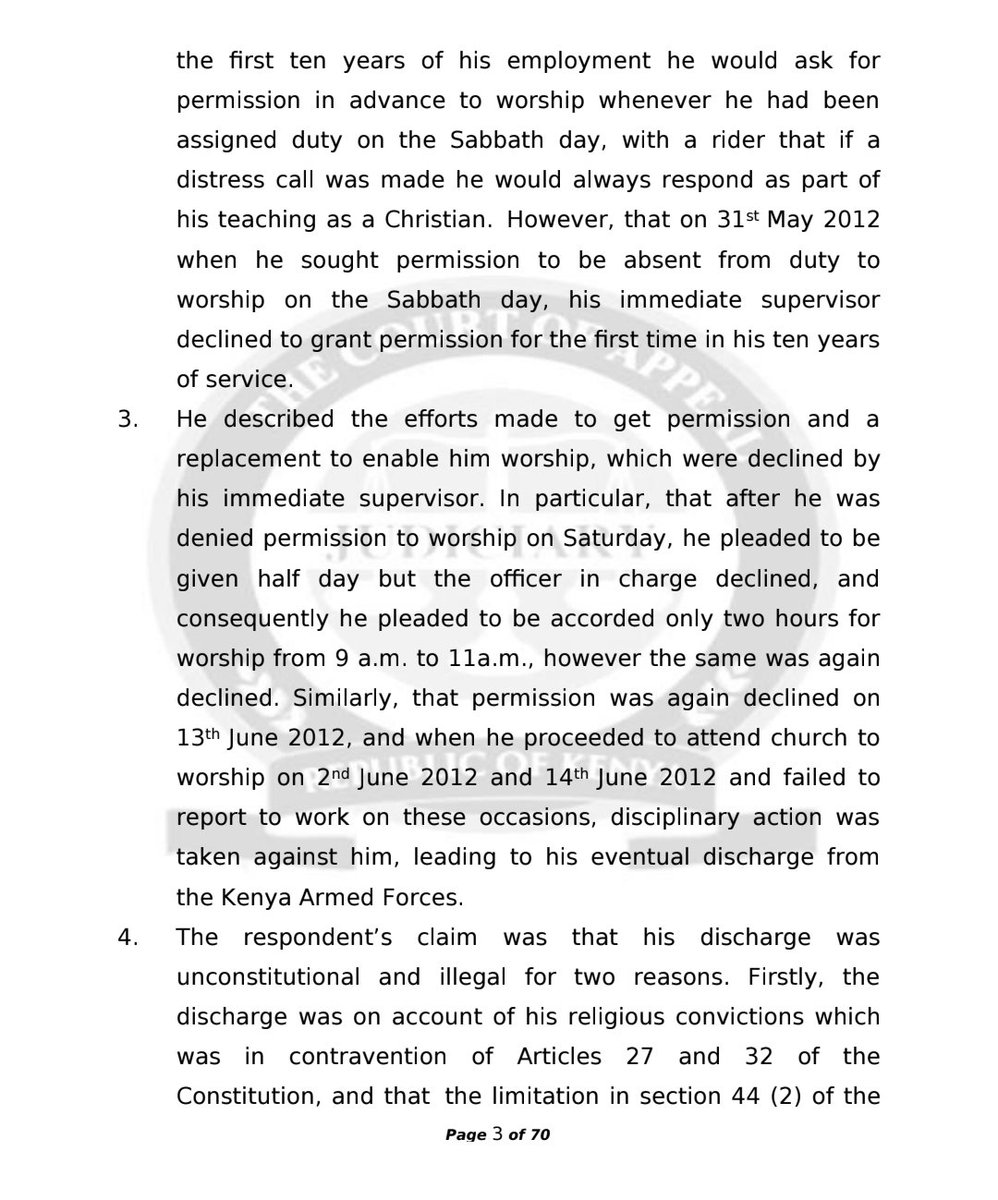
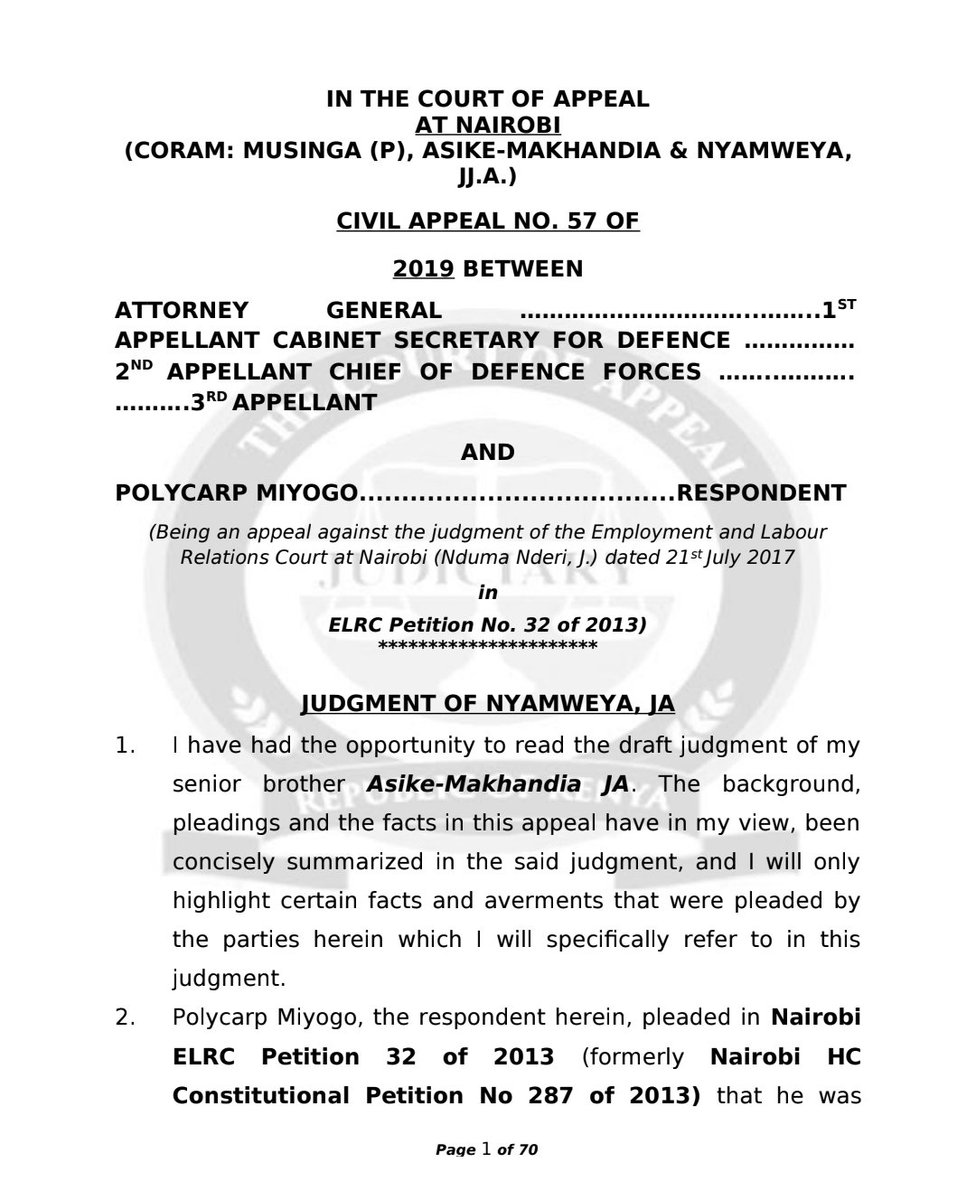
KDF has been ordered to pay Kshs 8 MILLION to a soldier they jailed and fired,just because he refused to work on Sabbath!
Polycarp Miyogo was a Kenya Defence Forces (KDF) serviceman and a Seventh-Day Adventist (SDA). For ten years, he was always allowed to worship on Saturdays,his Sabbath without issue.
But in 2012, his supervisor suddenly denied him permission to worship, even after he offered to work half-day or get someone to cover his shift. When he still went to church, KDF court-martialed, jailed him for 42 days, and discharged him claiming his services were “no longer required.”
The Court of Appeal has held that wearing a uniform doesn’t cancel your freedom of worship.
Dear Law Students,
Please find 34 of the 80 judgments and rulings delivered by the Court of Appeal on 7th November 2025 for your continued learning.
Consider this my pro bono for the day.
https://t.co/sL83l4iPvH
@MyKenyaLaw
Norway’s Supreme Court has set a precedent on hate speech posted in social groups. So long as your message can reach 20–30 members, even in closed Facebook groups, your statements are considered public. Question, Do we have a numeric threshold for who is the public
Senior Counsel John Khaminwa Puts to Task a Witness in the Murder of Security Guard
Defence lawyer Dr. John Khaminwa cross-examined Sergeant Mike Kumali over his testimony in the case against Sergeant Douglas Okwii. The questioning focused on firearm issuance, missing ammunition, and whether proper investigations were conducted following the SGR patrol shooting.
Catch the detailed exchanges as the defence challenges the prosecution’s version before Hon. Muteti at the Milimani Law Courts.














![AssociatesRoba's tweet photo. 🔴🚨GROUNDBREAKING DECISION: EVER BEEN LOCKED OUT OF A JOB APPLICATION BECAUSE OF YOUR AGE? THE COURT CALLED IT ILLEGAL.
In Jared Juma v Kenya Broadcasting Corporation & Others [2014] KEIC 149, the Industrial Court confronted a recruitment practice many Kenyans quietly accept as normal. KBC advertised the position of Managing Director with a hard age cap: not more than 45 years old. No law required it. No regulation justified it. Still, the Board enforced it. The Court was clear. When a public body limits access to employment without a legal basis, it is not “policy”. It is discrimination. The Constitution does not tolerate silent exclusions disguised as job requirements.
The Court went further than merely condemning the age limit. It dismantled the excuse often given by public institutions that “the Board has discretion”. Discretion, the Court held, is not absolute. It must be reasonable, proportionate, and consistent with Article 27 of the Constitution. By fixing an arbitrary age ceiling, KBC excluded competent, qualified Kenyans without justification, failed the test of reasonableness, and violated the minimum core of equality. The recruitment was therefore declared unconstitutional and null and void. The message was blunt: public employers cannot invent barriers the law itself does not recognise.
This decision still matters today because the practice never stopped. Age caps, vague criteria, silent exclusions, and tailored adverts remain common across state corporations and public bodies. This case confirms that such practices are legally vulnerable. If a job requirement has no statutory backing and unfairly locks you out, courts will strike it down. Public offices are not private clubs. Merit must be real, competition must be fair, and discretion must bow to the Constitution. The law has already spoken. Many institutions just hope you don’t listen.
Reach us today via info@robaandassociates.com, for quick action.
Kindly repost widely.](https://pbs.twimg.com/media/HADkyPfW0AAemud.png)


![AssociatesRoba's tweet photo. 🚨🚨That Habit of Police Arresting Everyone at the Scene? Court Just Ruled It Can’t Stand in a Courtroom.🙌
The Court of Appeal in Asili v Republic [2025] KECA 2010 has just shaken a belief most Kenyans treat as gospel: that if police recover stolen items anywhere near you, you must be the thief. A man who had been sentenced to death for robbery with violence walked free after the Court found that the prosecution had built the entire case on assumptions disguised as evidence. The only link between him and the crime was that he happened to be inside a house where stolen goods were recovered. That’s it.
The Court did not mince words. You don’t convict a person simply because they were standing next to stolen property. For the doctrine of recent possession to nail you, the law requires exclusive possession: that the stolen items were under your control, in your space, or traced directly to you. In Asili’s case, the house belonged to his co-accused, other fugitives had just fled, and nothing showed Asili controlled or even knew of the goods. Once those facts appeared, the entire theory collapsed. Proximity is not possession. Presence is not guilt. Suspicion is not proof.
Legally, this judgment reinforces something many people ignore until it saves their life: the doctrine of recent possession is a precision tool, not a shortcut. Courts must see clear, exclusive, unexplained possession, not chaos packaged as certainty. Investigators who arrest everyone at a crime scene and hope the courts will sort it out are violating the constitutional demand for proof beyond reasonable doubt. The Court basically reminded the State that criminal liability cannot rest on guesses or convenience.
And the message to everyone out there? Simple. If the police want to take someone’s freedom for life, they must work for it. Shared houses, crowded compounds, group raids and “everyone was there so they’re all suspects” will not survive appellate scrutiny. The justice system is not a lottery where being in the wrong room costs you your life. After Asili, possession must be proven, not presumed.
#SHAMwalimuCover #JoinMbogiBet #StopIncitementNow #NoMoreManipulation Defend Our Future Rironi Mau Summit Mbeere Somalia Thanksgiving IEBC Gen Z @georgediano @Thuranira_1 @KensonMutethia @joshuamalidzo @NelsonHavi](https://pbs.twimg.com/media/G66HLx3XoAAQd_v.jpg)

![zakheem_rajan's tweet photo. Dear Law Students,
Today’s spotlight is on Supreme Court decision: Title Deeds are Prima Facie Evidence but Not Conclusive Proof of Land Ownership
Harcharan Sehmi & another v Tarabana Company Limited & 5 others, Petition E033 of 2023; [2025] KESC 21 (KLR)
https://t.co/7ApwFTrhhi
Brief Facts
The appellants were registered leasehold proprietors of land in Nairobi acquired in 1968. Before the lease expired in 2001, they applied for renewal but received no formal response. In 2009, the Government allocated the same land to the 2nd respondent, who later transferred it to the 1st respondent. The appellants remained in possession until their eviction in 2014. They filed a suit before the Environment and Land Court, which nullified the respondents’ titles and reinstated the appellants as owners.
However, the Court of Appeal reversed the ELC’s judgment, holding that the 1st respondent was a bona fide purchaser. The Supreme Court considered whether such a purchaser’s title could withstand an illegal allocation and addressed the doctrine of legitimate expectation in lease renewals.
Issues
i. Whether the concept of indefeasibility of title under Section 23 of the repealed Registration of Titles Act was similarly applicable under Section 26 of the Land Registration Act.
ii. Whether a certificate of title is conclusive or prima facie evidence of ownership.
iii. The meaning, scope, and applicability of the doctrine of bona fide purchaser for value without notice.
iv. Whether a legitimate expectation arises in the context of lease renewal over public land.
Holding
1. Under the repealed Registration of Titles Act, title was conclusive evidence of ownership. On the other hand, under the Land Registration Act, a certificate of title is only prima facie evidence of ownership and can be challenged for fraud, misrepresentation, or illegality.
2. A bona fide purchaser must prove (i) innocence, (ii) payment of value, and (iii) acquisition of a legal estate. The doctrine protects purchasers against prior equitable interests, not illegal titles. It does not shield purchasers of illegally or irregularly allocated public land titles.
3. A title obtained through illegal or procedurally flawed processes is void. Such a title cannot confer valid ownership or attract equity’s protection, even where the purchaser lacked knowledge of the illegality.
4. An original allottee of leasehold public land remains a lessee, not an owner. The estate subsists until expiry, after which the land reverts to the Government. Any subsequent allotment must follow lawful procedures.
5. The appellants had a legitimate expectation of renewal based on their application, occupation, and past renewals granted to others. A legitimate expectation arises when (i) there is a clear promise by a competent authority, (ii) the expectation is reasonable, and (iii) it is not contrary to law. The Government failed to consider or respond to their application, thus breaching procedural fairness.
6. The Court cautioned that recognising pre-emptive rights over public land leases could improperly convert leases into permanent ownership. A legitimate expectation gives a right to fair consideration, not automatic entitlement to renewal.
The petition was allowed.](https://pbs.twimg.com/media/G6qLcNlWAAAWXzK.jpg)





