1. ☢️ Invest in Nuclear Energy
2. 👨🌾 Free the Agricultural markets and incentivize Regenerative Ag practices
3. 🏢 Zone new urban growths to permit maximal density and minimal land usage to preserve untouched wilderness and agricultural communities.
4. 🤝 Culturally foster more localized, self-reliant, and circular economies, with less wasteful consumption and dependence on global industry.
THAT is how you create a free, healthy, and sustainable society…
one with more wild nature, and less Govt bloat.
Politics is not left vs. right or Democrat vs. Republican.
The conflict is between the rooted, real, organic, and free, and the artificial, imposed, and rigid.
It's between decentralization and centralization, nature and artifice, divine ordination and vain human imposition.
The superior one is the natural one, the one that forms useful, voluntary, demanded connections, natural and meaningful hierarchy, and free sharing and exchange:
“The city of Libtown has concluded its $1,000,000,000 study on why housing is so expensive”
“And?”
“There’s demand.”
“So will we build?”
“Yes, a million ugly units of subsidized section 8 housing and million-dollar condos”
“And for the middle class?”
“That’s… problematic”
I recommend that every:
Libertarian
Distributist
Paleoconservative
RFK fan
Ol’ fashioned Moderate
Isolationist
Nationalist
Integralist
Agrarian
Neo-Luddite
PresTwt nerd
Who sees this post, reads this book
Unbelievably, it will will deeply appeal to and apply to ALL of you.
🇺🇸THE GRAND YOUNG PARTY IS CALLING ALL CONSERVATIVE YOUTH!
🔔Follow @G_Y_Party.
💬Join us on Discord https://t.co/CL3Cn0BJ1Y.
🔎And don't forget to view our website: https://t.co/NcWEWeRoxe
"Classical Liberalism must be paired with a culturally conservative social backbone"
Yes, and that doesn't mean just having a nominally Christian populace, or Representatives who make performative prayer circles during congressional sessions. That doesn't mean using RW aesthetics to sell corporate junk, jeans, beer, or Nicotine pouches (though its cool to see advertisers give up on Lefty messaging).
It also doesn't mean thinking you can legislate your way to a righteous and virtuous society when you maintain and permit the causes of social decline in the modern world. Instead, we must 'go back';
We need decentralization of economic and political power. We need to re-establish Agrarian/Pre-industrial community and familial structures. We need a closer relationship to the natural world, and greater personal and community self-sufficiency. We need local, national, and cultural identity.
If we want a free and liberal society that enshrines the meaning beyond GDP growth, and doesn't devolve into state-sanctioned oligarchy, that's the ONLY way to go.
Liberty and the organic go hand in hand, one cannot fully stand without the other. Freedom and tradition must be wed. The future must maintain its roots in the essential social conditions of humanhood which we have only recently departed from.
Please consider RTing if you think this is a message more people on the Right should hear. Thanks for coming to my Ted Talk.
1⃣Legalize traditional styles and forms of housing universally.
2⃣Use LVT and Zoning deregulation to allow for demand-based density in urban areas and prevent suburban sprawl into rural areas.
3⃣Encourage localized agriculture, give Tax reimbursements to small farms, and Incentivize familial inheritance of property.
4⃣Design urban growths to allow for necessary vehicular traffic while being walkable, containing storefronts and a variety of housing types, maintaining public safety services, etc.
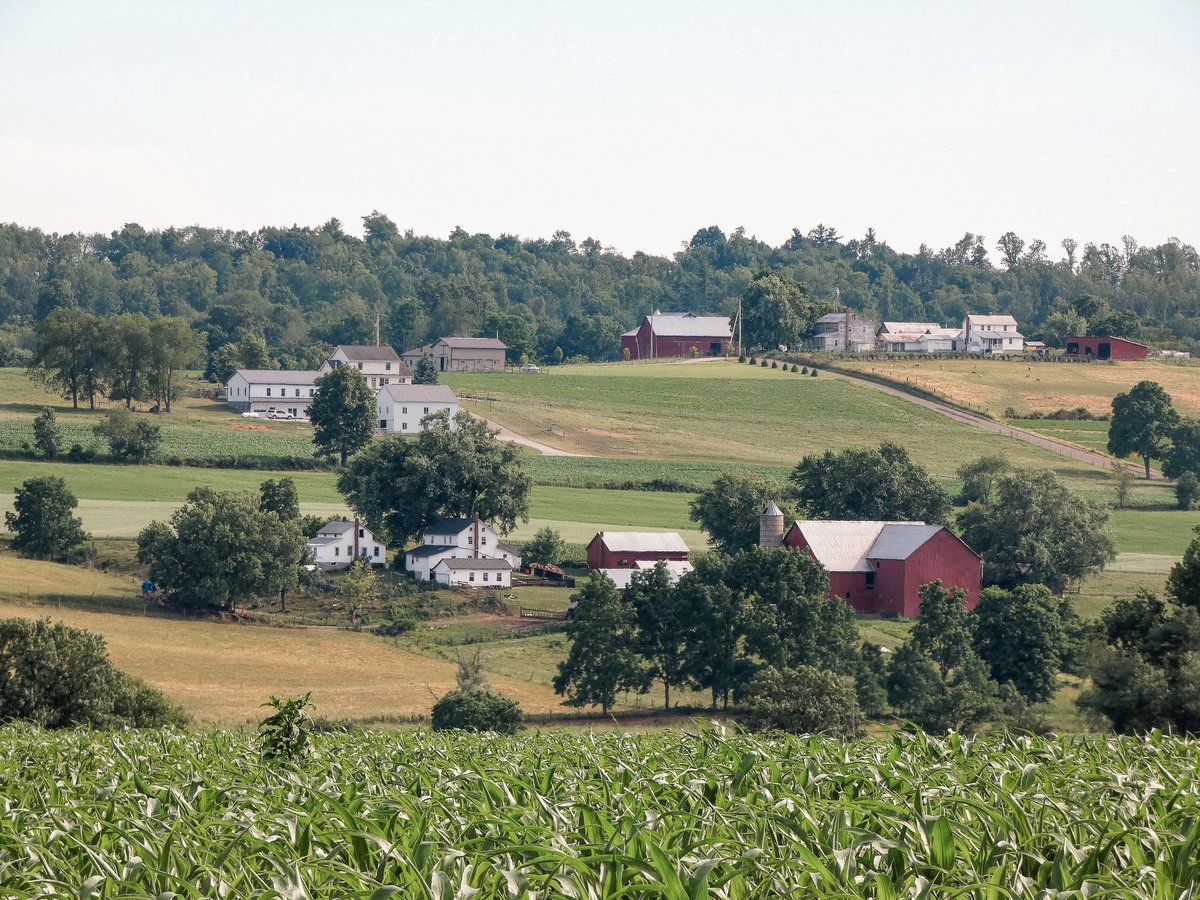
America can, and should, still look like this.
Certain aspects of Pre-War and Pre-Industrial America, in being more organic, more healthy, less centralized in planning and implementation, and just more beautiful overall, are objectively better for the human mind and spirit.
I never thought that the label "Post-Libertarianism" could ever describe my personal position, But I think it might.
I've historically scorned the label, and associated it with knee-jerk, New-Right reaction, and that whole "Heh... I used to be a Libertarian when I was, like, 14... but then I stopped being delusional" sentiment held by those who either never really understood what Libertarianism was, or merely hung out with the kind of visionless, passive, Libertarian who can stare societal decline in the face and shrug it off with a good 'ol "But how does it affect you personally?".
If not that, I associated it with chronically-online Neo-Reactionary daydreams about how giving up the ideal of Voluntaryism and living under cyberpunk absolute-monarchist city-states simulating would be the real answer to what the Classical Liberal mind yearns for... but that doesn't seem to be the implication of the term either.
Post-Libertarianism, based on much of the casual literature surrounding it online, seems to just be the simple recognition that you're not evil or a communist if you approach the State realistically; If you don't seek to just abolish and defund anything and everything all at once, if you don't think we should be tearing down all borders (at least without addressing other issues or gradually installing alternatives first), if you vote and engage in partisan politics, if you try to participate in the system to improve where possible, but not annihilate, the system, etc.
Post-Libertarianism is the practical sentiment that we should rule and legislate with Libertarian principles and ideals in mind, seeking to get as close to those ideals as possible and practical, while maintaining a safe, stable, and decent society, settling for less damaging, but necessary or unavoidable policies if need be, and not demanding pure Anarchism or even a Night-Watchman state that handles nothing apart from policing and law.
But... is this sentiment really "POST"-Libertarianism, or is it just pragmatic Libertarianism, or a Libertarianism that can think outside of an extremely rigid, dogmatic, application of the N.A.P. that requires hours of education to get normies to wrap their heads around?
That's the debate, and honestly, I think Post-Libertarianism is just practical or pragmatic Libertarianism, or more broadly, one could think of it as just radical or purer Liberalism in the Classical sense (as one could think of Libertarianism as a whole), always pursuing, but not rigidly, the absolute and universal application of the essential principles of self-ownership, free exchange, and the live-and-let-live sentiment, while being willing to not get all the way to Anarcho-Capitalism.
Even though I would say this pragmatism isn't so much of a divergence from, as it is an improvement to, Libertarianism, the ideology has indeed, from its earliest inception, often been more about absolutes and ideals than means, even if that means Libertarian praxis is just starting podcasts where you daydream about Ancapistan, and endlessly critique those in power yet never obtain power yourself. In that sense, if you think of this sentiment and phenomenon as key to Libertarianism, perhaps Post-Libertarianism is indeed a progression beyond Libertarianism (especially if we're talking about specific expressiond of Post-Libertarianism that seems practically just Paleoconservative).
I deeply respect this sort of purism, this idealism, and occasional wide-eyed naivety (hey, I 'grew up' ideologically listening to Free Talk Live, reading up on the Free State Project, and sticking in Voluntaryist online spheres), and I respect the consistency and ideological purity there, but I can't bring myself to fully identify with the praxis of much of those spheres.
Post-Libertarianism also allows one to think about politics outside of just affirming private property rights, and live-and-let-live, it allows one to think about a broader vision.
Standard Libertarianism is excellent in its ideal of a world built on top of voluntary interaction, decentralized political power, and the findings of Observational and Classical Liberal economics, especially of the Austrian School, and it's spot-on in its pointing to the State as the central problematic entity in today's social and economic issues, with a level of knowledge and articulation you won't ever see from your average "Small-Government Conservative", but, Libertarianism is incomplete, It's only a core, a central kernel, of a full-fledged political ideology covering all bases, social, economic, and otherwise.
In some ways, that's good; every Libertarian, from any sort of cultural or religious bacground agrees in the essential principles of their ideology, and holds that the other is entitled to their own views, philosophy, ideals, and lifestyle as it pertains to issues of personal expression, but too often, Libertarian sentiments lead individuals to not really think beyond said principles.
'let the market figure it out', and 'live and let live', can, quite often, become the entirety of one's philosophy, and so many Libertarians never develop much of a real, concrete vision for how a Libertarian society can work and thrive, how it can deal with cultural issues, and how, practically, to get closer to such a society right here and right now (Partly because most viable solutions involve engaging with, and not immediately abolishing the State).
Some will go half-way there, and daydream about private cities and contract communities, and repurpose some NRX ideas when it comes to imagining a Libertarian society, but the whole aspect of immediate praxis is severely lacking, and that whole philosophy is hard to explain and sell to your average person. The average Democrat voter isn't going to care about or attain to the works of Curtis Yarvin, and there is definitely not going to be any kind of Libertarian Revolution or overthrow of the American State that only requires a small microfraction of the population being on board. You need Libertarianism to be pragmatic, and you need to make it simple and widely-appealing in its descriptions.
Personally, in my own case, what drives me to consider the label of Post-Libertarian, is that my personal views affirm, but have extended so far beyond just the N.A.P. that the Libertarian label only seems to cover only a portion of my views. I generally see myself as just a Neo-Agrarian, with Libertarianism, or Post-Libertarianism, just being part of that view.
I hold that the need for freedom is but one of the psychological needs of man. Man, to be upright in his freedom, needs nature. Man needs the local, rooted, and real. Man needs God. Man needs greater self-sufficiency, meaningful tradition, a closer relationship to the ecosystems that sustain him, strong familial ties, interdependent, high-trust communities, etc. Man cannot achieve these through artificial or authoritarian implementation, though- Liberty and Reaction (to divorce that second term from... certain connotations) are two arcs that, on their own, fall, but united with a keystone, they form a coherent and long-sanding whole.
But that's just my two cents on the subject, and an example of a philosophy that takes the essential principles of Libertarianism and makes them but a core of a fuller, broader, more nuanced position, and seeks to pursue them practically and realistically.
This is something I'm going to cover in a book I'm writing on the vision and principles of a New Agrarian movement (shameless plug, follow for updates on that), and while the point of this post is not to advertise that, it's the reason I was thinking about this subject in particular.
Regardless, I may be looking at some narrow sources, and perhaps Post-Libertarianism just means what I used to think it does. Feel free to discuss the semantics in the comments here.
Thank you for coming to my Ted Talk, lol.
“Libertarians want drug addicts to defend their meth labs with machine guns and collaborate with undocumented cartel members while their 5 year old children get sex changes”
“Heh, yup. We’re pretty based, aren’t we?”
That’s what Libertarians sound like with this strategy, lol.
“Every piece of beautiful wild land you want to preserve is a buff in that sweet sweet GDP you’re denying me…
Not a speck of greenery can be spared if we want to achieve humanity’s true potential I saw in a sci-fi book”