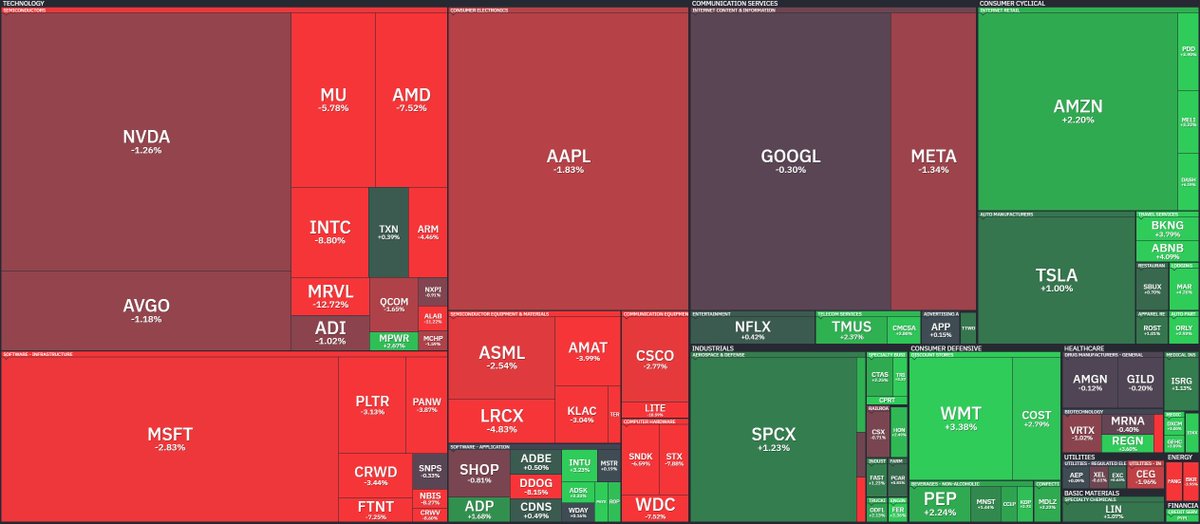
🚨 3 brutal days in the market. Most people look away. I start hunting.
Instead of sitting on my hands, I moved a small slice of capital into a handful of beaten down small cap communication stocks. 👀
Not a recommendation. Just what I’m watching and why.
📊 Inside our FREE trader group, I share:
• The tickers on my radar
• Key support & resistance levels
• Catalysts, volume & price structure
• How I rank setups as conditions change
Same process I share here on X. Just more room to dig into the details and compare notes with other traders.
✅ No fees. No sales pitch. No pressure.
Want in? Comment “YES” and I’ll send you the invite.
💡 The best setups don’t always show up when the market is green. Sometimes, they start taking shape when everyone else gives up looking.
#Stocks #SmallCaps #StockMarket #Trading #TelecomStocks #MarketRotation #BreakoutStocks #StockWatchlist
Elon Musk's Latest AI Bets Could Point to the Next Big Rotation
What a week for the market.
The post-election rally didn't last long. By Friday's close, the Nasdaq was down 3.4% for the week, the S&P 500 lost 2.7%, and the Dow fell 0.9%.
So what happened?
The midterm election results initially boosted risk appetite, with Democrats taking control of both chambers of Congress. But investors quickly started questioning what that could mean for AI infrastructure, especially data center expansion and potential regulation.
At the same time, the AI trade faced another reality check.
Investors are becoming more selective about massive capital spending, expensive valuations, and neocloud companies that depend heavily on external financing.
Then Friday's jobs report added another layer. October payrolls increased by 165K, well above expectations, while unemployment fell to 4.1%. A resilient labor market gives the Fed less reason to rush toward rate cuts.
Now here's where Elon Musk's latest views get interesting.
He's looking beyond traditional AI infrastructure and highlighting several areas:
Space Computing: Musk believes future superintelligence computing could eventually move almost entirely into space, powered by solar energy and lower launch costs.
Optimus & Robotics: He sees humanoid robots as a major part of Tesla's long-term value. The real challenge is moving from impressive demos to practical, repeatable work.
AIDD & Biotech: This is the part I'm paying closest attention to. AI could accelerate drug discovery, molecular design, mRNA development, and personalized medicine.
I've been bullish on AIDD since mid-September. I believe AI-driven biology deserves a place in the next phase of the AI investment story.
Names I'm continuing to follow: $RXRX, $SDGR, $TWST and $MRNA.
What matters next week?
Tuesday: CPI inflation report
Thursday: Initial Jobless Claims
Friday: PPI inflation report
The market will be watching whether inflation keeps pressure on the Fed, while investors continue to reassess AI spending, data center economics, and the next areas of growth.
My takeaway:
The AI story isn't ending. It's expanding.
From chips and data centers to power, robotics, and drug discovery, the next opportunities may come from companies applying AI to the real world.
The question is no longer just who builds AI. It's who turns AI into real productivity and profits.
Not financial advice, just my market view.
#ElonMusk #AI #AIDD #DrugDiscovery #Robotics #Optimus #Tesla #RXRX #SDGR #TWST #MRNA #AIInfrastructure #SpaceComputing #Biotech #StockMarket #MarketRotation
Both $TSLA and $SPCX getting smoked isn't about the stocks—it's about the midterm blue sweep. Musk poured nearly $450M into GOP coffers, and Democrats just took Congress and Texas. The real damage? $SPCX's $1.9T valuation is built on government contracts, and $TSLA's SpaceX merger now faces a Congress that's openly talking subpoenas. This isn't a dip to buy, it's a political risk premium being repriced.
Calling $100 "inevitable" for $SPCX while the stock is at $126 is a bold call, but the chart says the real fight is at the IPO price of $135, not $100. The stock already broke below $135 and is now testing the $133 zone, with 50-day SMA at $149.64 sitting way above price. The dilution math from the $TSLA merger is the real bear case—Fortune estimates SpaceX would need to issue 92% more shares, diluting existing holders massively. But "inevitable" implies certainty, and there's nothing inevitable about a $2T company cratering to $100 without a macro shock.
Daily Update | November 5
The post-election rally is already being tested.
Yesterday, the Dow jumped 3%, while the S&P 500 gained 1.58% and the Nasdaq added 1.44%.
Today, the picture is different. The Dow is holding up better, but the Nasdaq is under pressure as AI and semiconductor stocks continue to struggle.
The message is simple: less political uncertainty doesn't automatically mean more buying across the board.
Here's what I'm watching today:
Market Rotation
Money is becoming more selective. Consumer and financial stocks benefited from yesterday's relief rally, while AI and semis are facing renewed pressure.
The next move needs earnings support, not just election optimism.
Two Stocks on My Radar
$QCOM: The market is questioning its smartphone business after earnings, even as management points to growth in data centers, automotive and other non-handset markets. Watch whether buyers see the selloff as a warning or an opportunity.
$EOSE: Q3 revenue jumped 171% year over year to $82.7M. The company also announced a 10MW/100MWh storage project serving Google's data centers. Margins are still negative, so execution and manufacturing efficiency matter more than headline growth.
Today's Key Events
10:30 AM ET: Challenger Job Cuts
1:30 PM ET: Initial Jobless Claims, Q3 Productivity and Unit Labor Costs
1:50 PM ET: Fed's Hammack speaks
2:10 PM ET: Fed's Barkin speaks
Friday's jobs report is the next major macro checkpoint.
My Market View
I'm watching whether the Nasdaq can stabilize while money rotates into other areas of the market.
AI remains a long-term opportunity, but today's tape is a reminder that not every AI-related stock gets rewarded equally.
The next winners may be the companies turning AI demand into real revenue, better margins and measurable productivity.
Not financial advice, just my market view.
#StockMarket #MarketUpdate #QCOM #EOSE #AI #Semiconductors #EnergyStorage #DataCenters #FederalReserve #EarningsSeason #LaborMarket
What if AI and robotics are not just the next big tech trade, but the answer to a much bigger economic problem?
There's an interesting idea gaining attention: the West may eventually face two very different paths.
One is a growing debt burden, slower growth, and an economic system struggling to sustain itself.
The other is a massive productivity boom powered by AI and robotics.
I think the second possibility deserves serious attention.
For decades, governments have tried to manage debt through spending, taxes, and monetary policy. But none of those solutions creates real wealth on its own.
Productivity does.
And that's where AI could change the game.
Software AI makes information cheaper to process. Robotics takes that efficiency into the physical world.
Manufacturing, logistics, construction, energy, healthcare, and services could all see major cost reductions.
Imagine a world where machines can work around the clock, production becomes dramatically cheaper, and services become more accessible.
That's not just another technology cycle. That's a potential shift in how the economy creates wealth.
But here's the part investors need to understand:
The biggest opportunity may not belong only to the companies building AI models.
It could belong to the companies turning AI into real-world productivity.
Compute is the starting point. Data centers provide the foundation. Power is the constraint. Robotics and automation bring AI into the physical economy.
Of course, higher productivity doesn't automatically mean wealth is distributed equally. The companies controlling
Volume drying up on $RCAT monthly doesn't mean the bottom is in—it means the crowd left. But check the math: at $14.10, it's holding the 0.618 Fib ($14.10) while revenue is actually growing (Q3 revenue ~$9.6M vs $1.3M last year). Compare this to $KTOS or $AVAV—same drone narrative, but they have government contracts while $RCAT is still burning cash at -$17M operating. Volume dropping is a pause, not a reversal.
15 seconds vs 120 seconds is an 8x headline, but it's just a solver upgrade on an existing product—not new revenue. $QBTS is trading at a $3.86B market cap on $12.4M TTM revenue, and it burns roughly $37M a quarter. Compare that to $IONQ or $RGTI—same quantum narrative, but $QBTS's cash burn makes every headline a dilution risk, not a demand signal.
Elon calling $QCOM's tech excellent isn't random praise—it's the sound of a $100B network deal being signed. SpaceX just picked Qualcomm's Dragonwing chips to power Starlink Mobile's nationwide 5G buildout. Same headline, but the real signal is Qualcomm quietly becoming the infrastructure backbone for Musk's carrier ambitions.
Gap filled at $17.20, but the real story is what happens next. $VIX cratering this fast after election week is pure relief trade, not a regime change. The one-day vol gauge is still elevated and the upside gap at $25.78 is untouched. I'm not chasing the complacency; watching for a reversal candle to confirm the fade.
Daily Market Update | November 4, 2026
Post-Election | Follow the Money
The election is behind us. The market has its first answer, but the next move will depend on where capital goes.
Democrats swept both chambers of Congress, setting up a divided government. Futures reversed sharply higher after the initial selloff. Investors are betting that political gridlock could limit major policy changes.
But don't confuse relief with certainty. AI regulation, data center expansion and crypto policy are still in play.
Here's what matters today:
1. The Election Trade | Risk-On, But Selective
Dow, S&P 500 and Nasdaq futures all reversed higher. Big platforms like AMZN, MSFT, META and GOOGL are benefiting from the relief trade.
The other side of the market is more complicated. Data center developers and some AI infrastructure names face potential regulatory pressure, while TSLA and SpaceX are under pressure following the election.
2. $AMD | The AI Demand Test
AMD delivered a strong Q3:
Revenue: $13.4B, up 45% YoY.
Data Center revenue: $8.5B, up 97%.
Non-GAAP EPS: $2.09.
Q4 revenue guidance: approximately $17B.
The numbers confirm that AI infrastructure demand is real. But the stock's reaction has been volatile despite the beat.
That's the bigger lesson: great earnings don't automatically mean a great stock trade. Watch whether buyers defend the move.
3. Today's Economic Data
8:15 AM ET: ADP private payrolls added 86K jobs, above the 69K forecast.
10:00 AM ET: ISM Services PMI. Watch employment and prices paid.
Friday, November 6: October Nonfarm Payrolls.
A stronger labor market can support economic growth, but it can also complicate the Fed's rate outlook.
4. Earnings to Watch
$QCOM: After the close. AI PCs, handset demand and chip margins.
$SNAP: After the close. Advertising demand and forward guidance.
$AMD: Management conference call at 5 PM ET.
5. My Watchlist | Follow the Rotation
Large-cap platforms:
$AMZN: 245 is an important reference support level.
$MSFT: 510-520 is the key support zone to watch.
AI power and infrastructure:
$BE: Watch for renewed institutional buying.
$VST: Core power and grid exposure.
$GNRC: Backup power demand tied to data center expansion.
AI healthcare:
$RXRX
$TWST
I still believe the next opportunity is bigger than just buying more chip stocks.
Compute → Data Centers → Power → Infrastructure → Real-world AI → AI Healthcare.
My plan today:
Don't chase the opening gap. Let the first hour show where buyers are actually committing capital.
Large-cap platforms look cleaner. Semis and pure-play AI infrastructure still need confirmation. Small caps need individual catalysts and relative strength.
Keep position sizing disciplined. 5-8% maximum per position, scale in 40/30/30, and respect hard stops.
The election changed the headlines. It didn't change the need to follow the money.
Not financial advice, just my market view.
#StockMarket #DailyMarketUpdate #AMD #NVDA #ARM #QCOM #AIStocks #ArtificialIntelligence #DataCenters #AIPower #EnergyInfrastructure #BloomEnergy #BE #Vistra #VST #Generac #GNRC #AIHealthcare #RecursionPharmaceuticals #RXRX #TwistBioscience #TWST #ISM #ADP #TreasuryYields #MidtermElections #Nasdaq #SP500
This is the perfect example of why political headlines don't move markets. Traders are hyper-focused on the tape, Fed minutes, and AI capex cycles—nobody is pricing in domestic political noise until it hits liquidity or regulation. The real risk isn't a pardoned individual, it's the broader rule-of-law premium. But today? The S&P doesn't care.
Amazon finally catching Walmart on revenue is a huge milestone, but the market is missing the punchline: the profit margins aren't even close. Amazon is doing ~$776B with a 17% net margin, while $WMT hauls in ~$736B at roughly 3%. Same top-line race, but completely different games. Selling dollar bills to stack pennies is a brutal way to grow.
Ligue 1 launching a tender for 2027-2032 sounds proactive, but let's check the actual math. They bailed out of the DAZN mess and built Ligue 1+, which reportedly generates maybe €150M a year against €65M in production costs. A confidential "ambitious" reserve price is being floated to the market without a number, and the real tell is that they refuse to name it. Streaming platforms like Netflix and Disney+ may kick the tires, but acquiring an entire league's rights at a premium when the domestic market has already been gutted is a stretch. Compare this to the Premier League's global TV deal, which prints billions. Ligue 1 is trying to sell a product nobody has been willing to pay up for.
Heisenberg calls $700 the line in the sand, but let's check the tape—$QQQ closed at $681.09, already sitting just above the 200-day at $679.82. That $700 level isn't support anymore, it's overhead resistance. He's talking about a date with the $715 gap fill, but bulls need to reclaim $700 first without breaking the 200-day. The real line in the sand is the one nobody's watching: $680.
11/3 Update | Election Day 🇺🇸
Mixed open today.
$AAPL is under pressure after weaker margin guidance. Semis are bouncing ahead of $AMD earnings tonight, but I’m not convinced this is a real turnaround yet.
The bigger event today is the midterms. Policy expectations and market sentiment could shift quickly.
Same playbook. Stay disciplined.
• Platforms: Cleaner setups. $AMZN holding around $245. Watching whether buyers keep stepping in on dips. $MSFT has key support near $510, holding so far on relatively light volume.
• Semis: Still trading on sentiment. Weak volume and no real follow-through. Not chasing this bounce.
Risk management stays the same:
5% to 8% max position sizing. Scale in gradually. Hard stop below deeper support.
No need to chase. Let the market show its hand first.
I'll update after $AMD earnings and the early election results.
Not financial advice, just my market view.
@Benzinga Brookfield calling out "unexpected winners" is just marketing their own book. Check the receipts: their AI fund has $NVDA anchoring it, and they're building a $26.8B UK data center with $DRX. The real winner of this narrative is $BAM's fee stream, not some mystery industrial.
AI Healthcare Is Moving From Hype to Commercial Reality. What's Next?
What if the next big AI opportunity isn't another chip company, but the companies using AI to actually develop new medicines?
$TEM just gave the market an important signal.
Tempus AI reported Q3 revenue of $411.5 million, up 23% year over year. Data & Applications revenue grew 33%, while adjusted EBITDA reached $25.6 million, marking its first quarterly adjusted profitability.
The bigger story isn't just the earnings beat.
Pharmaceutical companies are increasingly willing to pay for medical data, patient insights, and AI-driven research tools.
Medical data is becoming a commercial asset.
But I think the opportunity goes much further than TEM.
Look at the broader healthcare pipeline:
$TEM | Medical Data & Clinical Intelligence
Connecting genomic testing, clinical records, and pharmaceutical research. Its business model shows how medical data can generate commercial value.
$RXRX | AI Drug Discovery
Using AI and biological data to accelerate drug discovery. Recent clinical progress and Sanofi's selection of its first development candidate from their collaboration make this one worth watching.
$SDGR | Computational Drug Design
Combining computational chemistry and AI to improve molecular design and drug development. The key is whether its technology can become an essential part of pharmaceutical R&D.
$TWST | Synthetic Biology Infrastructure
AI can design molecules, but those designs still need to be produced and tested. Twist provides the DNA synthesis infrastructure behind that process.
Here's how I'm looking at the bigger picture.
AI is moving through several stages:
Chips → Data Centers → Power → Infrastructure → Real-world Applications.
Healthcare could become one of the most important real-world applications.
TEM is showing that medical data can become a business. RXRX, SDGR, and TWST represent different opportunities across the drug development chain.
These companies have different risk profiles. Not all of them will succeed, and clinical progress doesn't guarantee commercial success.
But the investment question is changing.
It's no longer just about who has the best AI model.
It's about who can turn AI into better research, successful clinical programs, and ultimately profitable products.
That's the next stage of AI healthcare I'm watching.
Not financial advice, just my market view.
Search Topics:
$TEM $RXRX $SDGR $TWST $MRNA $LLY $NVO $NVDA
#AIHealthcare #AIDrugDiscovery #TechBio #PrecisionMedicine #ComputationalBiology #SyntheticBiology #Genomics #DrugDevelopment #ClinicalTrials #Biotech #HealthcareAI #AgenticAI #AIInfrastructure
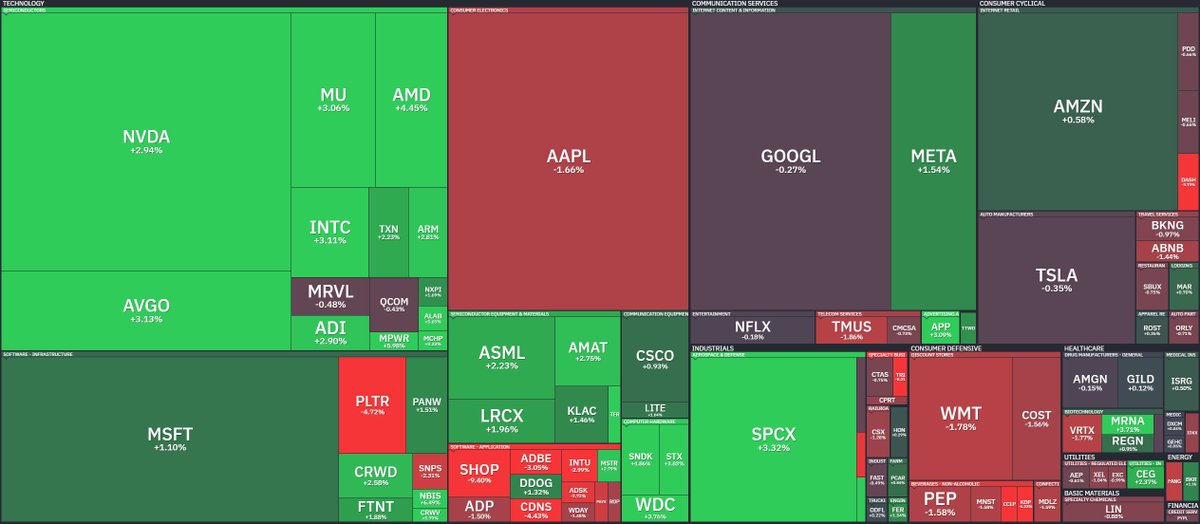
Wall Street closed mixed on Monday as a morning rally faded and tech/AI selling resumed.
Dow +0.4% to 51,984
S&P 500 -0.5% to 7,541
Nasdaq -1.1% to 25,164
Oil plunged about 7-8% on rising US-Iran diplomacy hopes, crushing energy stocks (sector about -4%) while lifting consumer discretionary and cyclicals. Breadth stayed positive overall, but mega-cap tech and chips dragged the indices lower after a brutal October for the AI trade.
Today’s hottest topics (most searched / most discussed):
• Apple (AAPL) & Palantir (PLTR) earnings after the close, top search interest
• Ongoing AI/chip pressure (INTC most active by volume, AMD/MRVL weak)
• Marvell’s $115B acquisition of Lumentum, both stocks slammed
• Oil crash + midterm elections tomorrow as key macro drivers
The market is still digesting last week’s AI capex concerns and now faces a stacked week: midterms, more earnings (AMD etc.), and Friday’s jobs data. Lower oil eases inflation pressure, but the AI “show me” story and election outcome remain the bigger swing factors.
This week’s two key focuses:
Whether the AI/tech complex can stabilize after the recent sell-off and post-earnings reactions (especially AAPL/PLTR tonight).
How midterm results + oil/geopolitics shape risk appetite and sector rotation (discretionary/cyclicals vs. energy/tech).
Volatility likely stays elevated. Position carefully.
#StockMarket #WallStreet #AI #Midterms #AAPL #PLTR