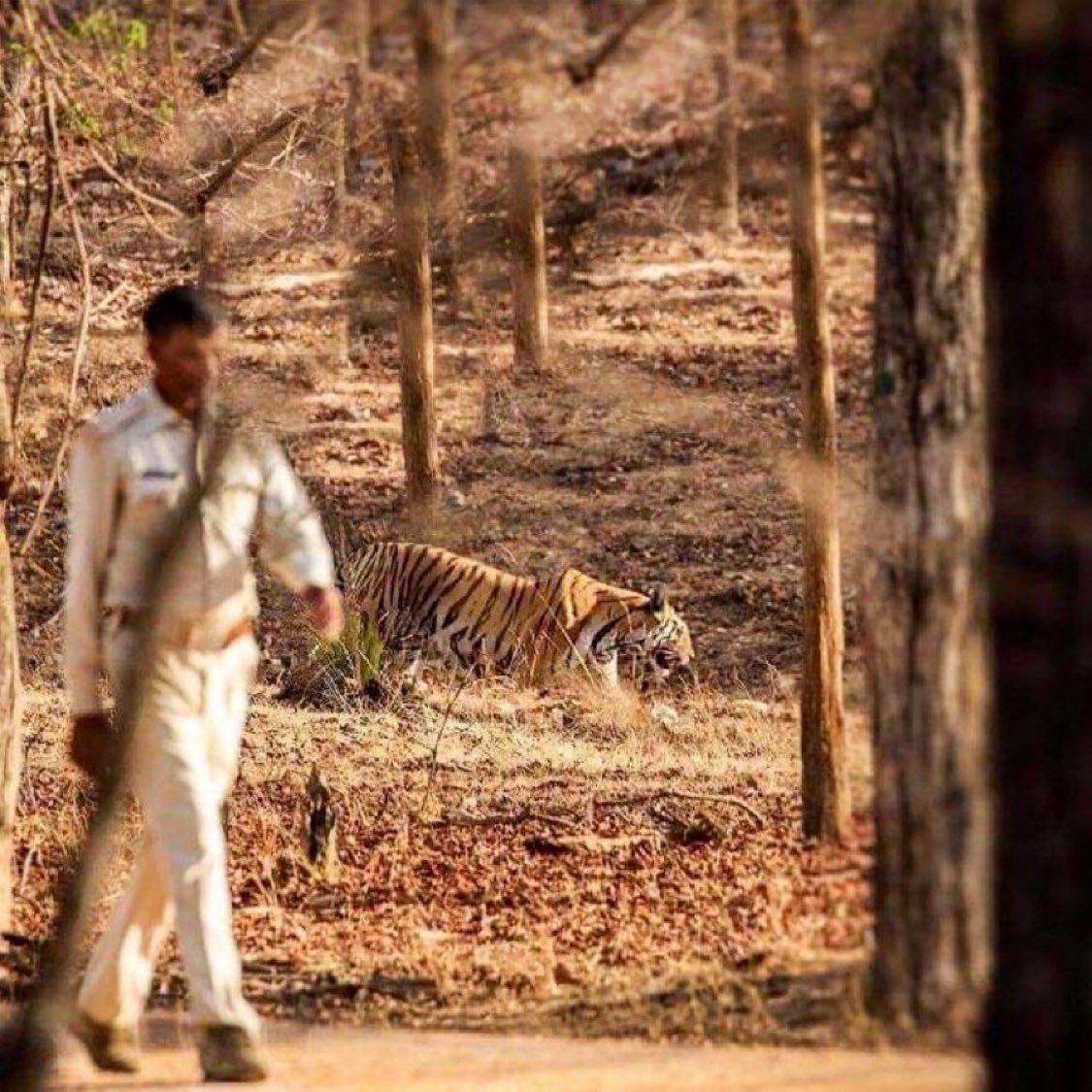
I had filed an RTI with the Uttarakhand Forest Department on the mass killing order issued against leopards and bears. The reply is still pending.
The only really complicated aspect of this case, as I see it, is this: the order came at a time when human deaths were already in the news. The department’s own confidential internal report itself says that capturing these animals, or even killing them, has not reduced the attacks. Then why was permission granted for mass killing?
Scientifically, the sequence should have been the opposite. First identify the individual animal. Then fit a radio collar and map the hotspots. Treat the wild herbivore base of that landscape, and treat the pressure that villages place on the forest. Firing first is not justified. Conducting the study after the shooting is foolish. This inverted priority is exactly what I object to most strongly.
In August the department announced a rapid assessment of leopards and bears across 18 sensitive divisions. That work should have been done before the order, not after it.
Animals in Uttarakhand have not suddenly become more dangerous. The core is already packed with tigers. The prey base is weak. Villages have pressed right up against the forest. And the government is trying to repair, with empty cages and bullets, a structure that was created by habitat and human pressure.
Killing 13 leopards will not remove the tiger pressure of Nainital, nor the leopard pressure of Pauri and Rudraprayag. The space will fill again.
Plan it properly. Do not take political advantage. #leopardkillingorder #uttrakhandwildlife #tigerhumanconflict #leopardhumanconflict #wildlifeofuttrakhand
Nobody wants a city on Mars. Nobody wants AI in every app. Nobody wants data centers in space. Nobody wants humanoid robots or flying cars.
We want clean water. We want a stable climate. We want a habitable planet. We want wildlife to survive. We want to live.
Long post but trust me its worth reading ! India is writing one of wildlife conservation’s most important comeback stories and it is about bringing its vultures back from near extinction !
Madhya Pradesh’s 2025 census recorded 12,981 vultures, up from 10,845 in 2024, a nearly 20% rise in the count in just one year. Panna Tiger Reserve is at the heart of this story, supporting seven of India’s nine vulture species i.e. White-rumped, Indian, Red-headed and Egyptian Vultures, along with the migratory Himalayan Griffon, Eurasian Griffon and Cinereous Vulture. Its sandstone cliffs, deep gorges and forests make it one of India’s great vulture landscapes.
In the South Indian States, the picture is encouraging too. The 2025 synchronised survey across Tamil Nadu, Kerala and Karnataka recorded 390 vultures, up from 320 in the previous survey. Tamil Nadu accounted for 157 vultures, while Mudumalai recorded 60 active nests and 34 chicks, very important evidence that this southern stronghold continues to support breeding populations.
Why does their return matter so much? A remarkable study by Anant Sudarshan of the University of Warwick and Eyal Frank of the University of Chicago found that the catastrophic collapse of vultures in India had serious consequences for human health too. In areas where vultures had once thrived, their disappearance was associated with a more than 4% increase in human mortality.
So what is being done ! India’s national vulture conservation programme, working with institutions such as the Bombay Natural History Society, Wildlife Institute of India and State Governments, has built a structured response through the Action Plan for Vulture Conservation, restrictions on toxic veterinary drugs such as diclofenac and other harmful NSAIDs, conservation-breeding and rescue centres, Vulture Safe Zones, research and systematic monitoring.
Vultures almost went extinct across the Indian subcontinent. Their recovery remains fragile and there is still a long way to go, but the early results of sustained conservation efforts are promising. Video @shanmughanandam photos @dhanu_paran #vultures #vultureconservation
The Clouded Leopard is a great evolutionary paradox.
It looks like a leopard, but it is not a leopard. It represents its own ancient lineage.
It primarily lives in trees, but it hunts substantially on the ground.
It is small enough to climb like a small cat, but strong enough to take down large prey.
It has canines reminiscent of sabre-toothed predators, but it has a modern cat-killing mechanism.
It is a carnivore that sits almost at the top of the food web, but is difficult to detect in forests.
It occurs across several Asian countries, but its populations are sparse & fragmented.
It shares space with large predators like tigers or leopards, yet it persists through niche differentiation.
Its greatest strength is its camouflage, but it is also a weakness. It can't survive except in dark, complex forests.
It represents an ancient lineage, but its ecology & behavior are still not fully understood.
A new paper talks about riverine bird populations in the Himalayan Rivers.
In addition to the threats faced by the birds due to habitat destruction, pollution, climate change, the study also reported 5-10% decline of five species.
Commentary: https://t.co/R2WMau1gfa
(1/3)
Have you ever seen an anhinga?
Unlike most water birds, they don't waterproof their feathers.
Why? Because it helps them dive deeper and hunt better underwater.
🪶🧪🌍
Beyond the news of human-animal conflicts, happy to share this example of human-animal harmonious existence.
A train in Jharkhand waited for two hours as an elephant delivered her calf. The 📹 shows how the two later walked on happily.
Following a whole-of government approach, @MOEFCC and @RailMinIndia have identified more the 110 sensitive spots by surveying 3,500 km of railway tracks in the country. It is lovely to see the efforts producing such heart-warming results.
Special kudos to @JharkhandVan officials for their sensitivity which helped the elephant deliver her young one.
🐯 A heartwarming first: A tigress in Kaziranga National Park was captured on camera reuniting with her lost cub, marking a milestone in wildlife conservation.
https://t.co/eOvg4yI5fq
Registrations and abstract submissions are now open for CitSci India 2024—the 5th Annual National Conference on Citizen Science for Biodiversity. Head here for details: https://t.co/erwV6hYAhu