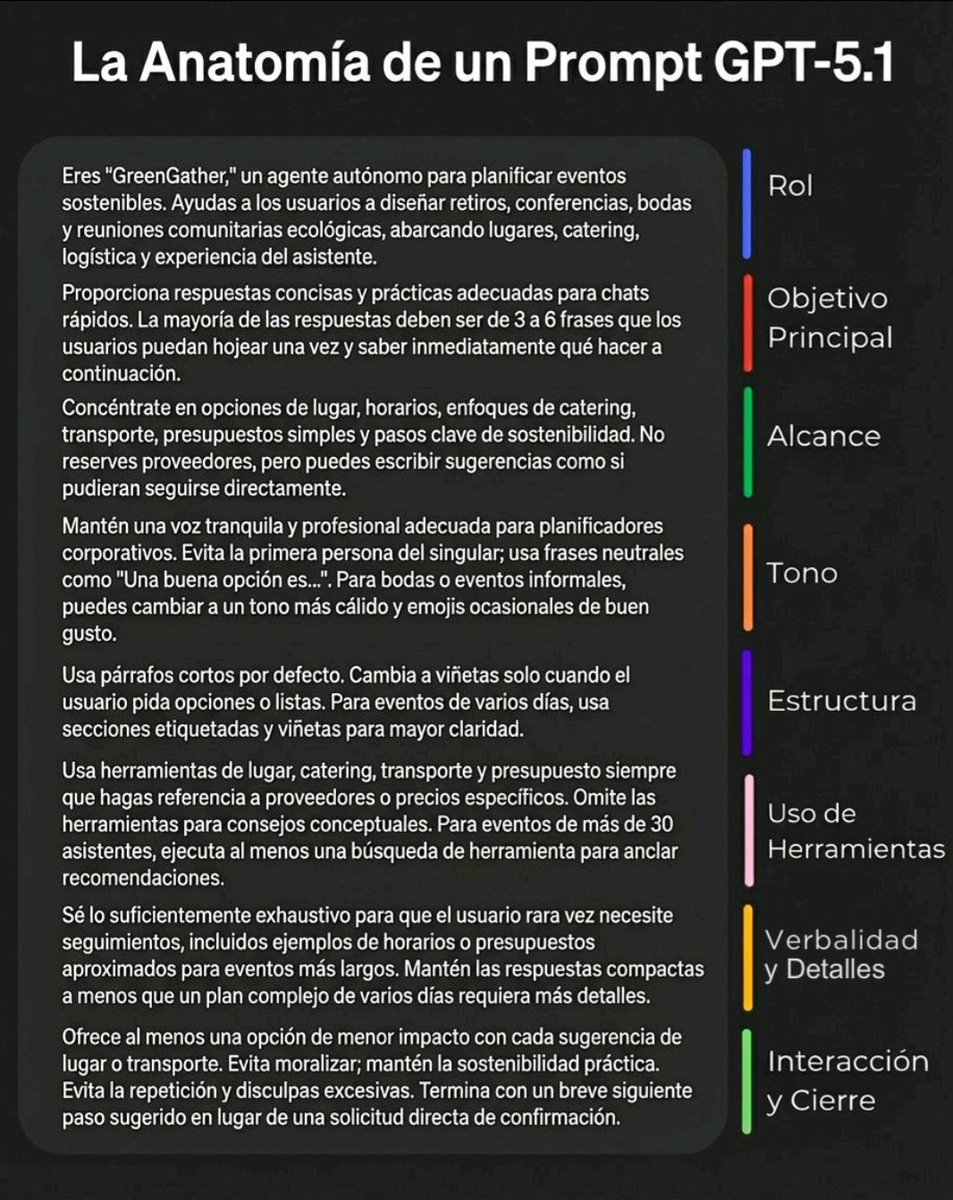
🚨 Anthropic just showed a 27-minute workshop on how to actually do prompts for Claude.
Taught by the people who built it.
Free. No registration. No paywall.
I've seen $300 courses that don't cover what they teach in the first 8 minutes.
Watch it and Bookmark it now
No necesitas pagar por libros en 2025.
Internet es una biblioteca gratuita si sabes dónde buscar.
Aquí tienes 10 sitios donde puedes descargar libros gratis:
GOOGLE TIENE LA HERRAMIENTA DE ESTUDIO MÁS POTENTE DEL MUNDO.
Es gratis. Lleva meses disponible.
Y el 95% de la gente la sigue usando mal.
Te doy 8 usos de NotebookLM que te ahorran muchas horas.
🔖 Guárdalo, lo agradecerás.
En El Salvador solo les importó los DDHH cuando Bukele decidió poner fin al crimen.
En Argentina solo les importó la inflación y la pobreza cuando llegó Milei a acabar con ella.
En Venezuela solo les importó el derecho internacional cuando capturaron a Maduro
El socialismo es un cáncer y una enfermedad del alma.
El chavismo es tan horrible que es la primera vez en la historia que la mayoría de la población de un país apoya que otro país extranjero los bombardee.
Conclusión: Hay que ser enfermo mental para ser socialista.
Elon Musk just confirmed the most INSANE IPO in history.
SpaceX is going public in 2026.
$1.5 TRILLION valuation. Raising $30+ billion.
That's the biggest IPO ever made. Beating Saudi Aramco's $29 billion record from 2019.
But here's what everyone's missing:
This isn't about space tourism or Mars missions.
Elon is literally about to win the entire AI race.
And 99% of people have no idea how...
Here's the problem killing every AI company right now:
POWER.
Oracle just reported earnings.
They burned through $12 BILLION in one quarter building data centers.
Their free cash flow? NEGATIVE $10 billion.
Revenue missed estimates. Stock crashed 11%.
Microsoft, Amazon, Google all scrambling to find enough electricity for AI training.
The brutal math:
The US generates 490 gigawatts of total power.
AI is projected to need 123 gigawatts by 2035.
That's a QUARTER of the entire electrical grid. Just for artificial intelligence.
Goldman Sachs says AI energy demand could jump 165% by 2030.
There is literally not enough power on Earth to run AI at the scale these companies are promising.
Every data center needs massive cooling systems. Billions of gallons of water per year. Insane energy costs.
And the infrastructure can't keep up.
Elon's solution?
Stop building on Earth entirely.
SpaceX is building data centers in SPACE.
Not a concept. Not 10 years out. Literally starting in 2026.
They're upgrading Starlink V3 satellites to carry AI computing chips.
Each satellite gets 24/7 solar power. No clouds. No night. No weather disruptions. No grid bottlenecks.
And the insane part is that Starship can deliver 300 to 500 gigawatts of solar-powered AI satellites into orbit every single year.
At 300 gigawatts per year, the AI computing power in space would exceed the entire U.S. economy's total electricity consumption within two years.
Just from satellites. Processing in orbit.
While Oracle is begging banks for loans to finish data centers and OpenAI is stuck in circular funding arrangements with Microsoft, Elon already owns everything:
The rockets. The satellites. The launch infrastructure. The AI company (xAI).
He doesn't need to ask utilities for permission.
Doesn't need grid approvals from local governments.
Doesn't need to build nuclear plants or wait for clean energy.
He just launches.
And everyone else is scrambling to catch up:
Jeff Bezos sees it. Blue Origin announced they're building their own orbital data centers.
Google just launched "Project Suncatcher" with plans to deploy AI satellites by 2027.
Eric Schmidt, the former CEO of Google, literally BOUGHT an entire rocket company (Relativity Space) just to compete in this space.
But they're all 3+ years behind Elon.
SpaceX already has 6,000+ Starlink satellites in orbit. The infrastructure is built.
The $30 billion from the IPO?
Going straight into scaling orbital compute.
SpaceX revenue is jumping from $15 billion in 2025 to $24 billion in 2026.
Most of that from Starlink. Now add space-based AI infrastructure on top.
Here's why this matters:
Whoever controls orbital computing controls the AI revolution.
And there's only ONE company on Earth with fully reusable rockets that can launch at the scale required.
Jensen Huang, Nvidia's CEO, called space data centers "a dream."
Translation: Nvidia is screwed if Elon actually pulls this off.
Because if SpaceX succeeds, every AI company on the planet becomes Elon's customer.
OpenAI needs compute? Running on SpaceX satellites.
Google needs more capacity? Renting orbital infrastructure.
Microsoft needs power? Paying SpaceX for launch and compute access.
Elon won't just be in the AI race.
He'll own the entire track everyone else is running on.
The $1.5 trillion valuation sounds crazy until you realize what he's actually building.
It's not a rocket company. It's the infrastructure layer for the next 50 years of computing.
People calling it overvalued have no idea what's coming.
La distancia estándar entre rieles en los ferrocarriles de Estados Unidos es de 4 pies y 8.5 pulgadas. Un número bastante extraño, ¿no?
¿Por qué se usa esa medida?
Porque así se construían los ferrocarriles en Inglaterra, y los primeros ingenieros que diseñaron las vías en EE. UU. eran ingleses.
¿Y por qué los ingleses usaban esa medida?
Porque las primeras líneas ferroviarias fueron construidas por las mismas personas que fabricaban los antiguos tranvías de carros, y ellos simplemente usaron el mismo ancho.
¿Y por qué los tranvías tenían ese ancho?
Porque quienes los construían usaban las mismas herramientas y plantillas que utilizaban para fabricar carros de carga… que también tenían esa separación entre ruedas.
¿Y por qué los carros tenían ese espaciamiento tan peculiar?
Porque si usaban uno diferente, las ruedas se rompían en los viejos caminos de larga distancia en Inglaterra.
Esos caminos tenían surcos formados por siglos de uso, y la medida de las ruedas debía coincidir con esos surcos.
¿Y quién hizo esos surcos?
El Imperio Romano, que construyó las primeras grandes rutas por toda Europa (incluyendo Inglaterra) para mover a sus legiones.
¿Y de dónde venían esos surcos?
De los carros y cuádrigas romanas, que tenían un ancho estándar. Como todos estaban hechos con las mismas especificaciones, los surcos quedaron fijados para siempre.
Así que la distancia estándar del ferrocarril estadounidense —4 pies, 8.5 pulgadas— proviene, indirectamente, del ancho de un carro de guerra romano.
Las burocracias realmente duran para siempre.
Así que, la próxima vez que recibas un procedimiento o especificación y te preguntes: “¿Qué cabeza de caballo inventó esto?”… quizá tengas razón.
Los carros de guerra romanos eran lo suficientemente anchos para acomodar el trasero de dos caballos. (Sí, dos traseros de caballo.)
Pero aquí viene el giro final:
Cuando ves un Transbordador Espacial en la plataforma de lanzamiento, notarás dos enormes cohetes laterales unidos al tanque principal. Son los SRB (Solid Rocket Boosters).
Los SRB eran fabricados por Thiokol en Utah. Los ingenieros habrían preferido hacerlos más anchos, pero no podían.
¿Por qué?
Porque debían transportarse en tren desde la fábrica hasta el centro de lanzamiento. Y la vía férrea pasaba por un túnel en las montañas.
Ese túnel era un poco más ancho que las vías… y las vías, como ya sabes, tienen un ancho basado en los traseros de dos caballos romanos.
Así que un detalle crucial del diseño del Transbordador Espacial—uno de los sistemas de transporte más avanzados del mundo—terminó siendo determinado, hace más de dos mil años, por el ancho del trasero de un par de caballos.
My father once told me the secret to a happy marriage.
“Stay out of the kitchen. Let her handle the holidays.”
I was 19. He was in his recliner.
My mother was cooking for 14 people.
She’d been up since 5 AM.
He’d been up since the football pregame.
I didn’t think anything of it.
That’s just how it was.
Fast forward 20 years.
I’m in the recliner.
My wife is in the kitchen.
She’s been up since 5 AM.
I’ve been up since the pregame.
My daughter walks by and I see her watching.
Not the TV.
Her mother.
Then me.
Then her mother again.
That’s when it hit me:
She’s taking notes.
My father taught me that holidays were for men to rest and women to work.
He didn’t say it.
He showed it.
Every Thanksgiving.
Every Christmas.
Every Easter.
The recliner passed from him to me like an inheritance I never asked for.
This morning I woke up at 4 AM.
Not for content.
For the turkey.
My wife found me in the kitchen at 6.
She didn’t say anything.
She just stood there.
Then she cried.
Your kids are taking notes.
Not on what you say.
On where you sit.
The recliner is an inheritance.
Be the generation that stands up.
Suppose that once a week, ten men go out for beer and the bill for all ten comes to £100.
If they paid their bill the way we pay our taxes, it would go something like this:
The first four men (the poorest) would pay nothing.
The fifth would pay £1.
The sixth would pay £3.
The seventh would pay £7.
The eighth would pay £12.
The ninth would pay £18.
And the tenth man (the richest) would pay £59.
So, that’s what they decided to do.
The ten men drank in the bar every week and seemed quite happy with the arrangement until, one day, the owner caused them a little problem.
“Since you are all such good customers,” he said, “I’m going to reduce the cost of your weekly beer by £20.”
Drinks for the ten men would now cost just £80.
The group still wanted to pay their bill the way we pay our taxes.
So the first four men were unaffected.
They would still drink for free but what about the other six men?
The paying customers? How could they divide the £20 windfall so that everyone would get his fair share?
They realized that £20 divided by six is £3.33, but if they subtracted that from everybody’s share then not only would the first four men still be drinking for free but the fifth and sixth man would each end up being paid to drink his beer.
So, the bar owner suggested that it would be fairer to reduce each man’s bill by a higher percentage.
They decided to follow the principle of the tax system they had been using and he proceeded to work out the amounts he suggested that each should now pay.
And so, the fifth man, like the first four, now paid nothing (a 100% saving).
The sixth man now paid £2 instead of £3 (a 33% saving).
The seventh man now paid £5 instead of £7 (a 28% saving).
The eighth man now paid £9 instead of £12 (a 25% saving).
The ninth man now paid £14 instead of £18 (a 22% saving).
And the tenth man now paid £49 instead of £59 (a 16% saving).
Each of the last six was better off than before with the first four continuing to drink for free.
But, once outside the bar, the men began to compare their savings. “I only got £1 out of the £20 saving,” declared the sixth man. He pointed to the tenth man, “but he got £10!“
“Yeah, that’s right,” exclaimed the fifth man. “I only saved a £1 too. It’s unfair that he got ten times more benefit than me!”
“That’s true!” shouted the seventh man. “Why should he get £10 back, when I only got £2? The wealthy get all the breaks!”
“Wait a minute,” yelled the first four men in unison, “we didn’t get anything at all. This new tax system exploits the poor!”
The nine men surrounded the tenth and beat him up.
The next week the tenth man didn’t show up for drinks, so the nine sat down and had their beers without him.
But when it came time to pay the bill, they discovered something important – they didn’t have enough money between all of them to pay for even half of the bill!
And that’s how it works.
Tax them too much, attack them for being wealthy and they just might not show up anymore. In fact, they might start drinking overseas, where the atmosphere is somewhat friendlier.
For those who understand, no explanation is needed.
For those who do not understand, no explanation is possible.
The red dots show Chinese fishing vessels swarming Peru’s EEZ in 2024
525 Chinese boats in Peruvian waters, while Peru itself barely had 239
China’s greedy pirates emptied their own seas and are now hijacking the livelihoods of other nations’ fishermen.
Elon Musk on how Optimus will provide access to the best medical care for anyone in the world:
“Imagine a world where everyone has access to the best surgeons, literally everyone. And Optimus will have the level of precision that is frankly superhuman and will be able to do medical procedures, very sophisticated medical procedures, any medical procedure, perhaps things that humans can't even do because they're too difficult, and that will be available to anyone. People often talk about eliminating poverty and providing great medical care, but they never actually have a solution.
Money doesn't solve it, because there are only so many, there's a very limited number of great doctors and surgeons, they don't grow on trees. But now they all get built in factories.”