Signing off from Twitter, but the conversation continues. 🗨️ Stay connected with Law & Social Inquiry for quarterly peer-reviewed research on law and society. @CUP_Law
https://t.co/qM4HQs7OiB
P. S. We think you might like our friends @ABFResearch too. https://t.co/9rT67YOJaz
Calling all grad students—and faculty who work w/ grad students! Don’t miss the chance to apply for the 2025 Law & Social Inquiry Graduate Student Paper Competition. Showcase your research for a chance to win $500 and get published.
📌Deadline: 4/11
🔗https://t.co/Ua8hD9AZ0h
Don’t miss the opportunity 10/18 to engage in critical discussions about inclusion, "bleached out" identity, and ethics at “Widening the Lens of Justice,” a 20th-anniversary #NewLegalRealism conference cosponsored by @ABFResearch/@HLS_CLP. Register today! https://t.co/RTO8xnHzVv
The latest issue of LSI has been published, featuring cutting-edge research and insights in sociolegal studies! Explore the new articles and contributions here: https://t.co/p91VsP9Kwk
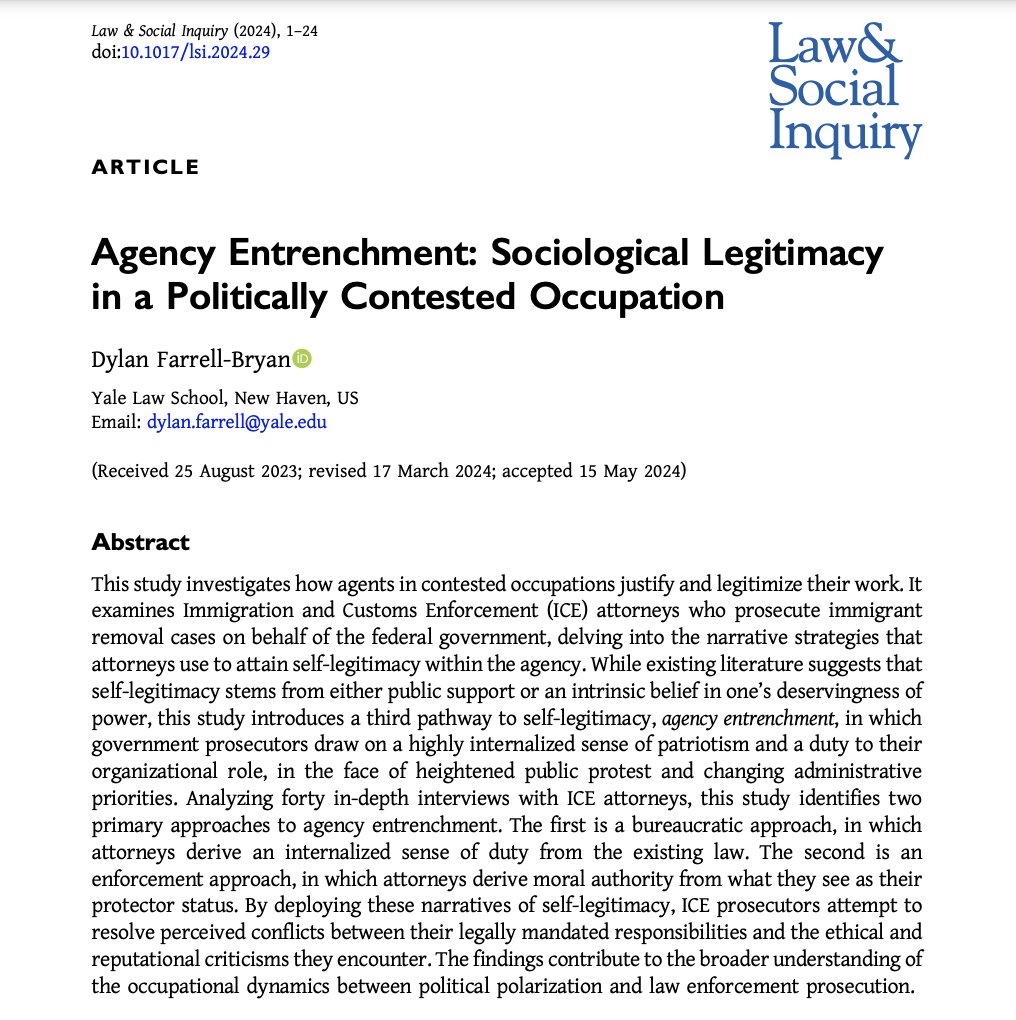
🚨 new pub, first view 🚨 really excited to share my new article, which draws on in-depth interviews with ICE attorneys to understand how they understand & legitimize the work of prosecuting immigrant removal, out now in @LSI_Journal. Full article here: https://t.co/cCz9q2arqv
Congrats to Prof. Gary Lee on receiving the 2024 Best Scholarly Article Award from the @ASAnews Global and Transnational Sociology Section for "Racialized Legalities: The Rule of Law, Race, and the Protection of Women in Britain's Crown Colonies 1886-1890" https://t.co/cSXqsapPdx
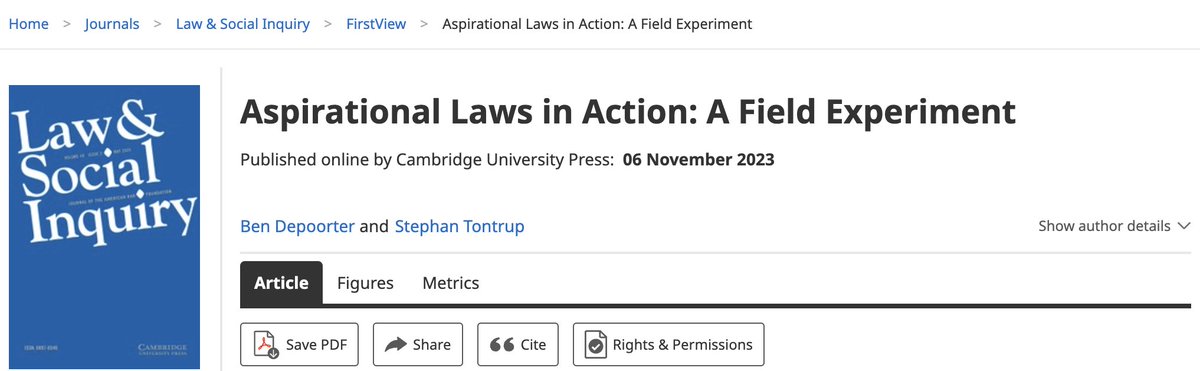
Can aspirational laws change how people act? Depoorter (@uclaw_sf, @ben_depoorter) and Tontrup (@nyulaw) explore this question on an LSI article that analyzes the impact of an unenforced public smoking ban on individuals' attitudes and behavior. https://t.co/ED2vmsH8Hm
Financial regulations oversimplify society, making them unequipped to handle financial crises. In LSI, @Giuliano_C (@HkuLaw) argues that “neglecting complexity is not only intellectually flawed but also politically dangerous and socially irresponsible”. https://t.co/iMd3Upg7qx
Voicing grievances activates legal rights. In LSI’s #firstview article, @LindaMulcahy7 (@OxfordCSLS) studies the NHS to raise questions around what motivates people to articulate their concerns in formal settings, independent of claims for recompense. https://t.co/XUcmmiesob
How do US states determine which gender boxes to include on govt. forms? In LSI, @ariezrawaldman (@UCILaw) directs attention to institutional, technological, political, and sociolegal contexts. Far from neutral, forms shape knowledge and gender inclusivity.https://t.co/i2l1WcMvz3
The US Supreme Court is under a legitimacy crisis. In LSI’s #firstview, Williams (@BatesCollege) and @leahchristiani (@Hunter_College) highlight ideology, partisanship, and descriptive representation's effects on how and why the public supports the Court. https://t.co/MmrwSccyn0
Why do people with lower credit scores “deserve” to pay more for things like car insurance? Reyes (@UBuffalo) and Headworth’s (@PurdueSociology) article explains how legal infrastructure solidified an economy of moral judgment around the auto loan market. https://t.co/yPx4OYttRB
Law’s moral legitimacy impacts people’s responses to legal evasion. In LSI’s #firstview, Qian Liu's (@UCalgary) research on Chinese villages under the one-child policy reveals how interpersonal relations and distrust of the law shape legal consciousness. https://t.co/oH5Ycoop0o
“He Is Still Your Father” illuminates the power of law in individual-family-state dynamics. In LSI’s #firstview, Chua (@NUSingapore) explores Taiwan’s parental maintenance litigation, advancing feminist vulnerability theory through the concept of tethering.https://t.co/TbvyRVji94
Parole work is perhaps the hardest but also most crucial part of criminal justice systems. In LSI’s latest issue,@KathMaier (@uwinnipeg) @R_Ricciardelli and @markdavidnorman (@MemorialU) explore how parole officers experience their occupational authorities.https://t.co/F1JBhBuDK1
“Who should be in prison?” is an urgent question in the face of the staggering size and racial disparities of US prisons. In LSI’s #firstview, Dalke (@UCBerkeleyISSI) shows how the parole board’s old ideas around punishment justify keeping people in prison.https://t.co/q1mGfjCqfq
What to do when justice is impeded by punctilious application of law? Mark Drumbl (@wlulaw) addresses this question in a review of @LianaMinkova's Responsibility on Trial (@CUP_Law), introducing systemic solutions to impunity in international atrocities. https://t.co/jLQpH8mrrq
Transforming constitutionalism in a continent shaped by colonialism urges a new political vision. In LSI’s #FirstView, Klug (@UWMadison) advocates for “recalibrating the African constitutional imagination,” citing Gould's ethnography on Zambia's struggles. https://t.co/pKCKWGkV3y
Just announced at #LSA2024 📣 The 2024 winner of the LSI Grad Student Paper Competition is @WaltGJohnson (@ANURegNet)! “It’s (Not) Just Semantics: Neurotechnology as a Novel Space of Transnational Legal Governance" uses a case study to show how spaces of global governance emerge.