My father died in Japan in February and I could not get back.
I told exactly one American, and only because he asked a direct question at a bad moment and I have never been able to lie fast enough.
He did not say he was sorry.
He said, "You busy Saturday?"
I was not busy Saturday. I have not been busy on a Saturday since I arrived in this country.
He wanted help moving a riding mower to the other side of his garage. The mower runs. He drove it out himself. I want to be accurate here, because I have thought about it a great deal since: the mower ended that day about two feet from where it started.
We were in the garage five hours.
There was a small refrigerator out there with beer in it and one orange drink belonging to his grandson, and neither of us touched the orange drink at any point.
We discussed a shelf. We discussed a bolt for some time. Around one o'clock we spent close to forty minutes on the correct way to coil a hose, and he was wrong, and I told him he was wrong, and he told me to prove it, and I proved it, and he said "huh," and that was the end of it.
He did not mention my father once.
I had prepared for it. In my country a man in mourning is approached with fixed phrases that have been in service four hundred years, which is the entire purpose of them, and I had built mine in English over three nights. They were not good. They were ready.
I never used them. I still have them written down.
At six he said, "Same time next week?"
We did that for five Saturdays. We moved a workbench. We rewired a light that already worked. One Saturday we sorted screws by length, which is not a job. That is somewhere to put a man.
In April a neighbor three doors down lost his mother.
I do not own a mower. I own a boat trailer that does not need to be moved.
He came at eight. He is coming again this Saturday.
I have not said one word to him about his mother and I am not going to.
He knows what time.
I don't give a damn if taking a side creates a mountain of enemies, if even my former fans turn against me, if my 300,000 followers shrink to three.
Deep in my soul I respect Elon Musk to the absolute maximum.
If he hadn't risked everything, succeeded, and bought X, free speech in Japan would already be dead.
We would all be living exactly as the leftist and Chinese-controlled television tells us to — and we would already be becoming Islamic.
By the time my daughter entered elementary school there might have been a law forcing us to hand her over to Muslims.
Human beings are not born to be liked by others.
We do not live so that our daughters can smile and say "you're a good person" while we enjoy a peaceful, smiling life.
Even if I lose everything, I will still protect my daughters somehow.
That is the definition of being human.
The only platform that still gives us any chance of protecting that is X.
From the very moment Twitter was renamed, I have deliberately and loudly called it X.
I have done nothing wrong.
I will never apologize to anyone.
America should be a country for Americans.
Japan should be a country for Japanese.
Britain should be a country for the British.
That is all.
For over 50 years #USSLiberty survivors have been seeking a complete and comprehensive public Congressional investigation of the attack on our ship.
Surely you aren't suggesting that appearing under oath before a Congressional Committee will be a supportive and respectful experience given that none of the members of that Committee (or any Member of Congress for that matter) have ever attended our annual Memorial Service at Arlington National Cemetery honoring our 34 fallen shipmates and that the US government has allowed the @IDF to commit alleged War Crimes against the US with impunity and without remorse during its attack on our ship.
You give yourself too much credit. Perhaps you should spend more time researching the attack and less time patting yourself on the back.
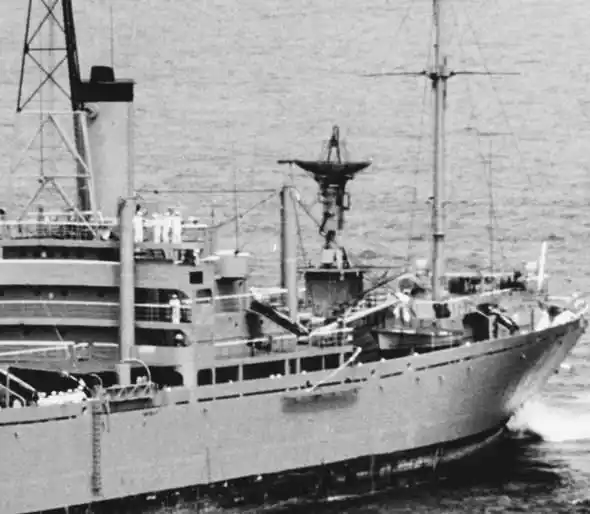
@exacqua1@WassonWatch El Quseir was laid-up in Alexandria at the time, hadn't put to sea in years, was less than 1/3 USS Liberty's size, and didn't have any moonbounce dish antennas the size of a house on deck.
Okay, time to explain guns to our new friends.
Every day, when I leave the house, I attach a holstered handgun to my belt, under my shirt or coat.
I would no more leave the house without a gun than I would walk around outdoors without shoes.
Is it because I "need" a gun?
No.
I live in rural Tennessee, which is state in the American south. It's very safe here. The dangerous parts of America are big cities where the local government is leftist, and they shelter illegal migrant from the third world, and won't send violent criminals to prison. Places like Chicago and New York City.
Yet, any time I leave the house, I put on a gun, knowing that I will probably never have to use it, and if I do, it will probably be on an aggressive stray dog, not a human.
So why do I do it?
Why do many other people who live around me do it?
Why do we do this so much that carrying a gun is considered totally normal? If someone spotted it, it would not even arouse a comment, much less any fear.
In fact, it is legal to carry a gun openly here, without covering it up. Covering it up is just considered polite.
So.... why?
Well, try thinking of an English nobleman, during the reign of Elizabeth the First. When he dressed to go ride to court, he would hang a slender fencing sword, called a rapier or smallsword, from his belt.
He didn't expect to be attacked.
He didn't even expect to fight a duel. And if he was challenged to a duel, he wouldn't need his sword right then. He would meet his challenger later at an agreed-upon place and time.
No, he wore his sword because it was an expression of who he was. He was a gentleman, a person of status, with the legal privilege of carrying a sword.
By carrying a sword, he asserted his rights and prerogatives as a nobleman.
In Japan, you had the same sort of thing happening. The samurai, members of the bushi class, wore the two swords not because they expected to be attacked at any moment, but because the two swords were an essential part of who he was.
So, in these two cases, weapons were carried by noblemen as an assertion of status. They had the right to do so, and they did so in order to assert, exercise, and retain the right.
Americans carry guns because every American citizen is a nobleman.
When we fought the British for our independence, that war began on April 19th, 1775, when British troops, fearing American rebelliousness, marched out from Boston to confiscate guns from people living in the surrounding countryside.
Our ancestors did not submit to this. We shot them instead, and they fled back to Boston with their tails between their legs, to cower under the cover of the guns from the warship HMS Sommerset.
Thus began several years of war.
And when we won that war, we made a country where no government, and no man, would ever be allowed to disarm the people.
No agent of the government may say to us, "I may have a gun, and you may not."
Because to say that is to say "I am a nobleman, and you are a peasant. I am a master, and you are a slave."
We are not peasants here. We are all noblemen. That is the most basic principle of what it means to be an American.
I can be impoverished, so I can to be so poor that I live in a van down by the river. But however reduced my circumstances, as an American, I still have the rights and freedoms of a nobleman, of a daimyo, because that is the basic founding idea of the nation we forged on that day.
If you come to America to visit, if you walk among us, you will pass many people carrying guns. You will not notice this. You will not see them. You will witness no violence. Everything will be normal. But the guns will be there.
Because that is who we are.
We don't carry guns to be violent. We don't wish to be rude, or to intimidate people. We keep our guns covered up.
But they are the deepest, most essential part of what it means to be American.