Been off Twitter for a couple of days for work & training.
I log on now & was wondering why there are so many Spanish speaking people in my mentions🤔
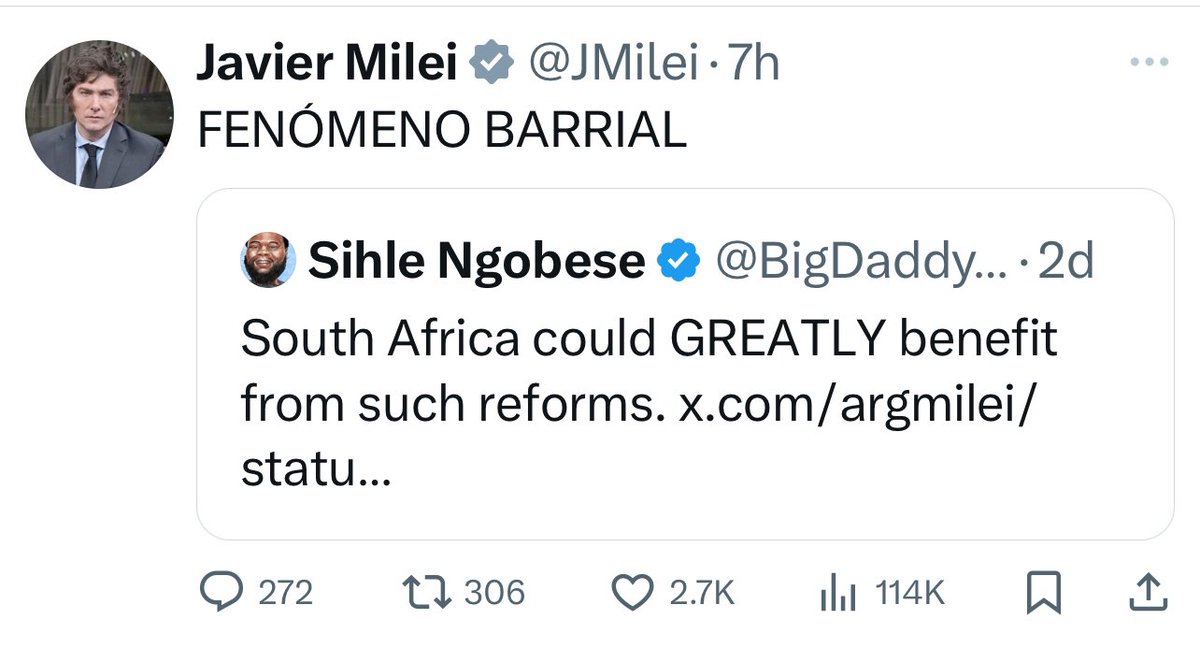
Then I see it is because the President of Argentina🇦🇷 quote tweeted me😳
X is such a fascinating app. It connects everybody…
In 1953, the Czechoslovak government legally stole the life savings of its citizens overnight.
My grandfather was 20 when it happened and it impacted him so much that he would still talk to me about it 50 years later.
Here's how it all went down:🧵👇
I frequently have to remind myself that not everyone has had access to a high standard of education, and that most have been victims of a highly effective propaganda campaign that has been running continuously in South Africa for over 30 years.
For some reason, the topic of the 1992 referendum has gained attention among the more liberal and intellectually minimalistic voices on X, such as @DanCorderOnAir and others. This is largely because @TheKiffness correctly pointed out that 68.7% of white South Africans voted "yes" in the referendum.
His illuminating post was duly met with a loud and antagonistic chorus from the majority, accusing him of being racist, an apartheid apologist, and clearly wanting apartheid to return. Nothing highlights the desperate need to play the victim card more than labelling someone as racist simply for stating a well-known fact.
As usual, I stirred the pot by pointing out that De Klerk's threats about the consequences of voting "no" and the fact that apartheid had essentially become a hollow shell by the time the referendum was held. Only to be met with the same banal accusations of racism, being an apartheid apologist, and wanting apartheid to return (yawn)—simply for stating a fact that anyone with the slightest bit of critical thinking could verify on Google. However, again I forgot that critical thinking left South Africa a long time ago and was replaced by racism.
I’ve realised that in this country, presenting facts that challenge the prevailing narrative and provoke discomfort often leads to unfounded accusations of racism. Quite frankly, I’ve reached the point where such accusations hold no weight for me. Your discomfort in confronting these facts is not my burden to bear. So, let’s focus on sharing truths that may unsettle the majority on X.
In 1986 the National Party began the process of dismantling Apartheid. In response to international pressure and the internal power struggles within the National Party. The South African government abolished the “pass laws” in 1986, although Blacks were still prohibited from living in designated white areas.
In addition, international events were to play a key role. In an article by Becky Little, titled: Key Steps That Led to End of Apartheid, “Visser speculates that the fall of the Berlin Wall in November 1989 helped speed the process of ending apartheid along because it took away one of the government’s main defences of itself among Western allies: that it needed to remain in place to fight communism.
“The argument that the ANC are only the puppets of the Reds couldn’t be used anymore,” Visser says, both because the Cold War was ending and because the ANC now had a lot more support in Europe and the U.S.”
During the period 1988 to 1989, differences in how to deal with the ANC, its unbanning and the release of Mandela, led in part, to the ousting of PW Botha from power, made easier once it came to light that he had suffered a mild stroke.
The repeal of major apartheid legislation, including the Group Areas Act, Land Act, Separate Amenities Act and the Population Registration Act, occurred on June 17, 1991, paving the way for the end of apartheid and the first non-racial elections in 1994.
By 1992, Apartheid existed in name only—it was finished, done, over, and never to return. The 1992 referendum wasn’t about dismantling Apartheid; it was about negotiating a settlement that would transfer control of the country to the ANC.
The fact that the white population believed they were voting for the end of Apartheid was a result of a highly effective and costly public relations campaign, designed to ensure a peaceful transition from white minority rule to black majority rule. This was aimed at leaving the country intact, ready to be exploited by "international investors" and corrupt individuals, who began pouring into South Africa from 1991 onward.
According to the records in the case against British Aerospace (BAE Systems), representatives were already in the country, meeting with Zuma and Modise, carrying cases full of money, long before the 1992 referendum ballots were even printed. It was all a sham. The referendum was purely about giving the NATS the green light to hand the country over to the ANC.
That said, this doesn't change the fact that the overwhelming majority of white people who voted in the referendum, sincerely voted to end Apartheid. It merely serves to highlight just how expertly the cover-up was executed.
When people were warned that the expropriation act is about private property and not just farm land, they shrugged it off. Ironically the first implementation of EWC will be urban private property: https://t.co/ZWZflqc3cN
@joelpollak@City_Press Well, there's a whole interactive database of the Zondo Commission's findings right here, and a whole lot more besides, if they are looking somewhere to start:
https://t.co/JYWQxrM3Ri
Chaps, this economic "growth" is about as bad as it gets. It's below population growth, so it's effectively negative. This is a disaster that you should be feeling sick about it, not applauding
If you agree that Head of NPA Shamila Bathoi should resign immediately and be replaced by the head of SIU Adv Mothibi or Adv Glynnis Breytenbach pls like and retweet this tweet.
We must be careful not to paint our fellow South Africans,regardless of religion,tribe,or colour,with broad brushstrokes. We are all uniquely South African.Throughout history,every SA government has sought to control us by turning us against one another.Don't give them that power
Despite hitting nominal all-time highs...
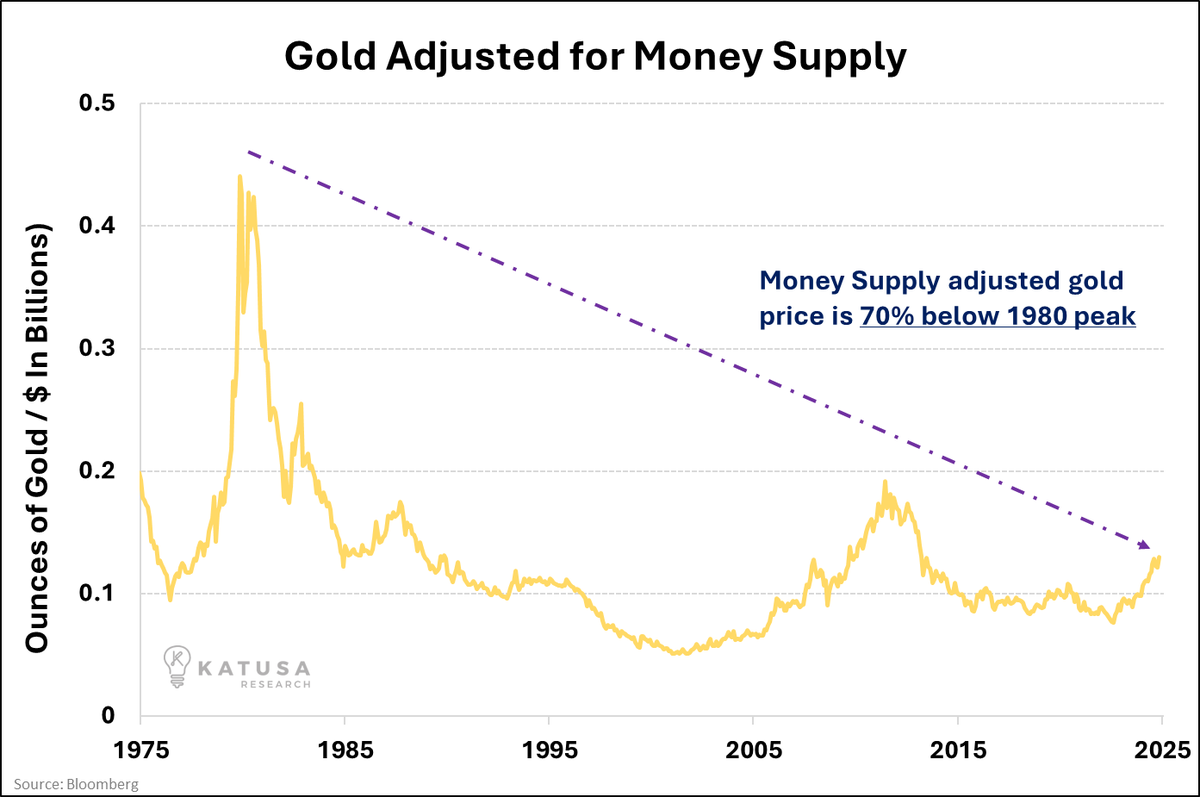
Gold remains severely undervalued at 70% below its 1980 peak when adjusted for money supply growth
We're nowhere near a true gold mania and institutional capital hasn't even begun to enter the market.
In 1980 (the peak), the ratio was around 0.44, meaning you could buy about 0.44 ounces of gold per billion dollars in the money supply.
Today, that ratio is much lower (around 0.13), only about 30% of what it was at its peak.
This decline happens because while gold's nominal price has increased over time, the money supply has grown much faster.
So even though gold costs more dollars today than in 1980, it has actually become "cheaper" relative to the total amount of money in circulation.
@Newzroom405 Let's also NOT forget, this is exactly what the #ANC did to the Apartheid Government when they did not want to talk, they went Global!
“If the ANC does to you what the Apartheid government did to you, then you must do to the ANC what you did to the Apartheid government.” Mandela
@Newzroom405 Let's also NOT forget, this is exactly what the #ANC did to the Apartheid Government when they did not want to talk, they went Global!
“If the ANC does to you what the Apartheid government did to you, then you must do to the ANC what you did to the Apartheid government.” Mandela