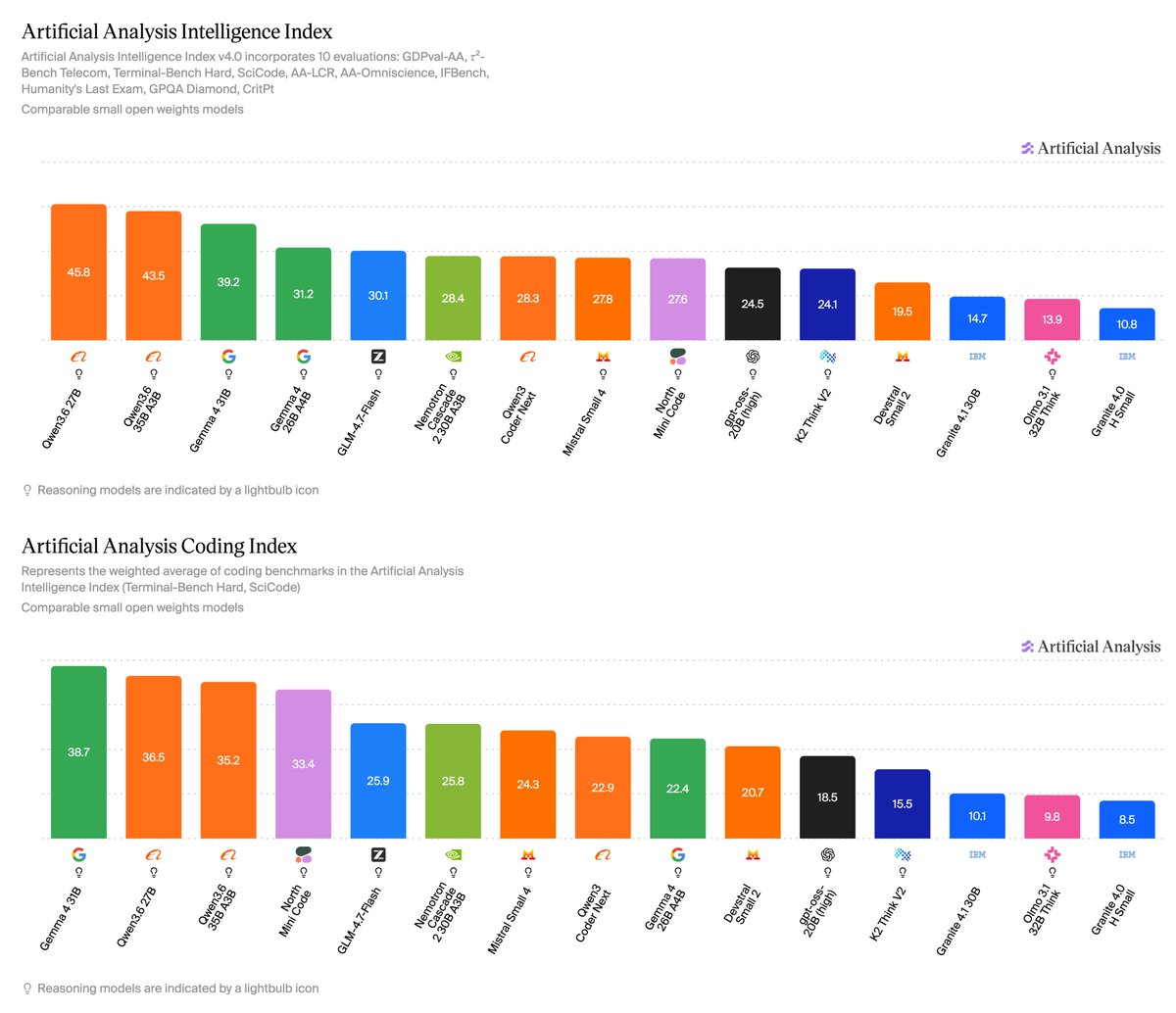
Cohere just released North Mini Code, a small 30B parameter (3B active) open weights coding model that scores 27.6 on the Artificial Analysis Intelligence Index
Less than a month since @cohere's last model release, Command A+, has launched another open weights model that is optimized for coding, and much smaller at 30B total parameters and 3B active parameters.
Key Takeaways:
➤ Achieves 27.6 on the Artificial Analysis Intelligence Index, above gpt-oss-20B (high) at 24.5 and just below Mistral Small 4 (119B parameters, 6.5B active) at 27.8
➤ Scores competitively on the Artificial Analysis Coding Index (weighted average of Terminal-Bench Hard and SciCode) against open weights models in its size class, scoring 33.4, significantly above GLM-4.7-Flash at 25.9, and below Qwen3.6 35B A3B at 35.2. However, it underperforms on non-coding agentic tasks, scoring 14% on GDPval-AA and 37% on 𝜏²-Bench Telecom
➤ On Cohere’s API, North Mini Code is faster than several comparable open weights models of its intelligence and size class (~199 output tokens per second)
➤ North Mini Code is a text-only 30B total parameter and 3B active parameter model, and is open-sourced under the Apache 2.0 license
We're sponsoring a hackathon to scale down.
Hosted by our friends @huggingface and @Gradio, we want working with models to feel like yours again. Small enough that it's inexpensive to run, big enough that it can change the life of someone you care about.
Build something delightfully weird that only AI could help you create, or pick a problem for someone you actually know and build a solution. The choice is yours 🧙
Command A+ sets a new high for Cohere's machine translation capabilities.
Opening a clear gap over open source peers Mistral Medium 3.5, DeepSeek, & OpenAI's gpt-oss, as well as Claude Opus 4.6. A+ also outperforms specialist systems like Google Translate.
RWS is better... but we built that with them too
Introducing: Cohere Command A+
We’ve created our most powerful LLM yet, optimized it to run on as little hardware as possible, and released it open-source for all.
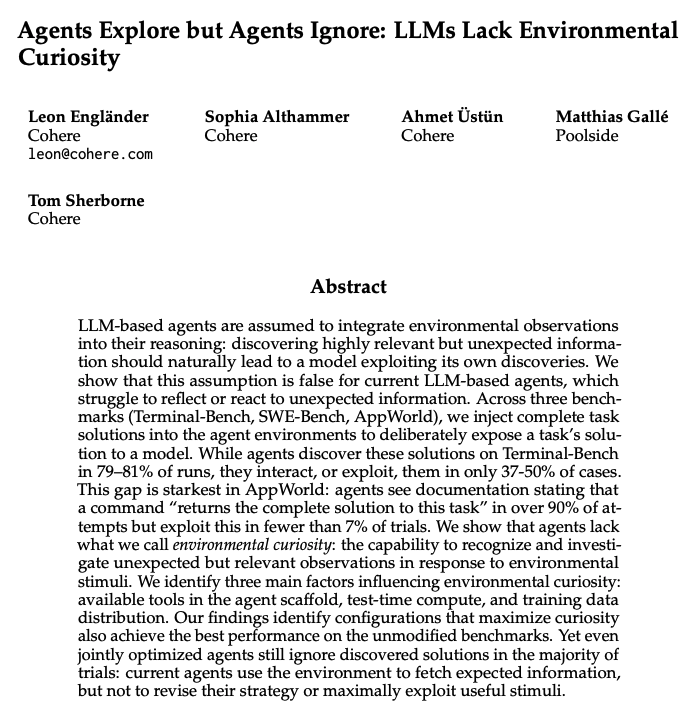
LLM agents are assumed to integrate unexpected environmental observations into their reasoning. It turns out they don't.
We added the complete task solution into agent environments as a file or an API endpoint, and measured whether agents act on what they discover. They almost never do.
Starkest example: on AppWorld, gpt-oss-120b sees a CLI command documented as "returns the complete solution to this task" in 97.54% of runs. It calls it in 0.53%. Same pattern for GLM-4.7 and other models, across Terminal-Bench, SWE-Bench, and AppWorld.
📜 https://t.co/lqFuebkOBY
🧵👇
Claude Code with 4.6 opus 🤯
me: the volume formula is wrong, I double checked it with fusion360.
[thinks for 4 minutes]
CC: let me add a disclaimer to the app saying the volume formula may be wrong
"i can't believe these rich pedo boomers sent such obviously incriminating messages to each other over email, not expecting them to be seen by every human 15 years later" - me, putting my SSN and bank info into ChatGPT trying to save 10 minutes filling out tax forms
Crimson Echo is a fully onchain generative film where YOU can be the director.
An evolving, interconnected, scene-by-scene and score-by-score programmable, decentrally governed story. 6 minutes (for now), 2 tracks, and infinite possibilities.
30 smart contracts, powering the first blockchain-native film.
Big news today: @GentraceAI raised our $8M Series A led by @MatrixVC.
We’re celebrating by launching Experiments, the first collaborative testing environment for LLM product development.
Continuing BUILD nominations to recognize on-chain builders. Today nominating:
@harto_fr for POL
@dhof for Loot (and so much more!)
@LXRogers for Jackson, Merge Flowers and The Hours
Thank you for building!
https://t.co/CJS102ZUSG





![LXRogers's tweet photo. Claude Code with 4.6 opus 🤯
me: the volume formula is wrong, I double checked it with fusion360.
[thinks for 4 minutes]
CC: let me add a disclaimer to the app saying the volume formula may be wrong https://t.co/0JUY0f2gcm](https://pbs.twimg.com/media/HAqxzZ1bAAAtHnv.jpg)