@sonjatwilson Äänestäjät antavat mandaatin, eivät poliittisia päätöksiä. Se, mitä äänestäjät haluavat on ihan vain arvailua, poliitikkojen omaa itsesensuuria.
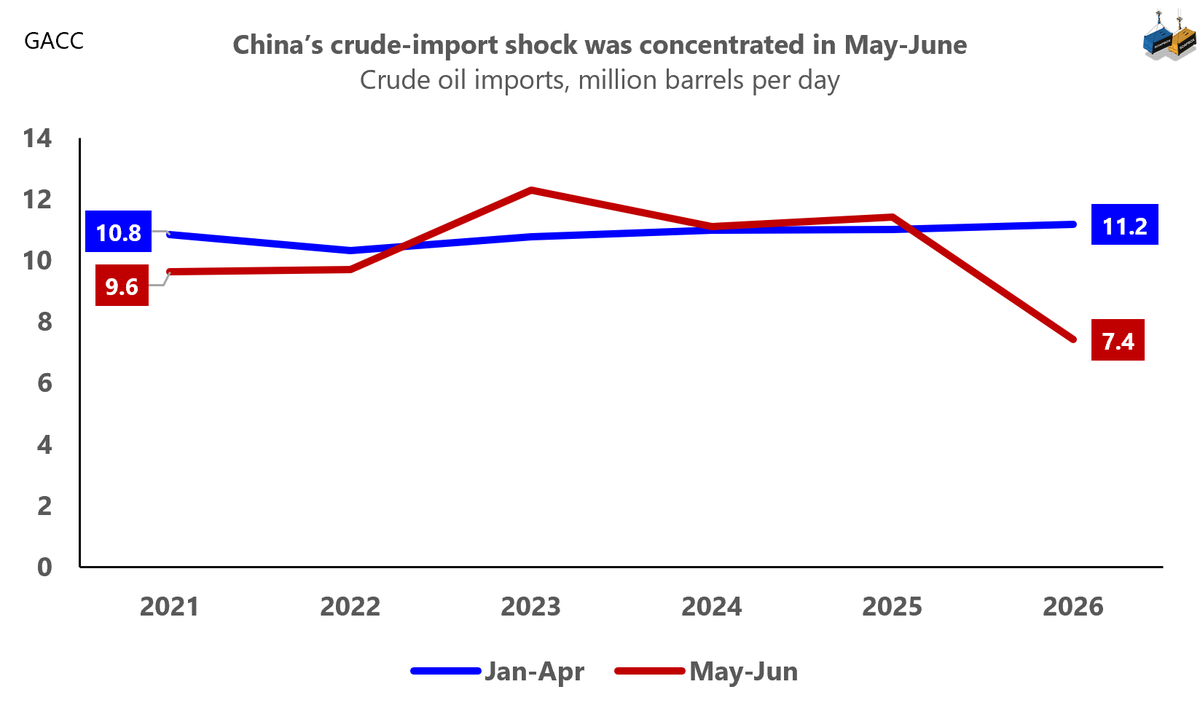
Apart from increased supplies from Brazil, China did not solve the Gulf shock by finding alternative oil. It absorbed the disruption by buying less, refining less, exporting less fuel and drawing on vast stockpiles.
Memory Is the Most Important AI Bottleneck: Who Controls HBM, DRAM, and NAND
AI infrastructure is increasingly constrained by memory bandwidth, memory capacity, and storage density, not only by GPUs. Accelerators need to be fed with data fast enough, or expensive hardware sits underutilized.
HBM is the most AI-critical segment because it sits directly beside the accelerator and solves the bandwidth problem. Q1 2026 HBM market was roughly $11B–$12B, based on Samsung’s reported HBM revenue and market share assumptions.
DRAM is the larger revenue pool. It includes HBM, server DRAM, DDR5, RDIMMs, and LPDDR. Global DRAM revenue reached about $97B in Q1 2026, driven by AI data center demand. Samsung, SK Hynix, and Micron control most of the market.
NAND is less direct than HBM for GPU performance, but it is essential for AI storage. Enterprise SSDs, training data, model checkpoints, retrieval systems, vector databases, and AI data lakes all depend on dense, reliable flash infrastructure.
$MU Micron
Micron is the key U.S. pure-play memory supplier across HBM, DRAM, and high-capacity SSDs. The company is ramping 12-high 36GB HBM4 ahead of schedule, has customer agreements covering HBM capacity through 2026, and is shifting HBM4E base dies to TSMC.
$SKHY SK Hynix
SK Hynix remains one of the most important HBM suppliers for Nvidia-linked AI accelerators. The company is scaling 1b DRAM for HBM4, expanding M15x capacity, and moving base dies toward advanced logic nodes to support wider AI memory interfaces.
$005930(.KS) Samsung
Samsung offers the broadest memory exposure across HBM, DRAM, NAND, and SSDs. The company is accelerating 10nm-class DRAM for HBM4, advancing 400-layer V-NAND, and scaling Key Value SSDs designed for AI inference workloads.
$SNDK SanDisk
SanDisk is focused on the NAND and enterprise SSD layer of AI infrastructure. Its BiCS8 3D NAND and High Bandwidth Flash architecture support dense storage, active data retrieval, training datasets, checkpoints, and AI data lakes.
$285A(.T) Kioxia
Kioxia is positioned as a NAND-focused AI storage supplier. Its 5TB high-bandwidth flash module targets PCIe 6.0 systems with 64 GB/s throughput, helping bridge the gap between expensive compute memory and traditional storage arrays.
HBM is the most strategic AI memory segment, DRAM is the largest profit pool, and NAND is the storage leverage behind AI scale.
@Rajajoppe Brexitin tavoite oli päästä eroon EU-maiden kansalaisista ja saada kontrolli rajalle. Kaikki on mennyt täydellisesti.
Tätähän Sebastian kannatti.
@chico_ray Well, Brexiteers wanted to get rid of people from the other EU countries, in order to control immigration independently. This one is a rare win.
@MVirtanen Kenen syy on, jos yrittäjä palkkaa maahanmuuttajan halvalla? Kaupasta sopivat ostaja ja myyjä, mutta työmarkkinoiden läpinäkymättömyyden vuoksi vain ostajalla on pääsy reaaliaikaiseen markkinahinnoitteluun. Koska markkina on ostajan puolella, tällä on suurempi moraalinen vastuu.
@MVirtanen Markkinoilla ostaja tekee tarjouksen ja myyjä joko myy tai ei myy. Yleensä hinnat laskevat, kun myyjiä on enemmän kuin ostajia, ja nousevat, kun ostajia on enemmän kuin myyjiä - paitsi tietysti Suomessa, jossa halutaan lukita alin hinta, ja sitten ihmetellä, kun kukaan ei myy.
@MichaelAArouet@AndreasSteno The US tax payer's public healthcare cost is pretty much the same as that of the European taxpayer's, but the US taxpayer doesn't get treated unless they pay the other half privately so that everyone can pretend that it's capitalism (the socialism part is "free").