Patrick Pouyanne, PDG de TotalEnergies :
"La vraie question, au niveau européen mais aussi français. Cela fait 40 ans qu'on construit une Europe des consommateurs, avec un seul objectif : battre l'inflation. Et donc on a ouvert nos frontières, on fait rentrer les produits.
Ce n'est pas une Europe de producteurs. Ce n'est pas vrai. On se ment à nous-mêmes. On construit tous les jours une Europe de consommateurs. Tous les matins, les décisions sont prises dans ce sens-là.
Donc à un moment, la vraie question, et c'est très prond ce que je pense là, on veut une Europe de consommation et une Europe écologique, mais cela ce n'est pas une Europe de producteurs.
Donc il n'y a plus d'industrie [en Europe], mais pourquoi ? Parce qu'on est mal accueillis, parce qu'on ne nous protège pas.
On a des facteurs profonds de productivité que sont les salaires, l'énergie, qu'on veut défendre dans notre modèle, mais qui ne sont pas comptaibles avec un monde ouvert.
La vraie question qu'on doit se poser collectivement, c'est : "Est-ce qu'on veut faire un projet de producteurs, ou continuer à satisfaire les consommateurs ?".
C'est un débat très compliqué, parce que nous sommes dans une crise du pouvoir d'achat.
Je vais poursuivre mon raisonnement. Pourquoi est-ce qu'il faut des producteurs ? Parce qu'on ne va pas s'en sortir si on ne fait pas grossir le gâteau avant de le redistribuer.
Notre problème, dans notre pays, c'est qu'on veut redistribuer une richesse qu'on n'a pas suffisamment créée. (...)
Si on pense production, on va re-réfléchir à la façon de faire grossir ce gâteau.
Producteur, ça veut dire augmenter le temps de travail. Enfin, pas le temps, sinon ça va grogner. Il faut que la masse de travail disponible soit plus importante. Il y a un écart par rapport à tous nos concurrents...
Alors, bien sûr, il fait bon vivre dans notre pays. Mais, simplement, on vit au-dessus de nos moyens. Et on redistribue avant d'avoir créé la richesse. Il faut d'abord des producteurs. Il faut une masse de travail plus importante.
Et il faut que notre système, je le dis, de charges, favorise le travail. Aujourd'hui, si je veux augmenter un de mes salariés de 100€, je vais payer 300€. Tout ça ne marche pas.
La contrepartie pour baisser les charges, c'est de diminuer les aides [aux entreprises]. Pourquoi y a-t-il tant d'aides ? Les aides, on les augmente parce que l'on compense les charges. C'est totalement absurde. Baissons les charges, et baissons les aides. Les grandes entreprises n'ont pas besoin d'aides si on leur baisse les charges.
Le fameux CIR [Crédit Impôt Recherche], dont on ne cesse de nous rabattre les zoreilles, pourquoi est-ce qu'on l'a créé ? Parce que l'ingénieur en France, il coûte trop cher. Donc on construit un système pour compenser.
Mais ce n'est pas ça [qu'il faut faire]. Il faut baisser els charges, et baisser les aides. Et, à ce moment-là, on va retrouver une dynamique collective. Si on n'arrive pas à se dire que l'algorythme, c'est la production, et c'est de faire croître le gâteau par le travail, je peux vous dire qu'on ne va pas trouver de solution collectivement.
Mais c'est un projet de société."
Taxe sur les plus-values sur les actions par pays en Europe 👇
🇫🇷 France → 31,4 %
Taux fixe par défaut (PFU), dès le premier euro. Option barème progressif de l'IR possible
🇵🇹 Portugal → 28 %
Taux fixe, option barème progressif si plus avantageux
🇩🇰 Danemark → 27 % puis 42 %
Barème progressif, taux max dès ~21 000 €/an de gains
🇩🇪 Allemagne → 26,4 %
Taux fixe, mais 1 000 € de gains exonérés chaque année
🇮🇹 Italie → 26 %
Taux fixe, stable depuis 2014
🇪🇸 Espagne → 19 % à 30 %
Barème progressif par tranches, le 30 % ne s'applique qu'au-delà de 300 000 €
🇬🇧 UK → 18 % ou 24 %
Selon tranche d'imposition. 0 % dans l'enveloppe ISA (20 000 £/an)
🇧🇪 Belgique → 10 %
Nouveau depuis 2026. Exonération des 10 000 premiers euros/an
🇸🇪 Suède (ISK) → 1 %
Taxe forfaitaire sur l'encours, pas sur le gain réalisé. Exonéré sous ~27 000 €
🇨🇭 Suisse → 0 %
Exonération totale pour l'investisseur privé (hors trading professionnel)
🇱🇺 Luxembourg → 0 %
Exonération après seulement 6 mois de détention
🇳🇱 Pays-Bas → 0 % sur la vente
Mais taxe annuelle de 36 % sur un rendement théorique du patrimoine, dès 59 000 €
Champion mon frère 🇫🇷
@hugoguillemet@lequipe@Tanziloic Bonne mentalité c’est bien, la résurrection du cerveau à Ben Arfa ou Guebbels.
Allez va prendre ton chèque ailleurs et disparait comme bien d’autres avant toi 😉.
Rome handed out free grain to 40,000 citizens in 73 BC. By 46 BC, Julius Caesar found 320,000 people lining up for their monthly ration. That eight-fold expansion happened in under three decades, and it shows you how welfare states actually grow.
No Roman senator stood up and announced a plan to addict a third of the city to government bread. It happened incrementally, through political competition. Each magistrate who wanted votes expanded eligibility. Each expansion normalized the next one. The citizen who once considered the dole shameful eventually expected it, then demanded it, then organized politically to protect it.
This is the core mechanism free market thinkers have identified across every era: once you create a transfer program, you create a constituency for that program. Recipients vote. Administrators build careers. Grain merchants who supply the state develop a stake in keeping the contracts flowing. The political economy locks in.
Caesar, to his credit, actually cut the rolls back to 150,000 through verification audits. It was one of his more economically coherent moves, though the Senate still murdered him. His successors quietly let the numbers climb again.
What did the dole require? Massive grain imports from Sicily, Sardinia, and Egypt, organized through state logistics at state expense, funded by taxation and conquest. When the conquest revenue dried up, the obligation remained. Rome had written a check against future military success, and future military success eventually failed to arrive.
The lesson is not complicated. Distribute a benefit and you distribute dependency. Distribute dependency and you distribute political power to whoever controls the distribution. The grain dole didn't weaken Rome overnight, but it made every subsequent reform politically impossible.
Vous vous souvenez d'Amélie Oudéa-Castéra ?
Mais si, c'était la macroniste responsable du comité national olympique.
Celle qui adOOOOre Aya Nakamura.
Bref, pendant qu'on était occupés à ne plus penser à elle, elle continue de nous couter cher.
Voilà l'affaire.
Il reste 16 Millions d'€ dans les caisses des Jeux Olympique de Paris 2024.
Plutôt que des rendre aux contribuables, les ponctionnaires ont leur petite combine pour détourner et blanchir cet argent : créer un fond chargé de redistribuer cet argent, histoire de trafiquer un peu d'influence.
À la tête de ce fond, Amélie Oudéa-Castéra a choisi de nommer Gladys Bézier, qui travaillait dans son cabinet de ministre.
Comme cette Gladys bosse déjà dans un autre fond, elle a accepté un salaire modeste pour cette nouvelle mission car elle ne pourra pas s'y consacrer à plein temps : 95 000 € par an.
Nous ne sommes pas du tout gouvernés par une mafia dont le seul but est de s'emparer de l'argent des contribuables.
🇫🇷 LE SAVIEZ-VOUS ? LA GAUCHE A ENTERRÉ EN 1997 UNE RÉFORME QUI AURAIT PU CHANGER LE FINANCEMENT DE NOS RETRAITES.
En mars 1997, la France adopte la loi Thomas.
Le principe était simple : conserver la retraite par répartition, mais permettre aux salariés de se constituer en parallèle une épargne retraite par capitalisation, éventuellement abondée par leur employeur.
Quelques mois plus tard, Lionel Jospin et la gauche arrivent au pouvoir.
Le gouvernement décide alors de ne pas publier les décrets nécessaires à l'application de la loi.
La réforme avait été votée.
Elle avait été promulguée.
Mais elle a été volontairement laissée sans application.
Le Sénat résumera lui-même cette situation par une formule très claire : « ni abrogation, ni application ».
Puis, en 2002, le gouvernement Jospin finit par supprimer définitivement la loi Thomas.
La France aurait donc pu commencer à construire, il y a près de 30 ans, un système dans lequel les salariés disposaient à la fois de la répartition et d'un véritable complément par capitalisation.
La gauche a fait le choix inverse.
Aujourd'hui, le financement de nos retraites repose toujours massivement sur les cotisations des actifs et chaque déséquilibre démographique conduit au même débat : travailler plus longtemps, augmenter les cotisations ou réduire les pensions.
On peut être favorable ou non à la capitalisation.
Mais historiquement, une chose est certaine : la France avait ouvert cette porte en 1997, et c'est le gouvernement de gauche de Lionel Jospin qui l'a refermée.
Sources : Légifrance, Sénat.
Ticket prices for the 2026/27 Paddy Power World Darts Championship have been confirmed

Full details and ballot FAQs

https://t.co/TBLsgj8Icg
Register now for ticket alerts

https://t.co/uLitbLMkOr See less
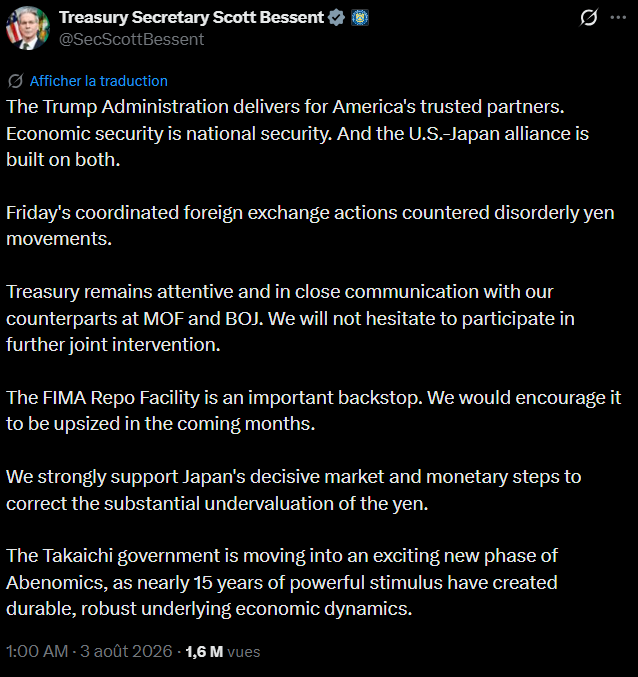
🚨 Bessent remet encore une sacrée couche ce matin et il faut bien mesurer ce qui se passe. Les États-Unis ont envoyé au marché le signal qu’ils étaient prêts à défendre activement la stabilité monétaire du Japon et la réussite de son projet économique.
🇯🇵 Le tweet de Bessent est extrêmement important parce qu’il confirme que le Trésor américain restera mobilisé pour le yen, qu’il n’hésitera pas à participer à de nouvelles interventions conjointes et qu’il souhaite même que la FIMA Repo Facility soit renforcée. Pour faire simple, les autorités japonaises pourraient mobiliser plus facilement leurs actifs en dollars afin d’obtenir des liquidités et d’intervenir sur le yen, sans être contraintes de vendre brutalement de la dette américaine sur le marché. C’est extrêmement intelligent car les États-Unis aident le Japon à attaquer la spéculation sur le yen tout en protégeant son propre marché obligataire. Quitte à sacrifier la politique du dollar fort...
⚠️ Désormais, le marché doit intégrer la possibilité de se retrouver face au Japon, au Trésor américain, à la Fed de New York et à des outils de liquidité potentiellement renforcés. On ne parle pas de taux de change garanti mais l'histoire n'est plus la même. Continuer à vendre agressivement le yen devient beaucoup plus dangereux quand on sait que deux des plus grandes puissances financières mondiales peuvent intervenir ensemble et sans préavis.
🧐 A mes yeux, le dernier paragraphe du tweet est le plus important. Bessent valide politiquement la trajectoire économique du gouvernement Takaichi. C’est presque un adoubement officiel où on explique que le Japon n’est pas un pays arrivé au bout de son modèle, mais est un allié stratégique qui entre dans une nouvelle phase de développement. Cela réduit clairement la probabilité que les États-Unis restent passifs face à une crise japonaise.
🤔 D'ailleurs, cette possibilité m'avait déjà poussé à regarder, depuis un moment, les entreprises directement liées aux priorités budgétaires et stratégiques de l’État japonais. Le nucléaire est un bon exemple sachant que le Japon cherche à renforcer sa sécurité énergétique, à réduire sa dépendance aux importations de gaz et de pétrole, à redémarrer davantage de réacteurs et à reconstruire une chaîne industrielle nucléaire crédible. Une stratégie qui s’inscrit dans la logique américaine de sécurité économique et de sécurité nationale. Du coup, vous aurez compris le principe : les États-Unis et le Japon cherchent à bâtir des chaînes d’approvisionnement alliées dans le nucléaire, les composants critiques, les petits réacteurs modulaires, l’ingénierie et la maintenance, afin de réduire leur dépendance à la Chine et à la Russie.
🇦🇷 Tout cela me rappelle le parallèle avec l’Argentine. Trump entretient une relation politique extrêmement forte avec Milei, et Washington considère la réussite de son programme comme un enjeu idéologique et géopolitique. Les États-Unis veulent faire de l’Argentine une vitrine des réformes libérales en Amérique latine, mais aussi un partenaire sur les minerais critiques, l’énergie, l’agriculture et la sécurité régionale. Le FMI reste également engagé, et tout indique que l’administration américaine ne souhaite pas voir Milei échouer à cause d’une crise de liquidité ou d’un accident financier évitable.
🤷♂️ Je pense vraiment qu'il devient dangereux de shorter frontalement le projet politique de ces deux pays. Les États-Unis semblent prêts à empêcher qu’un choc de liquidité, une crise de change ou une attaque spéculative ne fasse dérailler des gouvernements qu’ils considèrent comme stratégiquement utiles. On réduit clairement le risque extrême et on modifie la distribution des scénarios. J'avais changé beaucoup d'euros en yens depuis avril mais je n’avais pas anticipé une implication américaine aussi directe. C'est assez historique ce qui se passe.
D'ailleurs, quand les États-Unis commencent à traiter la sécurité économique de leurs partenaires comme une extension de leur propre sécurité nationale, j'estime qu'il ne faut pas être sur leur chemin.
Adam Smith’s most famous sentence remains one of the clearest statements in all of social science:
“It is not from the benevolence of the butcher, the brewer, or the baker that we expect our dinner, but from their regard to their own interest.”
The point is simple and profound. We do not rely on the kindness of strangers to put food on the table. We rely on their self-interest. The butcher supplies meat because he profits by doing so. The baker rises early because customers will pay for bread. Their desire to improve their own condition leads them, without any central direction, to serve ours.
This is the central mechanism of a market economy. Self-interest, channelled through voluntary exchange, produces cooperation on a vast scale. No one has to love their customers or share their political views. They only have to respond to incentives. The result is a system that regularly feeds, clothes, and houses millions of people who will never meet.
Many on the left still struggle to accept this. Self-interest is treated as morally suspect - a form of greed that should be restrained or replaced by appeals to solidarity and collective purpose. The preference is for systems that rely on moral exhortation or state direction rather than on the everyday pursuit of personal advantage. Yet the historical record is clear: societies that suppress self-interest in the name of higher motives tend to produce shortages, stagnation, and coercion. Societies that allow people to benefit from serving others tend to produce abundance.
Smith’s insight is not a celebration of selfishness. It is a recognition of reality. People are more reliable when they can improve their own lives by improving the lives of others. That simple alignment of interests remains the most powerful engine of social cooperation ever discovered.
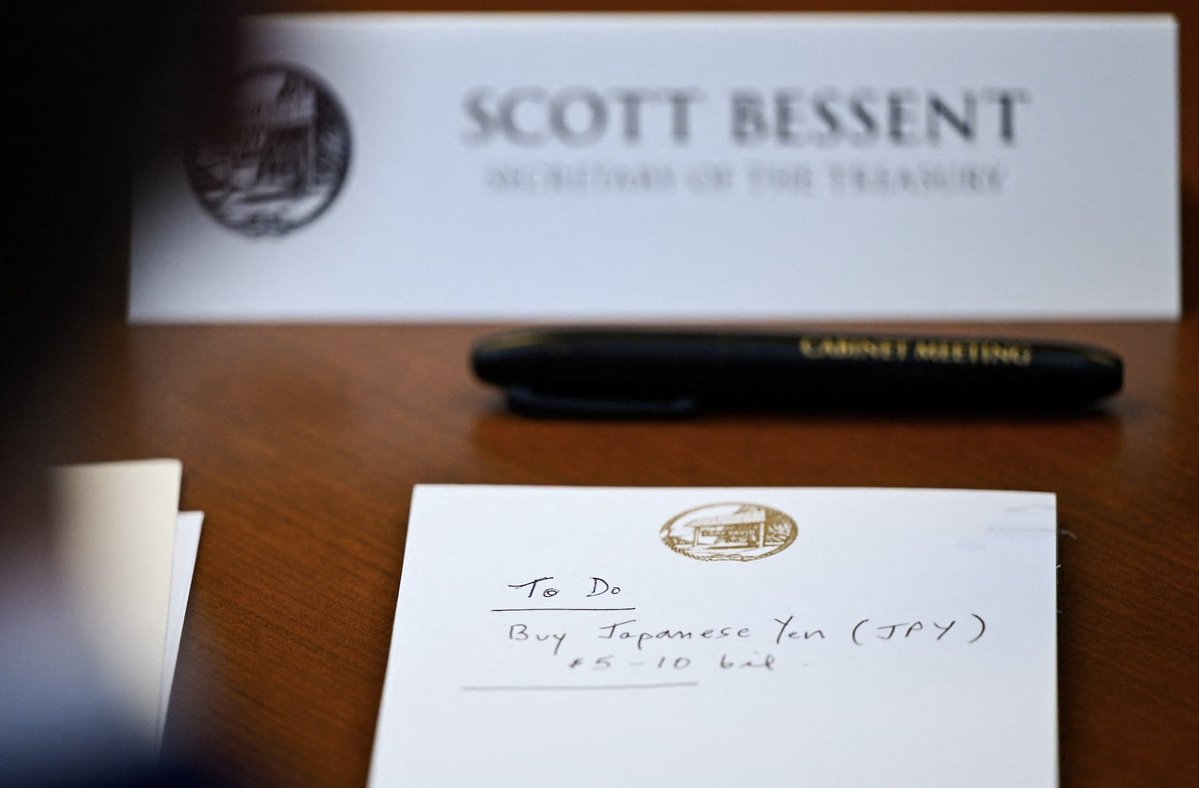
🚨 Le Japon a donc défendu le yen. Une opération à laquelle les États-Unis ont participé grandement, eux qui semblent désormais considérer qu’un yen trop faible n’est plus seulement un problème japonais mais aussi et surtout un vrai sujet de stabilité financière internationale.
🇯🇵 Jeudi, le yen a brutalement rebondi après avoir approché des niveaux complètement extrêmes face au dollar. Le mouvement a été tellement violent que le marché y a vu une intervention japonaise assez massive pour casser la dynamique de dépréciation. Mais vendredi, le sujet a pris une autre dimension puisque le Trésor américain a prévenu plusieurs banques qu’elles devaient être prêtes à une éventuelle intervention sur le yen. Dans le même temps, le responsable japonais des changes a laissé entendre que le soutien américain allait au-delà du simple soutien psychologique. Du coup, le yen est revenu d’un point bas autour de 164 à environ 157 contre un dollar.
🤔 Franchement, c’est assez dingue parce que le Trésor américain n’a plus soutenu directement le yen depuis 2011. Pour moi, le message implicite est assez clair. À partir d’un certain niveau, le short yen n’est plus un trade macro confortable mais un trade contre les autorités, et ça change tout. Jusqu’ici, les taux japonais restent trop bas, les taux américains restent hauts, donc on emprunte en yen, on achète des actifs mieux rémunérés ailleurs, et on laisse le carry trade faire le travail. Sauf que si le marché comprend que Tokyo peut intervenir et que Washington peut au minimum couvrir l’opération, alors le trade devient beaucoup plus asymétrique. On peut toujours avoir raison sur les fondamentaux mais se faire exploser sur le chemin.
✅ La grande réussite est que tout cela n’a pas déclenché de panique sur les marchés actions. Normalement, quand le yen remonte violemment, le risque est de provoquer un débouclage du carry trade avec des investisseurs qui rachètent du yen, vendent des actifs risqués, réduisent l’effet de levier, et envoient ainsi les actions au tapis, sauf que ce n’est clairement pas ce qu’on a vu.
🤷♂️ L’intervention a été lue comme une opération de stabilisation et pas comme un signal de panique. Le marché s’est dit que les autorités veulent empêcher un mouvement désordonné. Par contre, il faut être conscient qu’une intervention de change peut casser une dynamique sans changer les fondamentaux à elle seule. Le vrai problème du yen reste l’écart de taux entre le Japon et les États-Unis. Tant que la rémunération du dollar reste très supérieure à celle du yen, la pression structurelle ne disparaît pas. La BoJ ne peut pas monter trop vite les taux sans créer d’autres problèmes au Japon sur la dette publique, l’immobilier, les banques, et la croissance.
⚠️ À court terme, on a assisté à une nouvelle masterclass sur les marchés signée Scott Bessent mais c’est surtout un achat de temps (encore une fois). Si le dollar-yen reteste les mêmes zones dans les prochains jours ou prochaines semaines, le marché va vouloir savoir si les autorités sont prêtes à recommencer. Mais là, le sujet deviendra beaucoup plus lourd parce qu’une intervention ponctuelle peut impressionner, mais une défense répétée d’une devise coûte cher et finit toujours par poser la question des fondamentaux.
➡️ Le vrai signal à surveiller maintenant n’est donc pas seulement le yen mais aussi le marché obligataire américain parce que pendant que les actions tenaient, les taux longs, eux, restaient sous pression avec un 30 ans américain qui est monté autour de 5,24%, un plus haut depuis 2007. Si la défense du yen commence à s’accompagner d’une tension durable sur les rendements américains, alors le marché actions ne pourra pas indéfiniment regarder ailleurs.
Pour l’instant, tout le monde se dit qu’on a eu une intervention crédible donc pas de panique, sauf que si les taux continuent de monter, le narratif peut changer très vite.
For the first time in recorded history, a civilization has decided that the most enlightened virtue is to surrender its culture, heritage, women, and children without putting up any defence. Suicidal empathy shall prove to be the demise of the West.
💡 Les meilleurs investisseurs ne cherchent pas à battre le marché tous les mois. Ils cherchent à rester investis pendant des années.
C’est probablement la leçon la plus importante en Bourse.
Dans cet article d’Investir que je trouve plutôt intéressant, François Monnier rappelle 7 principes simples, mais souvent oubliés :
1️⃣ Pensez en années, pas en semaines : le temps et les intérêts composés sont les meilleurs alliés de l’investisseur.
2️⃣ N’essayez pas de prévoir les hauts et les bas du marché : investir régulièrement est souvent plus efficace que vouloir trouver le point d’entrée parfait.
3️⃣ Choisissez une stratégie adaptée à votre tempérament : la meilleure méthode est celle que vous êtes capable de suivre dans les périodes difficiles.
4️⃣ Achetez de bonnes entreprises plutôt que de simples “bonnes affaires” : la qualité finit souvent par créer davantage de valeur.
5️⃣ Diversifiez intelligemment : un portefeuille équilibré limite les erreurs inévitables.
6️⃣ Regardez vers l’avenir : la valeur d’une entreprise dépend de ses perspectives, pas de son passé boursier.
7️⃣ Continuez à apprendre : comprendre ce que l’on possède est indispensable pour investir avec conviction.
Au final, les performances durables reposent rarement sur des recettes secrètes.
Elles viennent surtout de la discipline, de la patience et de la capacité à rester fidèle à son plan lorsque les marchés deviennent plus agités.
Je vous mets l’article 👇
🚨 Pourquoi il faudra impérativement revenir sur l’interdiction des réseaux sociaux votée aujourd’hui à l’Assemblée, avec la complicité des LR et du RN, qui l’ont laissée passer.
1️⃣ Ils viennent de mettre le doigt dans un engrenage de surveillance des réseaux sociaux par l’État. Pour vérifier l’âge, il faudra associer l’identité réelle de chaque Français à ses comptes en ligne. On ne peut pas contrôler que les enfants : pour vérifier que vous avez plus de 15 ans, c’est votre carte d’identité qu’on vous demandera. Tout le monde sera fiché au nom de la protection de l’enfance.
2️⃣ C’est non seulement liberticide, mais c’est en plus une mise en danger. Quand on sait la fréquence à laquelle l’État se fait hacker et voit nos données compromises…
3️⃣ Si des parents n’arrivent pas à faire respecter une règle à leur enfant, pensez-vous que c’est l’État qui y parviendra ? On ne résout pas une crise de l’autorité parentale par une loi. Car, soyons lucides, c’est techniquement inefficace. Les adolescents déterminés utiliseront des VPN, des applis alternatives, des téléphones secondaires sans contrôle parental. On aura créé une infrastructure de surveillance générale sans avoir protégé un seul enfant.
4️⃣ Je suis favorable à ce que les parents interdisent les réseaux sociaux à leurs jeunes enfants. Les outils existent : les contrôles parentaux n’ont jamais été aussi performants, les smartphones permettent un suivi précis de l’usage. C’est aux familles d’exercer leur autorité. Et ce serait déjà bien que la société arrête de délégitimer les parents à longueur de journée pour ensuite venir les remplacer.
La solution, c’est de responsabiliser les parents, pas de fliquer les Français. Oui à l’autorité des parents. Non à l’État-nounou.