The bigger AI models become, the more GPU capacity they need.
This is important to understand if you are studying companies like E2E Networks and ESDS.
Let me explain it without the technical jargon.
When you hear 7B, 70B or 405B model, the B simply means billion parameters.
Think of parameters as the size of the model.
More parameters generally mean a larger and more capable model, but also much higher computing requirements.
A 7B model has 7 billion parameters.
A 70B model has 70 billion.
So the 70B model is roughly 10 times larger.
Now look at what happens to GPU memory.
If the model uses 2 bytes per parameter, just storing the model weights requires roughly
7B model = 14 GB
70B model = 140 GB
405B model = 810 GB
An H100 GPU has around 80 GB of memory.
So even before handling users, long conversations or other memory requirements, a large model can already need multiple GPUs just to fit.
And real usage needs even more.
Now look at training.
Training is much more demanding because the system has to store much more than just the model itself.
A simple rough estimate shows
7B model = around 126 GB
70B model = around 1,260 GB
405B model = around 7,290 GB
So as the model gets bigger, GPU requirements rise very quickly.
There is also the compute side.
If everything else remains similar, a 70B model can require roughly 10 times the compute of a 7B model.
That is the key point for investors.
AI is not only about more users.
The models themselves are becoming larger and more compute intensive.
At the same time
More companies are building AI applications
More users are using AI every day
Prompts and context are getting longer
Inference demand is increasing
New models keep getting trained
All of this increases the amount of GPU compute required.
This is what makes GPU infrastructure companies interesting to track.
Companies like E2E Networks and ESDS are essentially building the capacity that AI companies and enterprises can rent instead of building all of this infrastructure themselves.
The opportunity is not simply that AI is growing.
The opportunity is that every improvement in AI can require more compute behind the scenes.
#E2E #ESDS
The more I understand SEDEMAC, the more interesting its technology becomes.
First understand ISG.
In a normal petrol bike without ISG, you have a separate starter motor to start the engine and an alternator to generate electricity.
ISG combines both jobs.
The same electric machine starts the engine and then works as a generator once the engine is running.
But even inside ISG, there are two ways of doing it.
Sensor-based ISG:
Physical Hall sensors tell the ECU exactly where the rotor is, so the ECU knows when and how to rotate it.
Sensorless ISG:
There is no Hall position sensor.
The ECU itself estimates the rotor position using software, physics and control algorithms.
This is where SEDEMAC becomes interesting.
SEDEMAC has built proprietary sensorless commutation technology that can control the ISG even at zero and very low speed, which is exactly when starting the engine is difficult.
This means:
Fewer sensors
Less wiring
Fewer parts that can fail
Potentially better reliability
And importantly, ISG can be used on wet-magneto motorcycles where conventional Hall-sensor systems become difficult to implement.
Most competing ISG systems from players such as Shindengen and Denso are still sensor-based.
SEDEMAC's sensorless ISG started from zero in 2018.
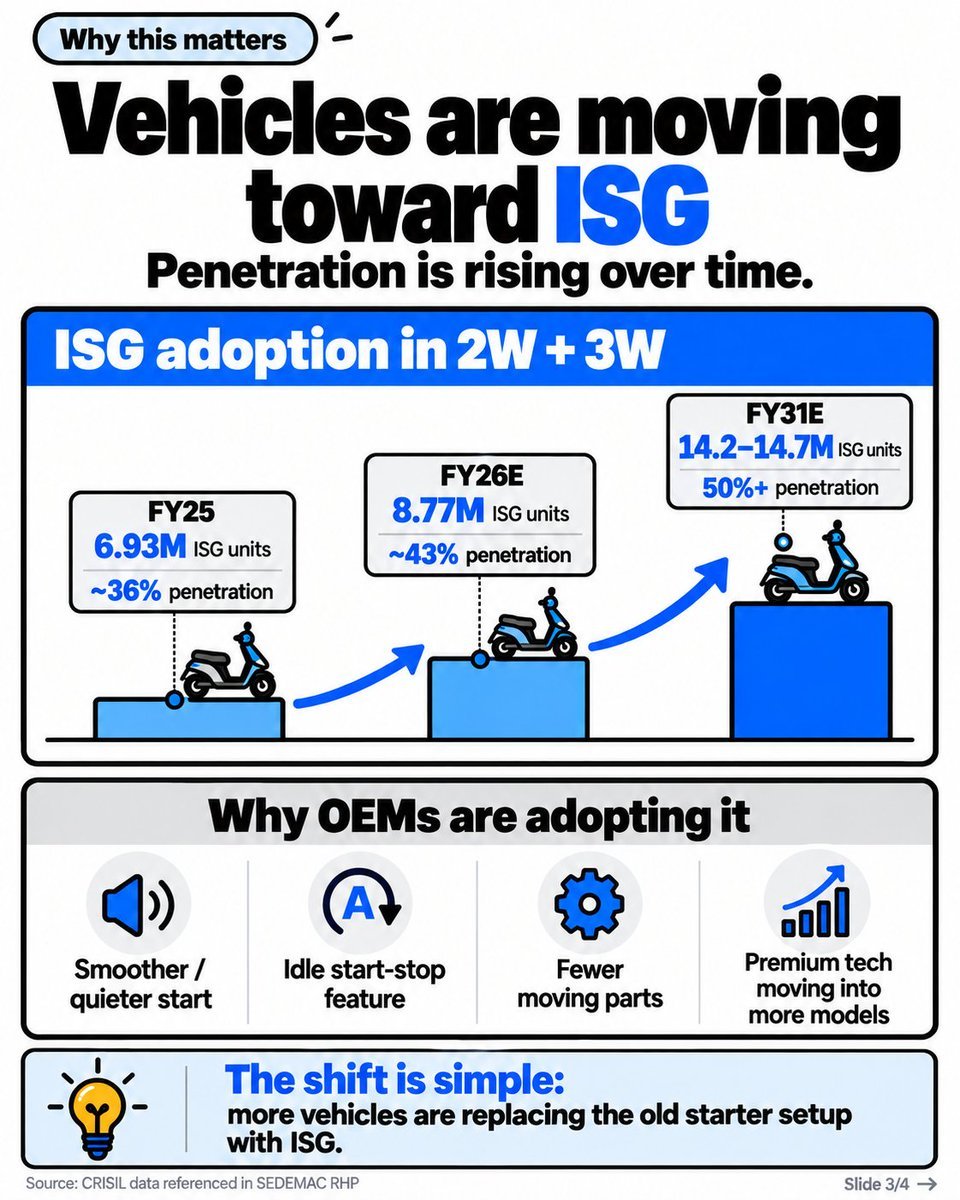
By FY26, around 35% of Indian 2W and 3W production had moved to ISG, and SEDEMAC estimates roughly 40% of these ISG vehicles were already using its sensorless technology.
What interests me is not just the current market share.
It is the direction.
As more motorcycles and 3-wheelers move from traditional starter systems to ISG, SEDEMAC is not just participating in that shift.
It is taking share inside the ISG market itself.
And because the differentiation sits inside algorithms, software, motor-control knowledge and years of real-world deployment, this is much harder to copy than simply manufacturing another electronic component.
That is the moat I find worth studying.
#SEDEMAC #IndianStocks #StockMarketIndia #Investing
1/
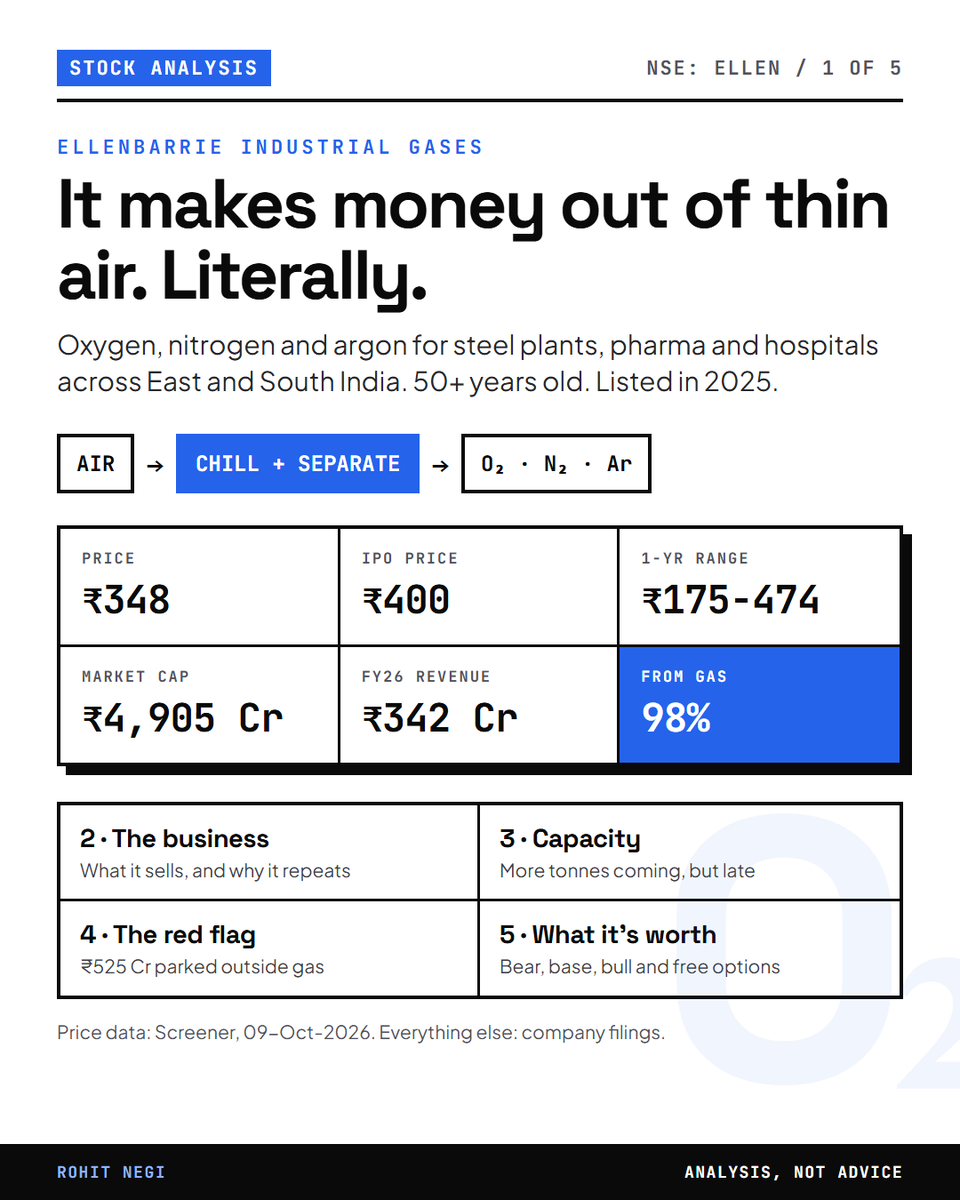
Ellenbarrie listed at ₹400.
In the last year it has traded between ₹175 and ₹474.
Today: ₹348.
It makes oxygen, nitrogen and argon out of thin air. Literally.
Supplies steel plants, pharma and hospitals across East and South India.
50+ years old. Listed only last year.
I was interested to see if it could be a play on India's chip and solar boom. What I found was a different story.
Here's my full analysis: the good, the red flags, and what it's worth 🧵
16/
What profit could look like (my base case, BHEL included):
FY26: PAT ₹104 Cr | EPS ₹7.4
FY27E: ₹127 Cr | ₹9.0 (+22%)
FY28E: ₹149 Cr | ₹10.6 (+17%)
FY29E: ₹166 Cr | ₹11.7 (+11%)
~17% a year. Slower than gas revenue (~22%), because treasury income shrinks as the cash goes into plants.
BHEL adds ~₹6 / ₹16 / ₹7 Cr of profit in FY27 / 28 / 29 (at an 8% margin, my estimate). A one-time bump in FY28, then it fades.
Bear: flat profit. Bull: ~30% a year.
At ₹348, the stock trades at ~33x my FY28 EPS.
Solar, chips and new coal orders are NOT in this. Free options.
17/
What I'm watching next:
• Uluberia-II filling up (bulk revenue should step up)
• Onsite revenue: ~₹14-15 Cr in Q2, then ~₹20 Cr a quarter from Q3 as the 325 TPD plant kicks in
• Loans and fund holdings in the Sep-26 balance sheet
• Any solar or chip contract with a number on it
Q2FY27 results due by 14-Nov.
18/
My lesson from this one:
A good business and a good stock are not the same thing.
The gas business here is real.
But I now read the "other income" note before I read the investor deck.
Nobody teaches better than the annual report. Except the market.
Would you own a gas company that lends money like a finance company, if the core business is this good? 👇
Not investment advice. I'm not SEBI-registered. These are scenario bands, not forecasts.
#EllenbarrieIndustrialGases #SemiconductorIndia #MakeInIndia #StockMarketIndia
AI models are trained once. So why does GPU demand keep growing?
This was one of the questions I wanted to understand while studying companies like E2E Networks and ESDS.
The simple answer is that AI needs GPUs for two very different things.
Training and inference.
Let me explain this in the simplest way possible.
Training is when an AI model learns from huge amounts of data.
That process needs massive computing power because GPUs can do many calculations in parallel.
That is why large AI models need thousands of GPUs during training.
But training is only one part of the story.
The more interesting part is inference.
Inference simply means people actually using the trained AI model.
You type a question into ChatGPT.
Someone generates an image.
A company runs an AI agent.
Another user uploads a document and asks for analysis.
All of these requests need compute.
And when millions of users are sending requests at the same time, the model needs huge GPU capacity just to respond quickly.
So you can think about it like this.
Training is heavy compute used to build the model.
Inference is recurring compute used every time people use the model.
And inference demand keeps increasing because
More people are using AI
AI applications are increasing
Models are becoming more capable
Context lengths are becoming larger
Users are sending more requests
AI agents are doing multiple tasks automatically
This is why GPU demand is not only dependent on new models being trained.
Even after a model is trained, serving millions of users creates continuous demand for compute.
This is where companies like E2E Networks and ESDS become interesting.
They provide access to GPU infrastructure to companies that need AI compute without buying and managing all the GPUs themselves.
So the AI demand chain becomes simple.
More AI models
More training
More users
More inference
More GPU compute required
That is the basic reason GPU demand continues to grow.
There is much more depth to this, but understanding training and inference first makes the entire GPU cloud opportunity much easier to understand.
#E2ENetworks #ESDS
Seeing causal opacity in action. When the markets go up, we tend to find good things to attribute it to. When the markets go down, we tend to find the bad things. But nothing has changed a lot in this short time. Serving our flaws very well.
#Markets#Nifty