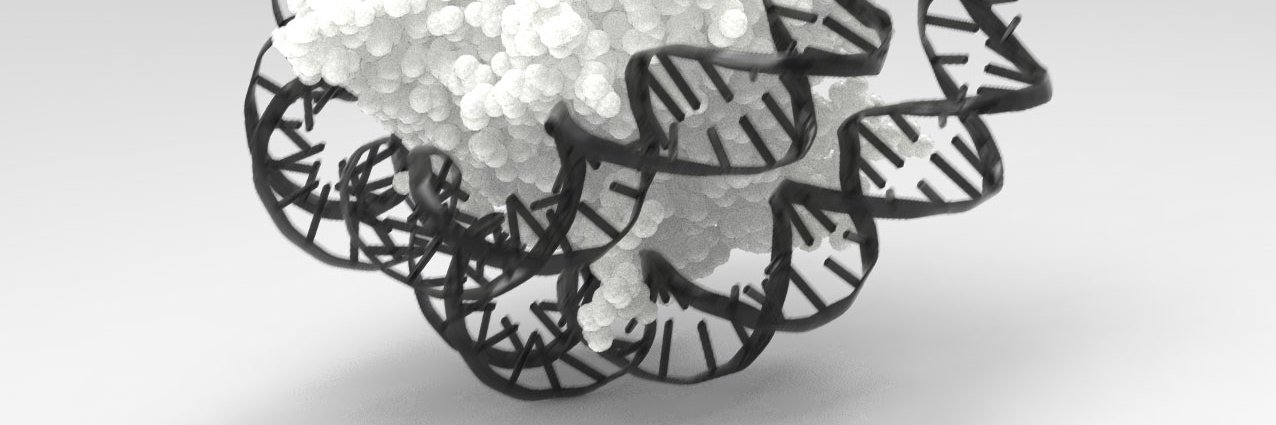
St. Jude scientists identified a direct role for PARP1 in chromatin remodeling, revealing for the first time how the protein partially disassembles nucleosomes to make damaged DNA accessible for repair. The findings could lead to more targeted PARP1 inhibitors and potentially reduce treatment toxicity. https://t.co/YWh6PuqrsW
Excited to share that our work is now published in Molecular Cell! We provide the first direct evidence for a role of hexasomes in DNA repair! Wonderful collaboration with @LabHalic, the Shelat labs, and St. Jude Imaging. https://t.co/TDbM38WDSJ
https://t.co/wmTnd9uv8x
Huge congrats to our collaborative team for their success achieving "Parallel stopped-flow interrogation of diverse biological systems at the single-molecule scale"
https://t.co/HjR3rgA6S0
An advance in experimental throughput and sensitivity that revealed unexpected results!
Researchers have mapped 117 kinases capable of phosphorylating the RNA polymerase II tail, revealing modifications at previously disregarded positions beyond amino acids two and five. This discovery expands our understanding of gene transcription control. https://t.co/vuaoK6uxfD
We analyzed cryo-ET dataset EMPIAR-11830 (@AbhayKot) and achieved in situ nucleosome reconstruction at 6.7 Å resolution, revealing clear DNA and histone density. Many more cryo-ET findings from @LabHalic are on the way. #CryoET#TEAMTOMO.
Scientists used cryo-EM to capture 13 distinct structures of the chromatin remodeler SNF2H in action. This research provides a complete view of nucleosome sliding, a key process in gene regulation. https://t.co/PF5duXioK0
Beautiful work from @JunminPengLab and @Yanshen73854711 in @CellCellPress
Turnover atlas of proteome and phosphoproteome across mouse tissues and brain regions: https://t.co/nyUA2qa4G1
Explore this amazing resource here:
https://t.co/Z2bCOKSzs5
A preprint from the lab led by graduate student Dana R Kennedy.
https://t.co/wG0dFQNVDO
Over 20 years ago, the Eissenberg lab showed that phosphorylation of HP1 is important for its silencing function. Why? Key observations from our study in fission yeast:
We have exciting news to share!
Abhay Kotecha (@abhaykot) is joining us as Senior Director of Technologies for Cryo-EM and Cryo-ET. We're thrilled to have him continue his great work in #CryoET, building on his innovation at @thermosciEMSpec.
Welcome to @stjuderesearch, Abhay!
Still hot off the press — @kellogg_liz and colleagues present the first structure of a Fanzor2!
Fanzors are eukaryotic RNA-guided DNA endonucleases. With the available Fanzor1 structures, the new work offers a comprehensive view of the family's evolution
https://t.co/9FuFjm1zzz
St. Jude names M. Madan Babu, PhD, as Chief Data Scientist. He’ll lead the new Office of Data Science, advancing biomedical research with 115 new roles. His work will help integrate vast datasets and improve patient care. #DataScience#BiomedicalResearch
https://t.co/c5nMfg9oCC
Happy to share our latest work from the @kellogg_liz lab, in collaboration with the Protein Technologies Center at St. Jude, where we describe the structure of Fanzor2. Special thanks to my co-authors, Zuhaib Qayyum and Ajay Tanwar.
https://t.co/tXTNMcHMgJ