Under the TNI standard, a legal chain of custody procedure is conditional. It's required if your customer requires it.
What applies to every sample is the receipt record. And the fields that fail assessment aren't the signatures. They're the times.
https://t.co/RNOq26T6Rt
Automation pays on three conditions together: high volume, low judgement, stable method. Not two of three.
Count exceptions before you count volume. A 10% exception rate with no exception design isn't 90% automated. It's two processes.
https://t.co/SindNLZN87
An inspector asks three things about a computerised system: what it's for, who approved that statement, what testing supports it.
A vendor's certificate answers none of them.
Which is why "pre-validated" can't exist. The signature is always the lab's.
https://t.co/3foYg3n7ud
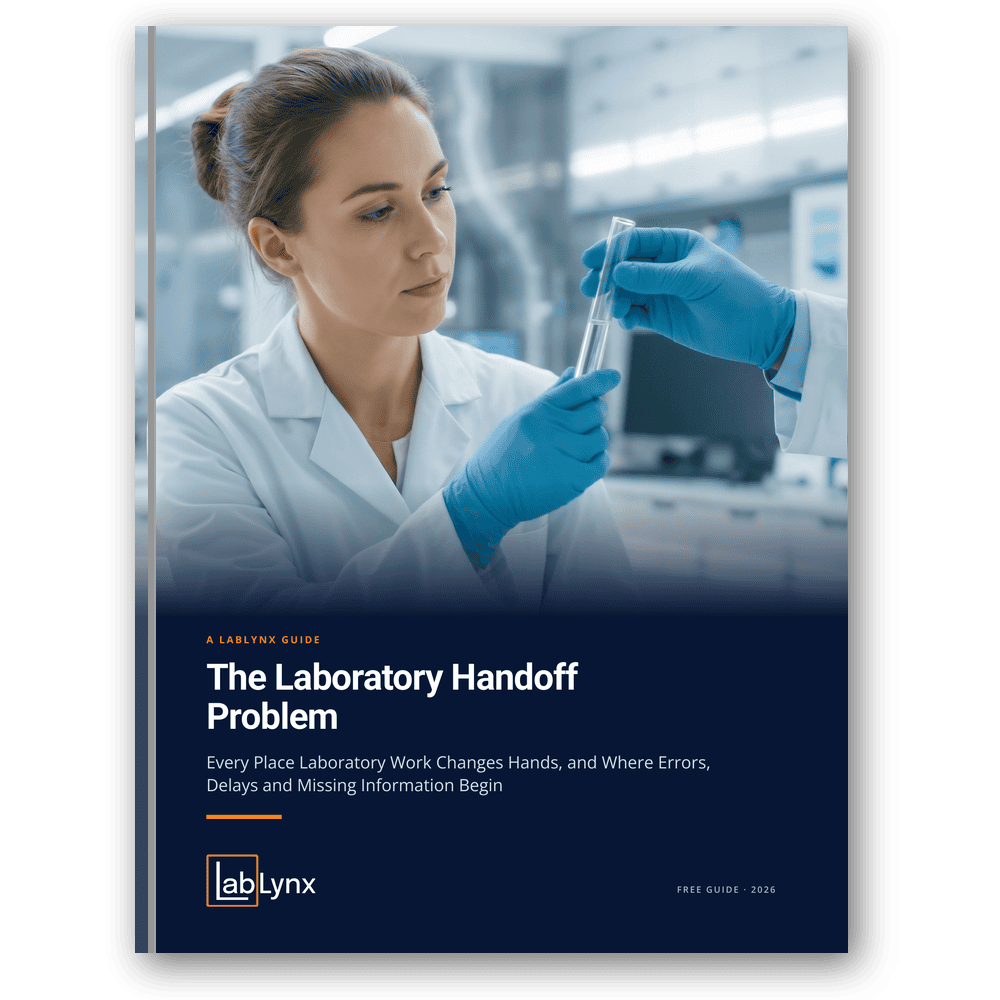
The test is often the quick part. The delays and errors live in the handoffs between steps. Our free 94-page guide maps every one, from request to report. Eliminate before you automate.
https://t.co/ls0gpXOIJM
#LIMS#LabManagement
Got the end-of-life notice for Element, HORIZON or Apollo LIMS? Staying with Clinisys still means a new system: new migration, new reports, new validation.
Here's how labs move on their own timeline, usually in 7 to 9 months.
https://t.co/gHX2QvI5XZ #LIMS
Every list of "LIMS types" is a list of somebody's product line. Cloud vs on-prem is who runs the servers. Industry is a configuration.
The cut that predicts fit: what does your lab track? Sample, patient, experiment, batch, machine.
https://t.co/2oDuwH8yHi
A signed worksheet says the procedure was followed. One claim, at the end.
An execution record says step three happened at 09:22, by name.
OOS investigation under the first starts with interviews. Under the second, with the record.
https://t.co/FgG7kRW7Uq
From The Laboratory Workflow Automation Ladder, a free 75-page guide to the six levels of lab workflow automation and where the handoffs fail: https://t.co/CwACdJUEQQ
6,930 lab results typed in by hand. 260 did not match the instrument. One blood sugar of 132 went in as 13.
The instrument was fine. The handoff was not. (Mays & Mathias, JAMIA 2019)
The state deliverable is not a PDF. It's a named format at a named version, validated before submittal.
Formats aren't interchangeable. Versions aren't backward compatible.
Ask which formats at which versions, not whether there's a report builder.
https://t.co/FECFDUrYxX
98% of respondents knew what an electronic lab notebook was. 11% used one.
The barrier wasn't awareness. 93% cited ongoing system cost, 90% future development cost. The upfront license trailed both at 74%.
https://t.co/gIUn0zpiV4
Laboratory informatics names five kinds of data: sample identity, experiment reasoning, instrument output, reportable result, evidence the work happened.
Four have an owner. The fifth has none, and that's where assessment findings get made.
https://t.co/pdVlQpZcVo
An LIS is built around a patient. A LIMS is built around a sample.
Feature lists converged. CLIA and ISO 17025 did not.
Ask a vendor which regime their reference sites run under, not which acronym they use.
https://t.co/CwzgyomliR
Counting your instruments gives you an integration schedule that is wrong in one specific direction: too optimistic.
Effort tracks the number of instruments producing a format nobody else reads, not the number of instruments.
https://t.co/ugKTN461Js
Next hard compliance date for US labs: 18 Dec 2026, statutory deadline for OMB to publish the BIOSECURE list. Everything downstream waits on it.
LDT rule vacated. QMSR in force. Subpart M in force. Full 2026 calendar with status on each:
https://t.co/rpQxthYae4
Published LIMS ROI percentages weaken a business case. They invite the question of whether that lab resembles yours. Numbers from your own timesheets do not.
Four cost lines, five vendor figures, the formulas:
https://t.co/236BZjBs9A
10:02:55, injection volume changed, reason recorded and checkable.
10:03:40, assay result changed 98.2% to 101.4%, reason: none.
45 seconds apart. The first entry closes a question. The second opens an audit of the whole data set.
https://t.co/Uvt4gAShh0
Headlines say 2031. The rule says April 26, 2027.
EPA's proposed extension moves PFAS treatment timing, not initial monitoring and reporting.
Small groundwater systems need 2 samples, 5-7 months apart. That first one is a 2026 problem.
https://t.co/cgTgPFntR6
FDA moved FSMA 204 to July 2028. Kroger's supplier deadline was June 30, 2025. Walmart's, August 1, 2025.
The extension moved the federal date, not your customers'.
The traceability gap most suppliers miss sits in the lab, not on the dock:
https://t.co/v9MYOO0Q7p