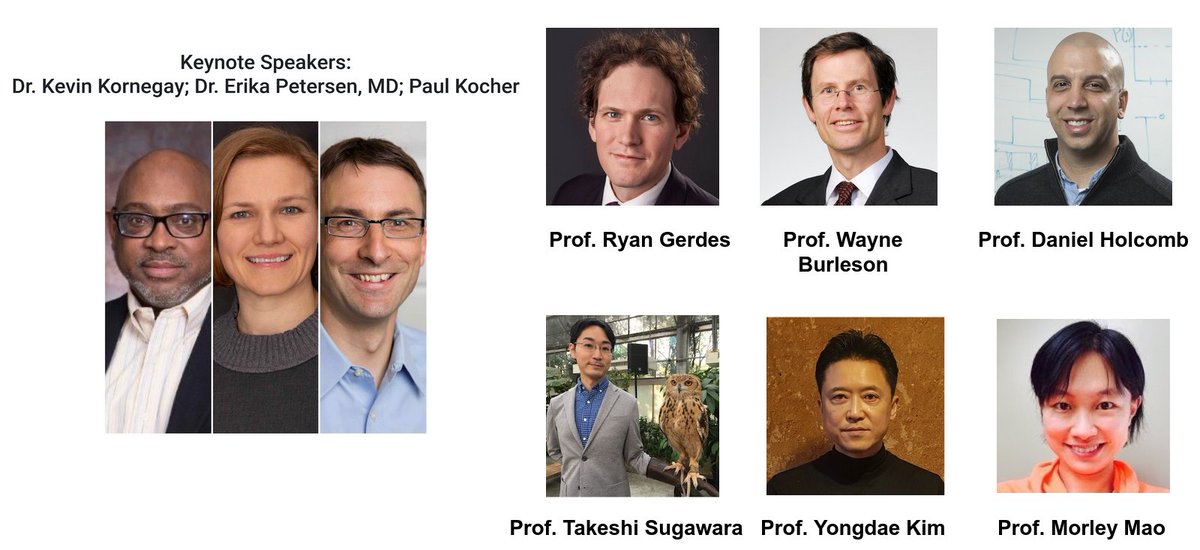
Applications to attend the 2nd Annual Embedded Security Workshop are due Aug 21. Participants are selected based on how the applicant fosters the mission of diversity and inclusion for embedded security research. See our great speaker lineup! Apply today!
https://t.co/8feG0X42O8
Learning from Prof. Takeshi Sugawara about laser fault injection on CMOS circuits while speakers join live and seamlessly from Japan, China, Korea, USA, a Massachusetts mountain top, and a hurricane in the gulf coast. Won't rain on this parade. 🌩🌩🌩https://t.co/8feG0X42O8
Protecting embedded security isn't brain surgery. Oh wait, it is brain surgery. Great research talks and student discussions yesterday. Brain implant privacy this morning by @ErikaPetersenMD!
Thank you to @Google for supporting the diversity, equity, and inclusion goals of our sold-out virtual 2nd Annual Embedded Security Workshop! We appreciate Google's commitment to DEI by helping us make this interactive event free to participants. @UMichCSE https://t.co/8feG0X42O8
Thank you to @Qualcomm for its commitment to diversity and inclusion by generously sponsoring our free (virtual) workshop on embedded security research this week! https://t.co/8feG0X42O8
Incredibly fortunate to have worked with folks in the trenches @MayoClinic. I learned a lot about preparedness on the ground by putting the patients first, and leadership when faced with the challenges of COVID-19.
My path now takes me to AWS.
Hello cloud.
"As manufacturers begin to integrate the Food and Drug Administration's recognized cybersecurity consensus standards such as AAMI TIR 57, these problems will eventually be designed out. However, it will take a long time for legacy systems to move on" @aami_connect@bozo777
"Authentication flaws are a common problem, and hard to get right," says Kevin Fu, chief scientist and founder of the Archimedes Center for Healthcare and Device Security at the University of Michigan. @ARC_MedSec @DrKevinFu @healthinfosec https://t.co/exsCQyyfnU
"Authentication flaws are a common problem, and hard to get right," says Kevin Fu, chief scientist and founder of the Archimedes Center for Healthcare and Device Security at the University of Michigan. @ARC_MedSec @DrKevinFu @healthinfosec https://t.co/exsCQyyfnU