WHEN BUILDINGS UNDER CONSTRUCTION COLLAPSE.
=======
The recent collapse of a building under construction in Kisasi is painful. Lives have been affected, families are distressed, and rescue teams are doing difficult work. At such a moment, we must speak with professional discipline rather than excitement.
It is too early to declare the cause. A proper investigation must examine the design, materials, construction sequence, temporary works, supervision records, approvals, and any external disturbances, including the recent tremor felt in parts of Uganda.
However, one lesson is already clear.
A building under construction is not the same as a completed building. The public often sees columns, beams, slabs, and walls. Engineers see something more complicated: a series of temporary structural states, each carrying its own risks.
Concrete may not yet have gained full strength, while formwork may still be supporting fresh loads. Shoring may be incomplete or removed too early, materials may be stacked on slabs that are still maturing, and columns may be standing before the structure has achieved full lateral stability. Workers, equipment, vibration, rain, and even a moderate earth tremor can become serious risks when the system is already vulnerable.
This is why construction technology matters. Good construction is not just about having drawings. It is about understanding how a structure behaves while it is being built. It is about sequencing, curing, testing, supervision, temporary works, material control, and risk management.
For developers, this is not an academic matter. Risk is expensive. A wrong decision on concrete quality, supervision, sequencing, or temporary support can cost far more than the professional advice that would have prevented it.
Knowledge has a dividend because it reduces uncertainty. At @ecoconcreteUG , our work is to help developers, contractors, and project teams identify construction risks before they become visible as cracks, delays, disputes, losses, or tragedy. Buildings rarely fail because one person forgot one thing. They usually fail because several unmanaged risks meet at the same time.
The best time to manage construction risk is not after a collapse. It is during design, planning, supervision, and construction, when corrective action is still possible and affordable. That is where professional knowledge creates value, protects investments, and ultimately saves lives.
ARE YOU GUARDING A CONCRETE SLAB?
In the words of Sandras J. Phiri. There was an army barracks that always had on its duty roster 4 soldiers to guard a concrete slab in front of the barracks. The soldiers changed shifts guarding the slabs for many years.
Different commanders came and went, and the tradition continued. After many years, a new commander was assigned to the barracks. Amongst the things he did was asking why things were done the way they were. When he asked why soldiers were guarding the slab, he was told, “We’ve always done it this way. It’s our tradition. Our former commanders instructed us to do that.”
The commander was adamant on finding out why. He went to the archives to look for answers and he came across a document that had the explanation. The document was very old. It had instructions written by one of the retired commanders who had even passed away. The new commander learnt that over 80 years ago, the barracks wanted to build a platform where events could be performed. When the concrete slab was laid, wild animals walked over it at night before the slab would dry. The soldiers would fix it the next morning but when evening came the same thing would happen. So, the commander ordered that 4 soldiers should guard the concrete slab for 3 weeks to allow it to dry. The following week the commander was transferred to another post and a new commander was brought in. The new commander found the routine and enforced it and every commander that followed him did the same.
Eighty years later the barracks continued guarding a concrete slab.
The new commander, armed with this newfound knowledge, decided that it was time to break free from the shackles of a decades-old tradition that had lost its relevance. He called for a meeting with the soldiers and explained the history behind the concrete slab, highlighting that it was a temporary measure meant to address a specific problem during the construction phase.
He emphasized the importance of adapting to the changing times and the need to reevaluate traditions that no longer served a purpose. The soldiers, initially resistant to change, started to see the logic behind the commander's words. However, breaking an 80-year-old tradition wouldn't be easy.
To ease the transition, the commander proposed a collaborative effort to repurpose the area. Instead of guarding the slab, he suggested transforming it into a space that could be utilized by the soldiers for various activities. The idea resonated with the troops, and they began brainstorming ways to turn the concrete slab into a recreational area, perhaps a gathering spot for camaraderie and team-building activities.
The soldiers took charge of the transformation, utilizing their skills to create benches, a small stage, and even a makeshift basketball hoop. As the barracks underwent this unexpected metamorphosis, a sense of unity and purpose filled the air. The soldiers realized that they were not just breaking free from an outdated tradition; they were building something new and meaningful in its place.
The news of the transformation spread throughout the military community, garnering attention from higher-ups who admired the commander's innovative approach. The once mundane concrete slab became a symbol of adaptability and progress, a testament to the power of questioning long-standing practices.
@kasujja IS ASKING THE WHY QUESTION
The traditionalists have been shaken to their core by the doings of the new CEO of Uganda Media Center.
When you disrupt expect resistance. Definitely someone must ask the Why Question. And Alan has asked.
State of the Nation Address 2026: What It Means for Uganda's Infrastructure, Mining, Engineering Construction, Construction Materials, and Skills Development.
=======
President @KagutaMuseveni's address presented a strong case for wealth creation, production, manufacturing, exports, infrastructure, and economic participation. These remain essential foundations for Uganda's development.
From the perspective of infrastructure, mining, engineering construction, construction materials, and skills development, the next national conversation should now move deeper.
It should be about economic power.
In my forthcoming book, The Five Levels of Economic Power, I argue that nations climb from resource ownership, to productive control, to technological command, to market power, and finally to institutional sovereignty.
The address spoke strongly to the first two levels. Uganda's agricultural transformation, expanding manufacturing base, infrastructure investments, and growing exports demonstrate real progress in moving people into the money economy and increasing productive activity.
The next challenge is climbing higher.
For infrastructure, success should not be measured only by roads completed, megawatts installed, or industrial parks commissioned. Those are important, but they are not enough. Even a very beautiful road can still leave the local contractor poor, the local engineer underused, and the local materials producer watching from the roadside like a wedding guest who was invited only to clap.
We should also ask whether these investments are strengthening Ugandan contractors, engineering firms, laboratories, equipment fabricators and suppliers, and maintenance systems.
For mining, one area that deserves greater attention in future national conversations is how Uganda's minerals can support industrialisation beyond extraction and export. A country should not be proud only because a stone has left the ground. The bigger question is whether that stone has created factories, skills, standards, brands, and jobs before it leaves the country.
For skills development, the challenge is to recognise that productive work remains the most powerful classroom. The future engineer, technician, artisan, miner, and industrialist is developed not only in lecture rooms, but also in workshops, laboratories, factories, mines, and construction sites. You cannot train a mason with PowerPoint alone and expect the wall to stand.
Another important question for Uganda's next phase is technological ownership. Economic growth is important, but long-term strength depends on who owns the technologies, standards, laboratories, designs, equipment, and technical knowledge that underpin production.
The address gives Uganda's productive sectors a useful foundation. The task now is to organise around the next frontier: stronger productive control, technological command, market power, and institutional sovereignty.
That is how a country stops celebrating activity and starts building strength.
A successful career, thriving business, and financial stability are admirable achievements. But do they automatically make us successful parents?
My today’s article in @newvisionwire explores this important question:
📰 Why Successful Parents Sometimes Fail at Parenting
Three nominees; Shartis Kutesa Musherure, Adonia Ayebare and Calvin Echodu with duo citizenship were approved by Parliament on the ground that they have commenced process to renounce other citizenships. What will stop Parliament in future from approving a nominee who files documents to prove, he/she has registered to sit senior six. The three should have been thrown out together with Prof. Lawrence Muganga.
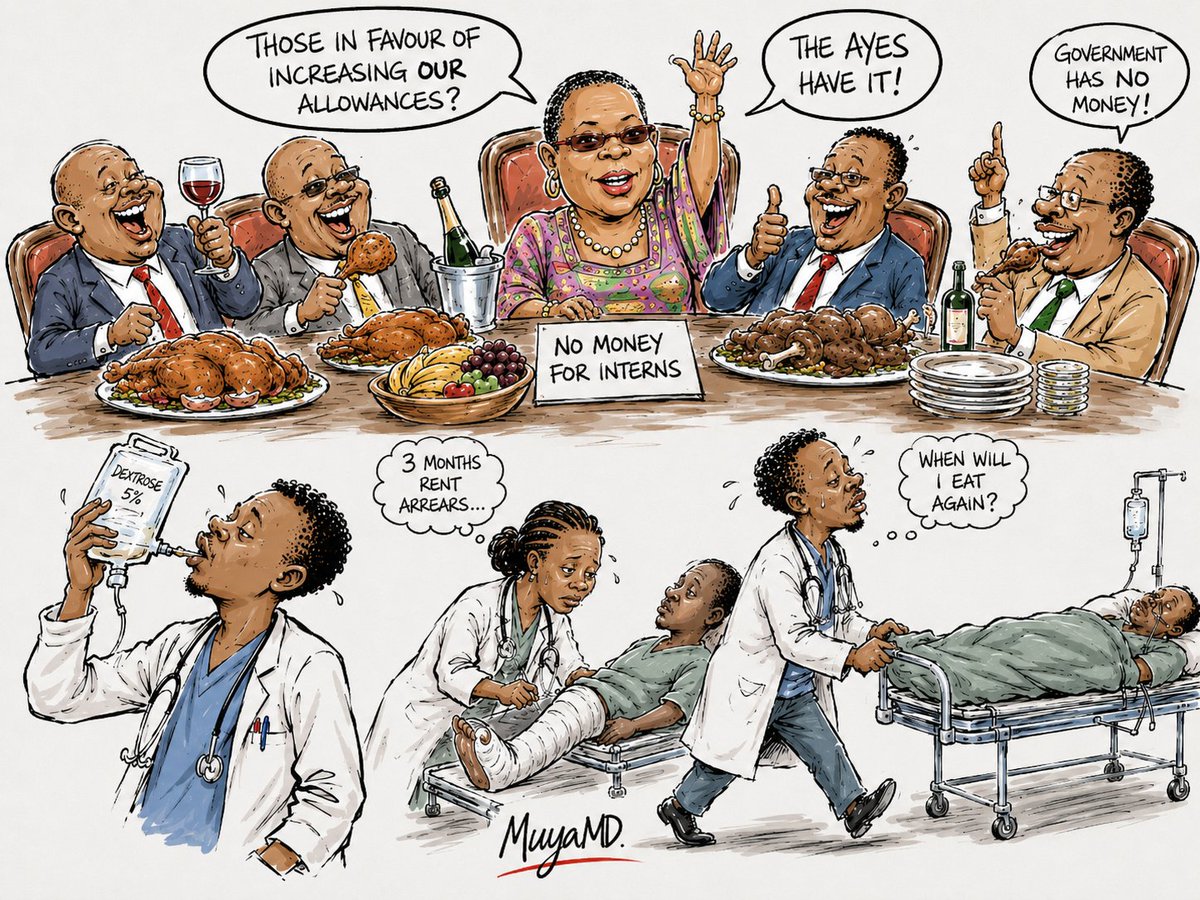
Let us be honest: the issue is not that medical interns are too many.
It is not that Uganda has no money.
It is that medical interns are not being treated as a priority.
Consider the choices being made:
• Parliament keeps growing.
Parliament’s budget reportedly doubled to about 𝗦𝗵𝘀 𝟭. 𝟮 𝘁𝗿𝗶𝗹𝗹𝗶𝗼𝗻. The money going to 529 MPs rose from about 𝗦𝗵𝘀 𝟰𝟬𝟬𝗯 in 2020/21 to 𝗦𝗵𝘀 𝟳𝟰𝟰.𝟰𝗯 in 2026/27, an increase of about 𝗦𝗵𝘀 𝟯𝟰𝟰.𝟰𝗯.
What direct return does this give the common Ugandan in a crowded hospital?
• Two offices alone tell the story.
The Speaker and Deputy Speaker offices had about 𝗦𝗵𝘀 𝟳.𝟭𝗯 combined in 2020/21. In 2026/27, they stand at about 𝗦𝗵𝘀 𝟱𝟬.𝟮𝗯 , an increase of about 𝗦𝗵𝘀 𝟰𝟯.𝟭𝗯 for only two offices.
That increase alone can pay 𝟯𝟬𝟬𝟬 interns 𝗦𝗵𝘀 𝟭𝗺 𝗽𝗲𝗿 𝗺𝗼𝗻𝘁𝗵 𝗳𝗼𝗿 𝗮 𝗳𝘂𝗹𝗹 𝘆𝗲𝗮𝗿, with money left.
• Questionable spending continues.
In 2025/26, selected Speaker’s office lines reportedly included 𝗦𝗵𝘀 𝟮.𝟰𝗯 for foreign travel, 𝗦𝗵𝘀 𝟵𝟲𝟲𝗺 for fuel, 𝗦𝗵𝘀 𝟰.𝟴𝗯 for incapacity, death benefits and funeral expenses, and 𝗦𝗵𝘀 𝟱.𝟮𝗯 for donations. Total: about 𝗦𝗵𝘀 𝟭𝟰.𝟮𝗯. What lasting public health return does this produce compared with doctors on wards?
• RDC structures are being funded.
Uganda reportedly has 146 RDCs, 170 Deputy RDCs and 432 Assistant RDCs, total 748 officials. Their proposed salary enhancement requires an extra 𝗦𝗵𝘀 𝟮𝟵.𝟬𝟳𝟵𝗯 every year.
Add the reported 𝗦𝗵𝘀 𝟯𝟬𝗯 for LC I to LC V political leader facilitation, and that is about 𝗦𝗵𝘀 𝟱𝟵𝗯. In what way does this benefit the common Ugandan?
• Donations are funded.
State House donations reportedly consumed 𝗦𝗵𝘀 𝟳𝟱𝟭𝗯 over seven financial years. In 2023/24 alone, donations were budgeted at 𝗦𝗵𝘀 𝟭𝟴.𝟭𝗯, but actual spending reached 𝗦𝗵𝘀 𝟴𝟬.𝟭𝟴𝗯. If tens and hundreds of billions can be found for donations, how does 𝗦𝗵𝘀 𝟮𝟰𝗯 to 𝗦𝗵𝘀 𝟯𝟲𝗯 for over 2,000 medical interns become impossible?
• Health was not protected with the same urgency.
The Ministry of Health vote fell from about 𝗦𝗵𝘀 𝟭. 𝟲𝟵𝟯 𝘁𝗿𝗶𝗹𝗹𝗶𝗼𝗻 in FY2023/24 to about 𝗦𝗵𝘀 𝟭. 𝟯𝟰𝟰 𝘁𝗿𝗶𝗹𝗹𝗶𝗼𝗻 in FY2024/25, a reduction of about 𝗦𝗵𝘀 𝟯𝟰𝟵𝗯. Even the 2025/26 estimate of 𝗦𝗵𝘀 𝟭.𝟱𝟲𝟰 𝘁𝗿𝗶𝗹𝗹𝗶𝗼𝗻 remains below the 2023/24 level. Yet health is the sector that directly touches mothers in labour, accident victims, children with malaria, emergency patients and families in public hospitals.
Now compare:
• 2,000 interns × Shs1m × 12 months = 𝗦𝗵𝘀 𝟮𝟰𝗯 per year
• 2,500 interns × Shs1m × 12 months = 𝗦𝗵𝘀 𝟯𝟬𝗯 per year
• 3,000 interns × Shs1m × 12 months = 𝗦𝗵𝘀 𝟯𝟲𝗯 per year
Even using the Ministry of Health’s own gross figure of Shs15.6m per intern per year, the reported 2,706 eligible interns would require about Shs42.2b. That is still small compared with what is being found for political comfort and administrative expansion.
That money is not a handout.
✨ It avails doctors on wards.
✨ It keeps emergency units covered.
✨ It supports maternity care.
✨ It fills staffing gaps in regional referrals.
✨ It protects patients.
So let us stop pretending.
This is not a numbers problem.
This is not a money problem.
It is a priority problem.
Medical interns are doctors under apprenticeship, not free labour!
#InternsNotSlaves
The Maintenance Paradox.
The Economics of Keeping Your Assets Alive.
Welcome to Issue 005 of The Concrete Corner. The Maintenance Paradox https://t.co/k5o7vtiInh
It is our pleasure to present this fifth edition of The Concrete Corner, Eco Concrete Ltd's technical newsletter dedicated to practical discussions on engineering, infrastructure, construction materials, and the long-term performance of the built environment.
This issue focuses on a subject that is often overlooked until problems become unavoidable: maintenance.
Across Uganda, enormous attention is given to the design and construction of buildings. New projects are celebrated, ribbon-cutting ceremonies are publicized, and impressive structures reshape our skylines. Yet the true success of a building is not determined on the day construction is completed. It is determined by how well that asset performs over the decades that follow.
This reality creates what we call the Maintenance Paradox. Many property owners postpone maintenance to save money, yet the very act of postponing maintenance often creates the highest future costs. A leaking roof becomes structural deterioration. A blocked drain becomes foundation distress. Failed waterproofing becomes extensive rehabilitation. What appears to be a saving today frequently becomes a significantly larger expense tomorrow.
Buildings rarely fail suddenly. They deteriorate gradually through small defects that go unnoticed, unreported, or unresolved. Water ingress, corrosion, cracking, drainage failures, service breakdowns, and deferred repairs quietly accumulate until they eventually disrupt operations, reduce property value, and demand costly interventions.
In this edition, we examine maintenance not as an expense, but as an investment in asset preservation and performance. We explore the economics of deferred maintenance, compare planned and reactive maintenance strategies, discuss lifecycle costing, and provide practical approaches for inspections, preventive maintenance, and maintenance record management.
We also present real-world examples from the Ugandan property sector demonstrating how maintenance philosophy directly influences durability, tenant satisfaction, occupancy rates, operating costs, and long-term asset value.
In a country characterized by heavy rainfall, intense solar exposure, growing urban density, and increasing demands on buildings and infrastructure, maintenance can no longer be treated as an afterthought. It is an essential component of responsible asset management.
A well-maintained building does more than remain functional. It protects investment, preserves dignity, improves user experience, extends service life, and delivers stronger financial returns throughout its lifecycle.
We invite property owners, developers, engineers, architects, facility managers, and construction professionals to join this conversation and to reflect on a simple question:
Is your building being maintained as an asset, or is it quietly being allowed to become a liability?
We thank you for reading and for being part of the growing Concrete Corner community.
Kind regards,
The Concrete Corner Team
Eco Concrete Ltd
[email protected]
+256 781 994 833
Do Engineers Design Earthquake-Proof Buildings? Hell NO! Nature Doesn't Allow It.
=======
Following last night's earthquake, several people asked whether engineers design buildings to be earthquake-proof. The answer may surprise you, because the honest answer is no.
Modern engineers generally do not design buildings to remain completely undamaged under every possible earthquake. Such a building would be technically difficult to achieve and, in many cases, economically impossible to justify.
Instead, engineers design buildings to protect human life. The goal is not to guarantee that a building will never crack, but to ensure that if nature decides to conduct an audit, the people inside have the best possible chance of walking out safely.
Many people think buildings only carry loads that push downward. We see roofs, walls, furniture, water tanks, and people pressing down through the structure, and these are what engineers call gravity loads.
An earthquake is different because it introduces movement. The ground suddenly pushes, pulls, twists, and displaces the building, much like a taxi that suddenly brakes, accelerates, and swerves while your body tries to remain where it was.
When the foundation moves, the upper parts of the structure resist that movement because of their mass. This creates forces that can crack walls, deform structural members, and stress connections throughout the building.
This is why earthquakes are not simply weight problems. They are movement problems, and movement can be more destructive than ordinary vertical loads.
Another important point is that a smaller earthquake can sometimes be more dangerous than a larger one. Magnitude is only one part of the story, because depth, distance from the epicenter, soil conditions, duration of shaking, and the rhythm of vibration all affect how dangerous a tremor becomes.
A shallow earthquake can produce stronger shaking at the ground surface than a deeper earthquake of similar magnitude. Soft soils can amplify movement, while some buildings naturally sway at particular frequencies and may respond more severely when the ground motion matches that rhythm.
This is why engineers rely on historical records, geological information, building codes, safety factors, and probability rather than certainty. A building that survives a severe earthquake with repairable damage may actually be evidence of good engineering, because the first responsibility of a structure is not to protect concrete and steel, but to protect human life.
By Dr. Apollo Buregyeya, CEO, Eco Concrete Ltd
https://t.co/7fWicWkllv
In 1981, a United States professor was conducting research for a book that she later published in 1988. She sat down with workers during a meal in the United States and discussed the possibility of machines taking over in the future.
#LabourLawConf2026
Kampala buildings just received a gentle reminder from the earth.
=======
A magnitude 4.5 earthquake, reportedly centered around the Nakasongola area, was felt across the city. For many residents, it was a brief moment of surprise. For engineers, it was a reminder that gravity is not the only force a building may one day have to resist.
Earthquakes are fascinating because they do not create weaknesses in structures. They reveal the weaknesses that already exist.
What many people do not realize is that one of the most vulnerable moments in the life of a building is not when it is old. It is when it is under construction.
Structural engineers design buildings assuming that concrete will achieve its required strength, beams and slabs will act together, walls will be completed, and the structure will function as an integrated system. During construction, however, that system is still being assembled.
Concrete may be only a few days old. Temporary supports may still be carrying significant loads. Materials may be stockpiled unevenly on slabs. Some structural elements may be complete while others are still missing. Construction activities themselves can create load patterns that the finished building will never experience again.
In simple terms, a building under construction often behaves differently from the building shown in the engineer's calculations.
This is why construction engineering matters. A good engineer is not only concerned with whether a building will stand when completed. They are equally concerned with whether it will safely survive every stage between excavation and occupation.
Fortunately, tonight's tremor appears to have been modest. However, it raises an important question for every developer and property owner.
Who is managing the risks while your building is being built?
Many people buy drawings. Some buy supervision. The wisest invest in engineering oversight throughout the entire construction process because structures rarely fail after the ribbon-cutting ceremony. They usually fail during the shortcuts, assumptions, and compromises made before it.
Tonight, General Tremor paid Kampala a courtesy visit.
Thankfully, he came carrying an inspection form rather than an enforcement notice.
God in His grace, gave us rhythms of life-moments to work, to rest, moments to reflect, and moments to worship. The Sabbath stands as a beautiful gift of grace, reminding us that we are not sustained by our labor alone, but by His love, presence, and provision. #HappySabbath
Why using 3 bars in a beam is dangerous.
=======
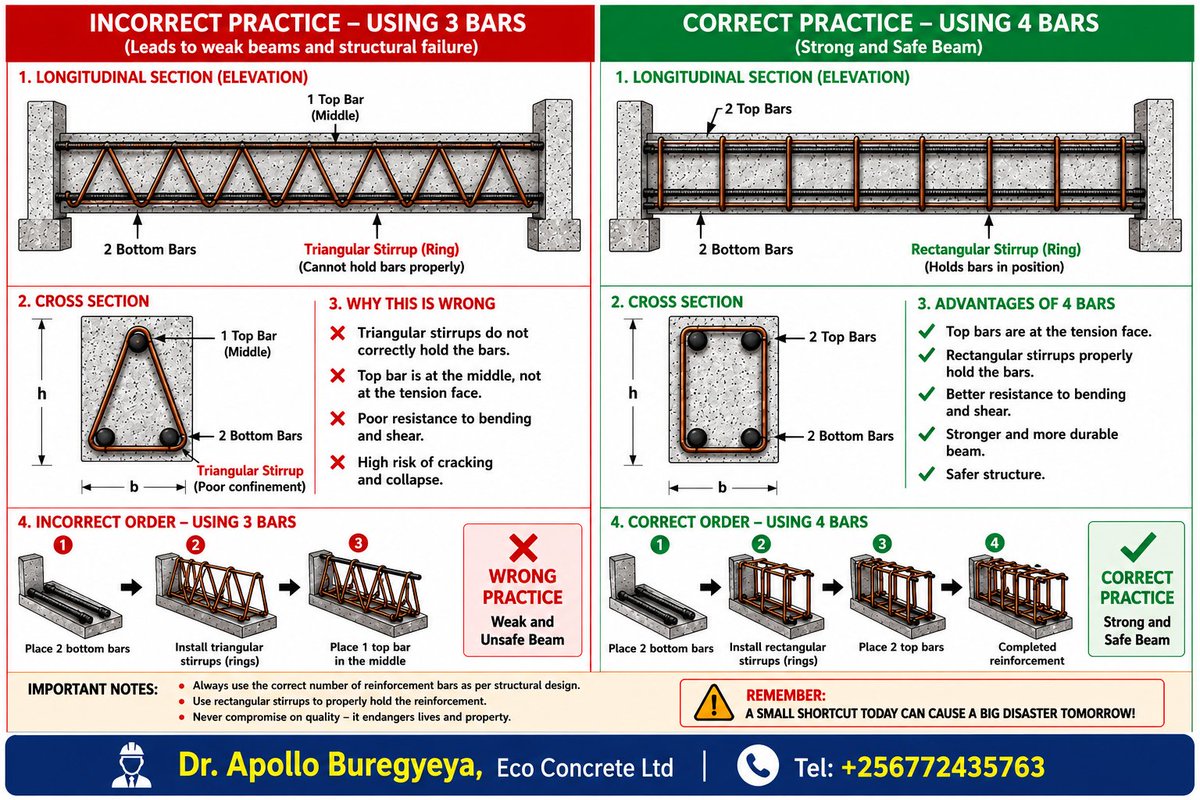
In many residential sites in Uganda, some builders use a shortcut in reinforced concrete beams. Instead of placing 4 longitudinal bars, usually 2 at the bottom and 2 at the top, they use only 3 bars: 2 at the bottom and 1 at the top middle.
At first, this may look like saving money. In reality, it is playing games with the safety of a building.
A reinforced concrete beam does not only need steel to “be there.” The steel must be placed correctly so that the beam behaves properly under load. The bottom bars help resist bending where the beam wants to sag. The top bars help with support zones, continuity, restraint, cracking, and stability. The stirrups, commonly called rings, help resist shear, hold the bars in position, and confine the concrete.
When you use 3 bars arranged like a triangle, you usually end up with triangular rings. That is where the real danger begins.
Rings in a beam are not decoration. They are shear reinforcement. They are supposed to help the beam resist diagonal cracking, especially near supports where shear forces are high. Rectangular rings work because they enclose the beam properly, hold the bars in their right positions, and confine the concrete core.
Triangular rings do this very poorly. They leave parts of the beam weak and unconstrained. They do not hold the reinforcement cage properly. They reduce confinement. They weaken shear resistance. In practical terms, the beam may behave almost as if proper shear reinforcement is missing.
That kind of beam may not fail slowly. It can fail suddenly.
A bad slab may show cracks. A bad column may show distress. But a beam with poor shear reinforcement can crack diagonally and fail without giving enough warning. That is why this shortcut is not small. It is dangerous.
The money saved by removing one bar is very little compared to the risk created. You may save a few thousand shillings today and create a structural weakness that threatens a family for decades.
A good beam needs proper detailing, not guesswork. Use the correct number of bars. Use proper rectangular stirrups. Follow structural drawings. Involve qualified engineers.
Buildings do not collapse because cement is angry. They collapse because people ignore the small details that carry big loads.
Build it right. Use 4 bars and rectangular rings. Safety is cheaper than failure.
When we raised concerns about Jennifer Bamuturaki (Former CEO-Uganda Airlines), some people said we were just malicious. When we raised concerns about the Speaker, the same people said it was both malice and hatred.
But as someone once said, give time some TIME!
While I’m not confident at all that the regime is now serious about fighting corruption and bad governance (because that’s their DNA), at least this should be a lesson to leaders whom they use to do ridiculous things and then throw them under the bus!
Whenever it rains, we all get wet.
Also, there are no survivors in a sinking boat!
That’s what happens when the rule of law is disregarded. Whenever we speak out condemning abductions, colleagues in NRM say it’s arrests and not abductions.
I hope the family and lawyers of the latest victim get to trace her, and that her rights as a suspect get to be respected…the same thing we’ve always demanded for Opposition leaders and supporters who are often abducted.