That's how Chinese ships intrude into our lawful waters with imperial approach!
When will China understand that illegally operating in others' EEZs is an offense?
Violating the laws of Sea & threatening neighbors with dangerous maneuvers will only worsen things.@Zhengyimingdao
⏳ 𝟓 𝐃𝐀𝐘𝐒 𝐓𝐎 𝐆𝐎! ⏳
Lace up and get ready for Takbo Para sa West Philippine Sea🏃🇵🇭
📍 Bridgetowne Central Park, Pasig City
📅 11 October 2025
Sama-sama tayong tumakbo para sa ating karapatan at yaman sa West Philippine Sea. 💙🌊
Registration is still open: https://t.co/oGKAtCEJFH
#TakboParaSaWPS #WestPhilippineSea #WPS #PCG #WPSTG #RunRio
Chinese thieves are seen poaching giant, centuries-old clams- all from a Philippine outpost in Spratlys
These are the same clowns demanding a 'nature reserve' in Scarborough Shoal after wrecking the environment they will use to accuse Philippines of harming.
@MalayaIrredenta
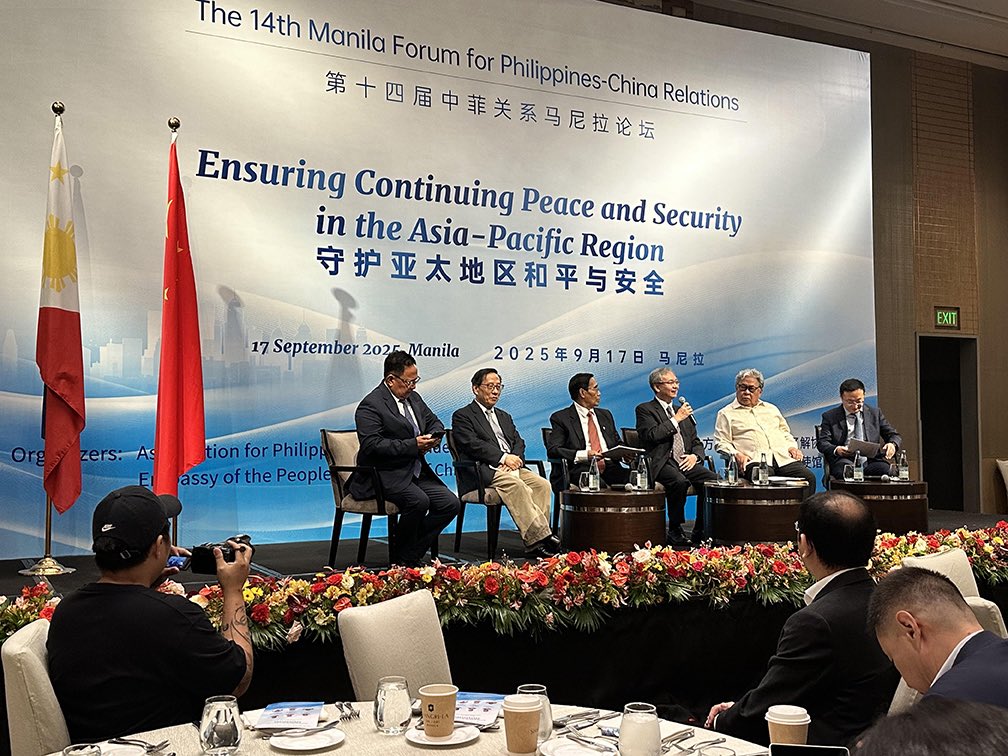
The Philippines must prioritize hosting more Track 1.5 and Track 2 dialogues to counter the People's Republic of China's growing influence in regional discussions, academic debates, and public discourse. The PRC uses state-affiliated think tanks and forums to dominate these tracks, normalizing its expansive territorial claims, reframing aggressive actions as defensive, shaping international perceptions, and marginalizing Southeast Asian voices—ultimately undermining support for international law, including the UN Convention on the Law of the Sea (UNCLOS) and the 2016 arbitral ruling.
A key example is the 14th Manila Forum for Philippines–China Friendly Relations, co-organized and funded by the PRC Embassy in Manila and the Association for Philippines-China Understanding. There, Chinese official Victor Gao dismissed the 2016 ruling as a "violation of the rule of law" due to China's non-consent, invoked a narrow reading of the 1898 Treaty of Paris to confine Philippine territory west of 118 degrees longitude (mocking Manila's claims under the 1900 Treaty of Washington and excluding West Philippine Sea areas), and issued implicit threats against deepening U.S. ties, warning they could "seriously harm Philippine national interests and endanger regional peace and stability." Such tactics undermine the ruling's finality, shape perceptions, and marginalize Southeast Asian voices.
To reclaim the narrative and amplify diverse perspectives, the Philippines should lead its own Track 1.5 and Track 2 initiatives for these reasons:
1. Balancing Narrative Control and Preventing Normalization: PRC forums portray Beijing's views as consensus, softening assertiveness and stifling resistance. Philippine-led dialogues can showcase alternatives, stressing the 2016 ruling's finality and a rules-based order, ensuring global audiences hear diverse viewpoints and blocking PRC claim legitimization.
2. Countering Disinformatio: PRC events embed propaganda that misrepresents Philippine operations and downplays Chinese provocations. Platforms like the Manila Dialogue (a Track 1.5 event for Indo-Pacific experts) can document incidents, foster media ties, expose tactics, build support, and advance a counter-narrative based on rules-based principles.
3. Building Coalitions and Regional Unity: The PRC exploits ASEAN divisions via bilateralism, stalling Track 1 talks. Track 1.5/2 forums enable multilateral confidence-building, interoperability training, and alliances with partners like the U.S., Japan, and Australia. Events such as the CSIS South China Sea Conference allow claimant states to coordinate responses, share intelligence, and unify ASEAN against divide-and-rule strategies.
4. Complementing Stalled Official Diplomacy: With slow ASEAN progress on the Code of Conduct under PRC sway, unofficial tracks provide flexible venues for workshops, cultural exchanges, and trust-building. These can shape future Track 1 outcomes, bolster normative leadership for mediators like Indonesia, and empower civil society, academics, and former officials of claimants to explore solutions free from state tensions.
In conclusion, without such efforts, the Philippines risks ceding the intellectual and discursive high ground, letting PRC narratives harden into consensus, complicating legal rights enforcement, and eroding its regional security role. Initiatives like @GregPoling’s Manila Strategy, @JeffreyOrdaniel’s Manila Dialogue, and @StratbaseADRi’s facilitated dialogues not only defend sovereignty but position the Philippines as a champion of a free and open Indo-Pacific.
China Coast Guard & Chinese Maritime Militia ships are seen blocking a Philippines Coast Guard ship near Second Thomas Shoal, way inside Philippines's territory!
And then, Beijing accuses Manila of creating tensions!
China is such a HYPOCRITE! @PacStandardTW@informedph2
WATCH: Yesterday, Taiwan's Coast Guard intercepted four China Coast Guard vessels operating in Kinmen's restricted waters without their AIS on.
The Taiwanese vessels conducted parallel shadowing throughout the incursion, staying close to the CCG vessels.
CCG vessels include: 14608, 14507, 14605, and 14527.
Thank you, @AmbDBHartman, for your firm stance against China's aggressive actions in the South China Sea and for urging all parties to uphold UNCLOS and the 2016 Arbitral Award. I also appreciate your concern regarding China's reckless use of water cannons at Scarborough Shoal.
PLA Navy issuing a possibly impromptu NOTAM on live-fire exercise near Scarborough Shoal seems rather unprecedented. It reminds us of what happened in Tasman Sea back in February. It's become a new norm as part of Beijing's lawfare that poses danger to sea and air traffic alike.
I will repeat it for endless times that Scarborough Shoal is within Philippines' EEZ. Therefore, the question of illegally intrusion doesn't arise at all. It was CCG who trespassed, harassed and injured Filipino personnel. @GordonGChang@SariArhoHavren
China warns the #Philippines to cease their “ganging up” in the #SouthChinaSea!
To be clear: It's not a collective attack, it's taking a stand against China's hostility.
Sovereignty can't be compromised, particularly not under duress or incitement. @informedph2@CarpioJudge
HARASS, DENY, NORMALIZE: A WEEK IN THE WPS |
This week’s pattern was clear: two Chinese warships shadowed allied drills near Bajo de Masinloc, twenty militia vessels crowded contested waters, Beijing issued a so-called “safety advisory” painting the Philippines as unsafe, and even warned Manila not to “play with fire” after a trade visit by Taiwan’s foreign minister. None of these are isolated. Together, they form a deliberate playbook of pressure.
The Philippines is not without law or dignity. The 2016 Hague ruling already affirmed our sovereign rights under UNCLOS. Our Navy and Coast Guard continue to stand watch, and our partners train with us to uphold the rules-based order.
The BRP Sierra Madre still stands, weathered but unyielding, a sentinel of Filipino courage.See the pattern. Share the truth. Defend what is ours.
#DefendSovereignty #WestPhilippineSea #BRPSierraMadre
PRESS STATEMENT
On Scarborough Reef
Marco Rubio
Secretary of State
12 September 2025
The United States stands with our Philippine ally in rejecting China’s destabilizing plans to establish a “national nature reserve” at Scarborough Reef. Beijing claiming Scarborough Reef as a nature preserve is yet another coercive attempt to advance sweeping territorial and maritime claims in the South China Sea at the expense of its neighbors, including by preventing Filipino fishermen from accessing these traditional fishing grounds. China’s actions at Scarborough Reef continue to undermine regional stability.
The United States calls upon China to abide by the 2016 Arbitral Tribunal’s unanimous decision that China had unlawfully prevented Filipino fishermen from engaging in traditional fishing at Scarborough Reef, which is final and legally binding on both Parties.
https://t.co/TQMBMQzHZ4