What tasks should AI be trusted with, and when should humans remain involved? Designing those decision rights is one of the defining challenges of the AI era. Researchers at the MIT Center for Information Systems Research have developed a framework to help.
Learn more: https://t.co/NbTi0Vvd7Z
🚨 Harvard just made its AI course free.
No tuition.
No application.
Just world-class AI education.
Harvard University just released 6 high-quality lectures on AI + Prompt Engineering— and anyone can access them.
If you're serious about AI in 2026, start here:
🎓 Harvard University LECTURES
1. Introduction to Generative AI
A step-by-step guide to how GenAI actually works.
Link: https://t.co/r1jcGmlm7Y…
2. Prompt Engineering
Real tips for improving output quality from any LLM.
Link: https://t.co/92z4Rmb88z…
3. Beyond Chatbots: System Prompts, RAG
Move past surface use cases into scalable applications.
Link: https://t.co/92z4Rmb88z…
4. Generative AI in Teaching & Learning
How educators can adapt and lead with AI.
Playlist: https://t.co/NnYJyy5Gb4…
5. Teaching with AI in the Classroom
Frameworks for trainers and educators.
Link: https://t.co/udrSLTk7QE…
6. The Basics of Generative AI
No jargon. Just clarity.
Link: https://t.co/smiNyLarvO…
BONUS
🟩 CS50x 2025 – Artificial Intelligence Lecture
LLMs, neural nets, and real-world use cases
Link: https://t.co/wzNGKUo8qM
🟩 CS50 Extension – AI / Prompt Engineering
Design prompts that think with you
Link: https://t.co/xmn3Nxrb6W…
🟩 GPT-4: How it works + how to build with it
Behind the curtain on GPT-4
Video: https://t.co/Ab0nwRXpEE…
🟩 LLMs and the End of Programming
Why prompting is the new coding
Video: https://t.co/cwvdKXgkfT…
---
💡 REALITY CHECK
✅ Harvard-level AI knowledge is now free
✅ Prompting = career acceleration
✅ 2 lectures can put you ahead of 90% of professionals
✅ The future belongs to people who can “talk to machines” strategically
Don’t just consume AI. Learn how to control it.
👇 Which lecture are you starting with?
♻️ Repost to help others learn AI
🔖 Save this (you’ll need it later)
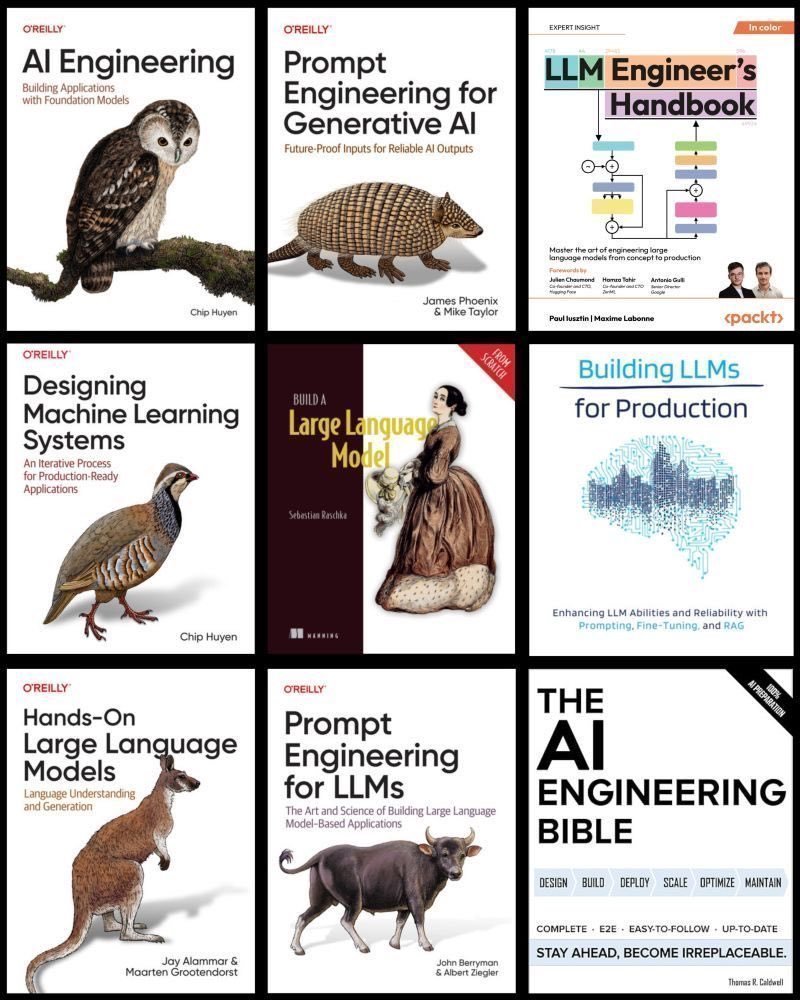
📚 40 books, countless lessons, and endless opportunities to grow.
Every page can teach you something new—about life, success, mindset, and yourself.
Start reading, keep learning, and become a better version of you.
#Books#Reading#SelfGrowth#Mindset#Success#Learning
Executives spend heavily trying to predict competitors' next moves. But they often overlook one of the clearest signals of strategic intent: job postings.
Because companies have to hire before they can launch products, enter new markets, or build new capabilities, recruiting data often reveals future priorities months before earnings calls, press releases, or product announcements.
By analyzing competitor job postings at scale, companies can sharpen their competitive advantage. Here’s how. https://t.co/eFyzUGQs2G
Algebra symbols provide a universal way to express mathematical concepts clearly.
Common ones shown are :
≜ for equivalence by definition,
≡ for equivalence,
∝ for proportional to,
⌊ ⌋ and ⌈ ⌉ for floor and ceiling brackets,
f(x) and f ∘ g for functions,
(a,b) and [a,b] for intervals,
△ for discriminant,
∑ and ∏ for sums and products,
∞ for infinity,
constants like e, γ, φ and π,
{} for sets,
∀ and ∃ for quantifiers,
a^b for powers and roots √ ∛ ∜.
These symbols are used to formulate equations in scientific research and software development for accurate computations.
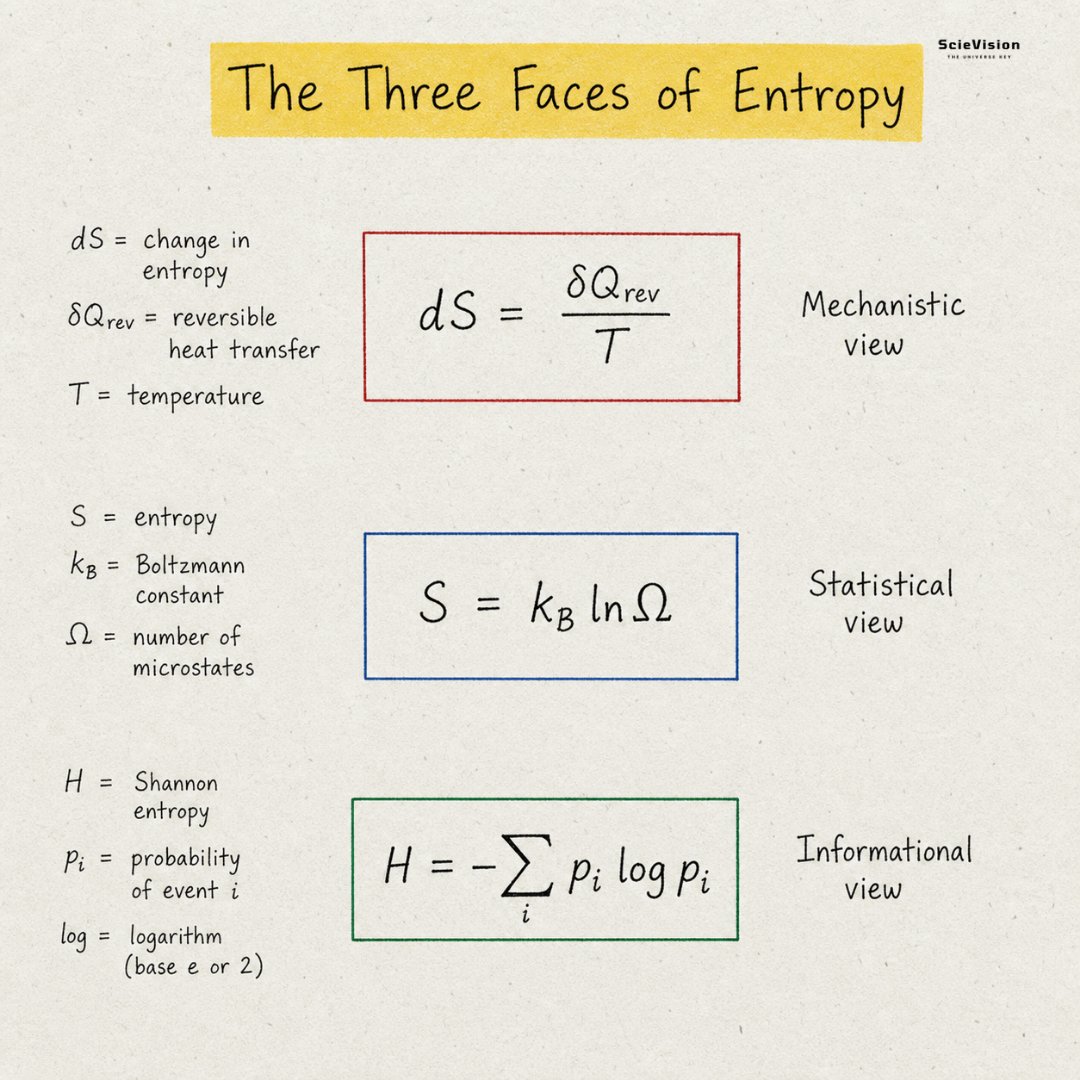
The Three Faces of Entropy ✍️
Entropy is a scientific concept that explains the connection between energy, disorder, probability, and information. The physicist Rudolf Clausius introduced it in 1865 to describe how heat moves in physical systems. Over time, scientists found that entropy appears in many fields, including physics, chemistry, information theory, and cosmology.
One way to understand entropy is through heat and energy. When heat enters a system, entropy usually increases. When heat leaves, entropy decreases. The same amount of heat affects something very cold more than it does something hot. This idea led to the second law of thermodynamics, which states that the total entropy of an isolated system naturally increases over time. This explains why hot coffee cools down, why ink spreads in water, and why broken objects do not fix themselves. Entropy gives time a direction because natural processes tend to move from lower to higher entropy.
Another way to understand entropy comes from Ludwig Boltzmann’s statistical perspective. He noted that entropy depends on the number of possible microscopic arrangements in a system. A system with many possible arrangements has high entropy, while one with few arrangements has low entropy. For instance, gas spread throughout a room has much higher entropy than gas trapped in one corner because there are many more ways for its molecules to arrange themselves. Entropy increases since high-entropy states are much more likely to happen.
The third way to understand entropy comes from Claude Shannon’s information theory. In this view, entropy measures uncertainty or missing information. If something is unpredictable, it has high entropy because learning the result gives us new information. A fair coin toss has higher entropy than a coin that always lands on heads because the outcome of the fair coin is uncertain. This concept links to physics, as a high-entropy physical system is one where we know less about the exact microscopic details.
Together, these three views describe the same idea in different ways. The thermodynamic view explains how energy changes, the statistical view explores the number of possible arrangements, and the information view pertains to uncertainty. Entropy is not just about disorder; it reveals a profound concept that shows how energy, probability, time, and knowledge are interconnected in the universe.
Tensors generalize vectors as lists and matrices as grids into higher-order arrays like 3D cubes.
Comparisons include a vector as a list, a matrix as a grid, and a 3-tensor as a cube, along with the stress tensor σij on a cube featuring arrows for components like σ11 and σ23, the product derivative rule, the Riemann curvature tensor R(u,v)w = ∇u ∇_v w − ∇_v ∇_u w − ∇[u,v]w, quantum superposition 1/√2(|00⟩ + |11⟩), and algebraic operations like the tensor product.
It is used to analyze internal forces and deformations in engineering materials and to describe the geometry of spacetime under gravity in general relativity.