Alexandr Wang says first-time founders should do every job themselves, then learn to stop.
His advice for a first company: hold a strong view on how every detail should work. Scale AI was built that way, and it succeeded because of that control. The cost was becoming the bottleneck, since every decision ran through him.
At Meta he couldn't repeat it. He is not an AI researcher or a product designer, and the timeline was too short. So his job became hiring the best people in every field and giving them room to shape the work.
Control builds the first company. Hiring builds the second.
Alexander Wang revealed DeepSeek holds 50,000 banned H100 chips it cannot discuss.
Alexander Wang said the United States led for the past decade. On Christmas Day roughly a month ago Chinese lab DeepSeek released its model while others celebrated the holiday, then followed with a second release.
Export controls were supposed to stop the highest-powered NVIDIA chips from reaching China. Wang stated DeepSeek already has about 50,000 H100s, more than outsiders expected, and cannot talk about the stockpile.
Those controls will still constrain what the lab can build next.
Wang showed the ban arrived after the chips were already inside.
SpaceX will capture an asteroid with more gold than Earth's crust and land Optimus robots carrying American flags on Mars within 8 years.
Starship parks Psyche in geosynchronous orbit over an American Pacific atoll. No humans within 50 miles. Optimus robots extract the metals. Delivery to Earth is free though some burns up on entry.
Bezos said 15 years ago Earth gets zoned residential as heavy industry moves to space. Vast distances make emissions irrelevant.
The same fleet lands on Mars in 8 years max. Optimus robots deploy solar panels, batteries, compute, and Starlinks for 4K video before humans arrive.
SpaceX moves the factories off the planet.
Alexandr Wang's company paid American contributors about $500,000,000 last year to teach AI what it gets wrong.
Scale AI runs a platform called Outlier, which he describes as Uber for AI: algorithms need data, and a network of people across 9,000 US towns produce and correct it for pay. A nurse, for example, catches an AI telling someone to ignore stomach pain that could be appendicitis, and her correction feeds back into the model.
Spam is filtered through peer review and automated checks. Experts are wanted in anything, from medicine to train tracks.
AI is a race on 3 fronts: chips, data, and algorithms.
The cleanest data wins.
Elon Musk says money may disappear entirely, and energy becomes the only currency left.
His logic: money exists as a database for allocating human labor. If AI and robots grow big enough to meet every human need, that database loses its purpose. Energy can't be legislated into existence, which is why he ties Bitcoin to it.
He measures civilization on the Kardashev scale: how much of a planet's, then a sun's, then a galaxy's energy gets turned into useful work.
The turning point comes when AI and robots mine, build chips, and make solar panels on their own. Once that cycle closes, the economy decouples from money.
Wealth only means something while humans are around to want it.
Alexandr Wang's company paid American contributors about $500,000,000 last year to teach AI what it gets wrong.
Scale AI runs a platform called Outlier, which he describes as Uber for AI: algorithms need data, and a network of people across 9,000 US towns produce and correct it for pay. A nurse, for example, catches an AI telling someone to ignore stomach pain that could be appendicitis, and her correction feeds back into the model.
Spam is filtered through peer review and automated checks. Experts are wanted in anything, from medicine to train tracks.
AI is a race on 3 fronts: chips, data, and algorithms.
The cleanest data wins.
Alexandr Wang says right now is the best moment in history to build a billion-dollar company.
He argues the bottleneck is no longer AI models but how fast the world adapts to them. Even if models stopped improving today, decades of economic upheaval would still follow, and that gap between technology and adoption is where new companies get built.
10 years ago, startups fought giants with cleverness and fewer resources. With AI agents, a small team can now compete head-on with incumbents, like a mecha Goliath against a traditional one.
He calls it a once-in-a-civilization window for anyone with a vision and ambition.
It won't stay open forever.
Elon Musk says money may disappear entirely, and energy becomes the only currency left.
His logic: money exists as a database for allocating human labor. If AI and robots grow big enough to meet every human need, that database loses its purpose. Energy can't be legislated into existence, which is why he ties Bitcoin to it.
He measures civilization on the Kardashev scale: how much of a planet's, then a sun's, then a galaxy's energy gets turned into useful work.
The turning point comes when AI and robots mine, build chips, and make solar panels on their own. Once that cycle closes, the economy decouples from money.
Wealth only means something while humans are around to want it.
Alexandr Wang dropped out of college and became a young billionaire anyway.
Both his parents are physicists with PhDs, and both older brothers followed the same path. His parents taught him physics and math at home, which fed his wins in math competitions.
When he left school, they were worried. He told them a white lie: he'd get the tech thing out of his system, then go back and finish. He never did.
Now they're proud.
He skipped the degree. He kept the education.
@vladuah The tuxedo was real. The wipeout just made that obvious. While everyone argued whether the photo was AI, he was out on the water, and the real bet is still the compute going into health, science, and education.
People thought Zuckerberg's tuxedo was AI, then watched a fire-hose wipeout on a lake.
He skipped the octagon for wake surfing behind a boat. Every fall hits like a fire hose. Priscilla Chan's initiative targets health, science, and education with AI, the right problems, and a compute cluster.
For a few hundred years most people farmed to survive. Less labor can cover the basics.
The tuxedo was real. The wipeout proved it.
Warren Buffett says the best investment costs $0, and a Dale Carnegie course raised his own value by at least 50%.
Buffett tells business students that communication skills, in writing and in person, add at least 50% to their value. He took a Dale Carnegie course himself, and he rates it above any complicated formula taught in graduate school.
Most investors lose money by moving around. Stocks can be sold in seconds for pennies, so people trade. A farm or an apartment house can’t be resold tomorrow, and that forced patience is why owners hold on. His fix is to buy across the whole market and stop watching it.
The same logic covers your body. You get 1 mind and 1 body for life, and by 50 neglect has already rusted them out. He also says to pick a spouse who is better than you, because you drift toward the people around you.
Skills nobody can take from you beat stocks anyone can sell.
Jeff Bezos spent 1997 deliberately refusing to make Amazon look profitable.
Revenue jumped 838% to $147,800,000, customers grew from 180,000 to over 1,500,000, and headcount went from 158 to 614. Almost every dollar went straight back into warehouses, selection, and lower prices.
Each cut to margin made the business bigger, and each bump in scale made it cheaper to run. That loop was the entire strategy.
In the shareholder letter he still called it Day 1.
He wasn't building a profitable company. He was building one nobody could catch.
Jeff Bezos speaks last in every meeting, because his opinion would quietly rewrite everyone else's.
He argues humans aren't built to seek truth. We're social animals, and 10,000 years ago the village truth-teller risked getting clubbed in the night. Any high-performing team has to deliberately build a culture that makes truth-telling survivable.
His fix is simple: the most junior person speaks first, seniority follows in order, and the boss goes last. Even sharp, strong-willed people shift their view once someone they respect weighs in.
He adds 2 guardrails: don't dismiss a hunch just because it lacks data, and when data has a happy reading and an unhappy one, assume the unhappy one until proven otherwise.
The most senior voice in the room is the loudest bias in it.
Donald Trump told an interviewer in 1980 he'd have gone to war in Iran himself, then said moments later he wouldn't go if actually drafted.
"If I were in the military... absolutely." Pressed again on whether he'd actually go if called up: "No, I don't see a war... that would have been the easiest victory we would have ever won."
His framing for the hostage crisis wasn't military strategy - it was reputation. "If they respected this country, I don't believe they would have our hostages for 10 minutes."
His prediction for where it was heading: That little sparkle of war is going to lead to a much, much greater conflict.
Phil Ivey lost $1,000,000 and poker history to a hand Chris Moneymaker now admits he shouldn't have even called.
2003 World Series of Poker. An ace on the river beat Ivey's full house and knocked him out of the tournament.
Moneymaker called him that night. Ivey said he'd have folded on the flop. Moneymaker now admits he didn't understand No Limit Hold'em well enough yet to know he should have too - the game wasn't solved for either of them back then.
Ivey replays his bad hands more than his wins. Moneymaker analyzes the same way, just without the attachment.
Bill Gates wrote a 200-page report on Delaware as a kid while classmates turned in 5 pages.
Teachers couldn't agree on him. "Some said skip him 2 grades. Some said hold him back." His parents sent him to therapy instead.
The therapist didn't fix a behavior problem - he fixed an argument. Gates had been fighting his parents, treating their rules as arbitrary because he out-thought most adults around him.
The message: "Your parents love you. They're on your side. Apply your energy elsewhere."
That redirected focus went from cards, to math, to software.
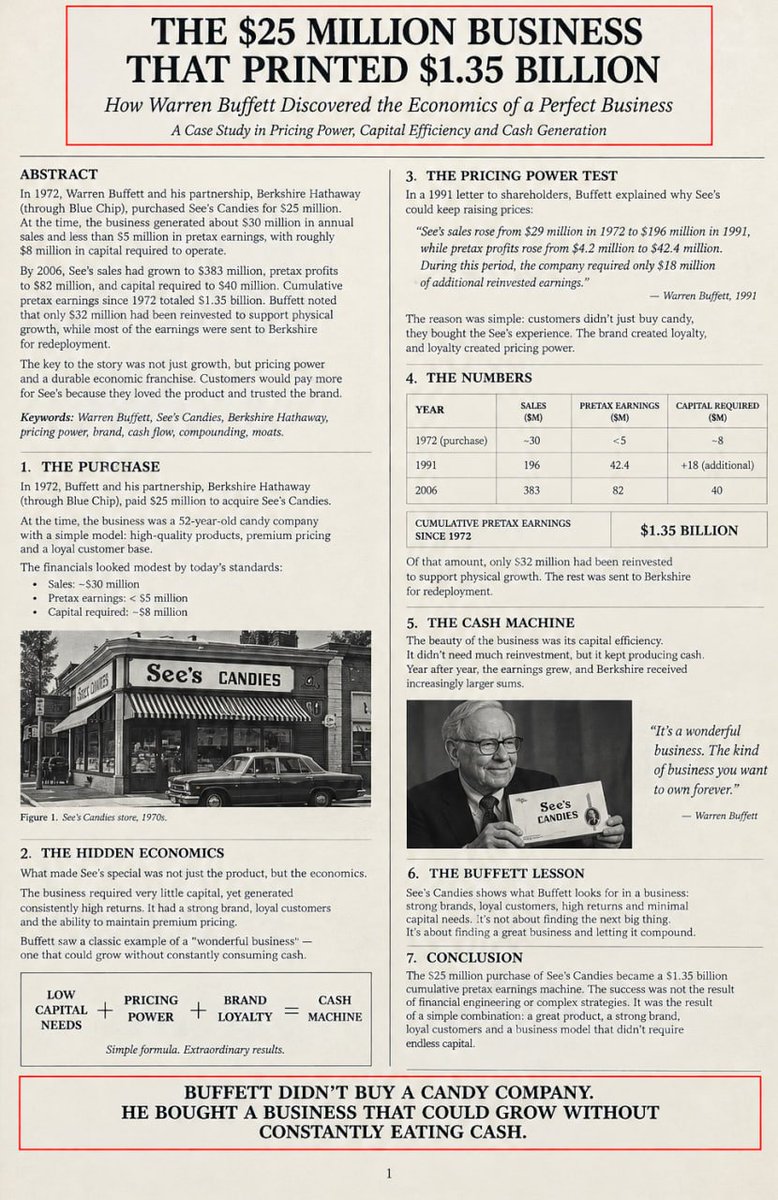
Warren Buffett paid $25,000,000 for a candy company in 1972. It generated $1,350,000,000 in pretax earnings.
1972: $30,000,000 in sales, under $5,000,000 in pretax earnings, $8,000,000 in capital required. By 2006: $383,000,000 in sales, $82,000,000 in pretax earnings.
Only $32,000,000 ever went back into the business. The rest went straight to Berkshire.
"It's a wonderful business. The kind of business you want to own forever."
Low capital needs plus pricing power plus brand loyalty equals a cash machine.