“we’ve never seen him frequenting gyms” “maybe he does pilates?” uh have i got news for you babes, you don’t get to look like THIS without intense workouts, strength training and weight lifting and an insane dedication.
also, no one gets to look like this anyways, #thisisjimin 😭
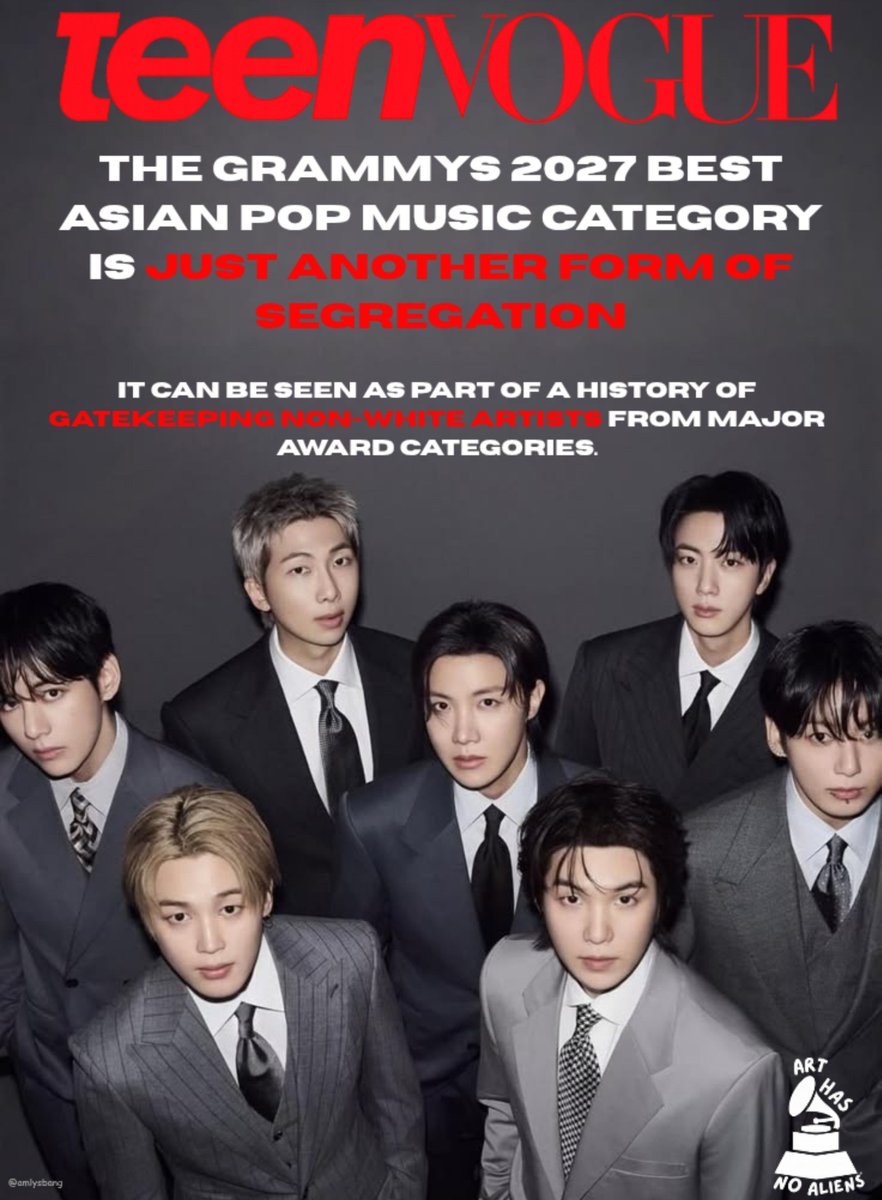
"There seems to be a pattern emerging here, and it becomes increasingly difficult to dismiss it the more you pay attention. It goes like this: A non-white artist breaks into mainstream-music consciousness by delivering a critically acclaimed project and looks likely to win a Grammy in a major category. Soon after, a new category is announced by the Recording Academy to help segregate these artists." — Teen Vogue
#ArtHasNoAliens @RecordingAcad
🐯: When I posted on Weverse asking people not to come looking for us outside our hotels, honestly, about 90 out of 100 people...
🐯: Even if ARMY happens to see us out on the street, they just pretend they haven't noticed us.
🐯: They seem to want us to make as many memories as we can in their country, so they simply act like they didn't see us and keep walking.
🐯: Some of them even deliberately avert their eyes when we cross paths. It makes us feel so grateful that we're the ones who end up saying hello first: “Hi, “Have a good day."
🐯: Sometimes we'll even shake hands.
🐯: Moments like that are so heartwarming. So we're the ones who thank them.
🐯: One time, we were even walking down the same street. We said, "Bye-bye," but it turned out we were both headed in the exact same direction, so that was pretty funny
jimin visitou a “Huntsman & Sons”, uma das alfaiatarias mais tradicionais e prestigiadas do mundo.
durante a visita, conheceu o Kingsman Room, o provador original usado como locação nas filmagens da franquia “Kingsman” (uma série de filmes de espionagem em que uma tradicional alfaiataria de Savile Row serve como fachada para uma agência secreta britânica.)
ele posou ao lado do icônico Orange Dinner Jacket, um dos figurinos mais reconhecíveis da saga, hoje preservado como parte de um espaço que homenageia o universo do filme e a tradição da alfaiataria britânica
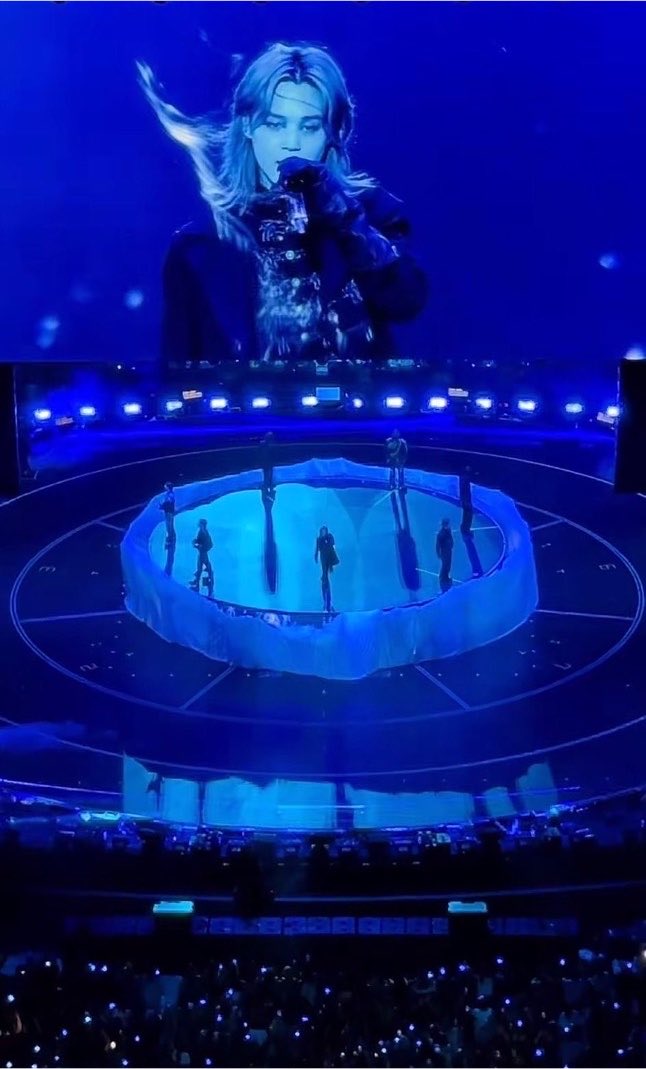
USA TODAY Network 소속의 미국 매사추세츠 지역 유력 일간지 The Worcester Telegram & Gazette가 BTS의 보스턴 지역 첫 뉴잉글랜드 공연인 폭스버러 Gillette Stadium 공연을 리뷰하며, 지민의 독보적인 영향력을 조명했습니다.
⎡ 길게 흘러내리는 금발과 섬세한 이목구비를 지닌 지민은 단연 BTS 멤버들 가운데 가장 큰 함성을 이끌어낸 멤버였다⎦
#JIMIN_WORLDTOUR_ARIRANG
STAGE GENIUS JIMIN
JIMIN SHINES IN BOSTON
JIMIN JIMIN
#JIMIN #지민 @BTS_twt
The Scholars at 'Modern Diplomacy' compares the Grammys newly introduced "Asian Pop Performance Category" with the post-colonial theory of “Two Worlds: Us and Them”— a way of thinking that consistently divides humanity into“Us” and “Them,” “the in-group” and “the out-group,” namely our civilization and theirs (the “barbarians”) derived from a chapter titled “Another World?” in the famous book 'The Clash of Civilizations and the Remaking of World Order', written by Samuel P. Huntington.
Asia’s BIGGEST music group, #BTS, reacted to this new asian sub-category by withdrawing from submitting their respective work for the 2027 Grammy Awards. This signals a backlash against categorizing and segregating music based on region or language. Despite the Academy’s attempt at clarification, does the categorization of music in the 2027 Grammy Awards reinforce the dichotomy between the West and the East, between “us” and “them,” between “insiders” and “outsiders”? Which further implies that the former is superior to the latter?”
The definitions of region and language often create mental boxes that actually reinforce and clarify the reality of the relationship between Asia and America/Europe, the West and the East. These categories seem to suggest that Western and Asian music cannot compete in the same awards ceremony. This situation seems to validate what Samuel P. Huntington wrote in “The Clash of Civilizations: Us and Them” a way of thinking that always divides humanity into the categories of “Us” and “Them,” “insiders” and “outsiders,” namely our civilization and their civilization, as reflected in "our music" and "their music".
This new Asian Pop Performance category definitely reinforces the “us versus them” dichotomy, where music is categorized by language and region, resulting in a division into “Two Worlds of Music”: “Our Music” and “Their Music” a mindset that perpetually divides humanity into “the in-group” and “the out-group,” namely Western music (the in-group) and Asian music (the out-group).
#ArtHasNoAliens
#GeographyIsNotAGenre
https://t.co/5x85ZPbYvB
ARMYs, this is one of the most interesting and trenchant takes on BTS's Grammys decision, even digging into America's history of "Separate but Equal."
Kim Ou-joon, one of Korea's most influential public figures and its most prominent progressive voice (I recently wrote a seven-part article about him in the Articles section), devoted a lengthy segment to the BTS-Grammys controversy on his program, Gyeomson News Factory. It is the most-watched live political and current affairs program on YouTube in Korea (and in the world), drawing more than 200,000 live viewers and averaging around 1.2 million views per day.
Kim was sick last Friday, so he wasn't there to host the show when three music critics appeared and made the most misguided arguments about BTS's decision:
1. This is just a Korean inferiority complex. It may feel emotionally satisfying, but it wasn't the right decision.
2. HYBE probably realized BTS had little chance of winning a major Grammy category anyway, so they made a calculated business move before the Grammys could reject them. This is basically a power game.
3. Now that the Grammys have created an Asian Pop category, future artists may dream of winning in that category. So we can't say BTS's decision was entirely the right one.
4. Didn't BTS work so hard to learn English and Japanese in order to break into the U.S. and Japanese markets? Now that there's an Asian Pop category, artists might not have to do that anymore. They could stay in their own language and still be nominated in the Asian Pop category. Isn't that actually a good thing?
Here is Kim Ou-joon's commentary from today's show. I translated them as faithfully as possible. Because of his short, conversational style of speaking, I added a few words here and there for context so that his intended meaning would come across accurately. And I omitted the exchanges between Kim and the announcer during Kim’s commentary.
—----------------------------
“I think the Grammys created the new Asian Pop Music category because they were planning to give that award to BTS. But then BTS refused to submit their music, and it became a global controversy.
Media outlets around the world started pouring out articles. From The New York Times onward, pretty much every major international media outlet we know covered it. And, for the most part, they viewed BTS's boycott positively.
They called it "a gentle but powerful criticism" (The Guardian). “Refusing was the right thing to do” (Cosmopolitan). "A declaration of independence" (Sportal Korea). “BTS had captured the spirit of the times" (The Economic Times)
Now, last Friday, the music critics who appeared on our program seemed to say that this new category could have become a stepping stone for Asian-language music to succeed in the global market, so they felt a little disappointed by BTS's decision.
Yes, I understand that point of view. There's some validity to it. But I think differently.
If I had been there, I probably would have argued against them pretty strongly. Since I wasn't, let me add my thoughts now, even if it's a little late.
Because I don't think this is something we should just let pass. I think this is a significant event, one that deserves to be recorded not only in Korean cultural history but also in the history of world culture.
Let me briefly explain why. To understand this, we have to look at it not from our perspective, but from the Western perspective. Using their way of thinking. Because it's a Western award show. It was their decision. We have to understand why they did it from their point of view. That's how you understand their intention.
Now, there's a precedent for this. I think it was 2019. MTV became the first major music award show to create a Best K-Pop category. It should have just been called Pop. Instead, they created a separate Best K-Pop category.
At the time, The Washington Post used a particular expression. They said this was America's "separate but equal" rule in music awards.
That phrase is extremely important in the history of the American civil rights movement. For Americans, just hearing those three words is enough. They immediately understand what's being implied.
This goes back to around 1890. Louisiana was one of the places where racial discrimination was especially severe. The state passed a law requiring separate railroad cars for white people and Black people. Black and white passengers had to ride in different train cars. Civil rights activists wanted to challenge that law as unconstitutional, as racial discrimination.
At that time, there was a man named Plessy. By appearance, he looked white. But he was one-eighth Black. His great-grandmother was Black.
At the time, America had what was called the one-drop rule. If you had even one drop of Black blood, no matter how white you looked, you were legally classified as Black.
So this man boarded a whites-only train car. Then he deliberately announced that he was Black. He wanted to be arrested.
That's how the lawsuit began. The case eventually reached the U.S. Supreme Court. The Louisiana judge's name was Ferguson, so in America it's known as “Plessy v. Ferguson.”
It's a very famous case. One of the most famous rulings in American history came out of that case. That's where the phrase "separate but equal" comes from.
The Court ruled that separating railroad cars was constitutional because, although they were separated, they were supposedly equal. In the end, it was a ruling that justified racial discrimination. This was at the end of the nineteenth century.
After that decision, segregation spread far beyond railroad cars. Because racial segregation had now been accepted under the Constitution, separation spread into every part of society. Schools. Hospitals. Parks. Buses. Theaters. Restrooms. Eventually even cemeteries. People were separated from birth until death.
But the facilities for Black people received less than one-tenth of the funding that white facilities received. Because the people making those decisions were all white. So the facilities for Black people were in terrible condition.
That's why the phrase "separate but equal" really meant separation, inequality, and exclusion. But those words were used to hide racial discrimination. That system continued for nearly seventy years.
That's exactly what The Washington Post meant when it described MTV's decision as "separate but equal." By creating a K-pop category, it looked as though K-pop was being treated equally. But in reality, it excluded K-pop from competing in the main categories while hiding that exclusion.
At the time, there was another expression people in the West used to describe MTV's decision. Ghettoization. During Nazi Germany, Jews were confined to ghettos. So people said K-pop had been ghettoized. It had been placed in its own separate space.
That expression also has a precedent. When Black music began to rise in America, award shows grouped Black artists into R&B and Rap categories. Black artists would receive those awards, while the major awards continued to go to the mainstream. People called that the ghettoization of Black music.
So MTV received that criticism. After that, MTV nominated BTS in the regular Pop category. And BTS won.
At the time, Billboard wrote that BTS had entered through the side door, and that it had taken a long time before they were finally allowed to use the front door like everyone else. After MTV, the other award shows adapted to that criticism.
The Grammys were the last one left. The Grammys see themselves as the most prestigious music awards because, unlike other shows, there is no fan voting. Like the Academy Awards, only industry professionals vote.
So they created a side door, just like MTV. This was basically saying, "Asia, come in through the side door. Separate but equal."
When MTV did this, BTS still attended despite the controversy. But this time, BTS declared to the American mainstream music industry, "We're not using the side door anymore." And they refused.
That's why Western media, who understand this context exactly, praised BTS. They said, "Well done." They called it the spirit of the times.
That's how I see it too. I think this will remain a landmark in world cultural history for a long time.
An artist from outside the mainstream boycotted the most prestigious award in the mainstream and declared, "You are out of step with the times."
It's contextually similar to Black Americans demanding racial equality and human equality.
That's why western media call it the spirit of the times. Some in Korea don't immediately understand why it's being called that. They think, "Wouldn't this have been a good opportunity for Asian artists?"
That Friday's comment comes from not seeing how people in America think about this issue. That's all I wanted to add.”
—--------------------------
For those who understand Korean, you can watch the video of his commentary here. (I wish I knew how to add English subtitles, but unfortunately I don't.)
https://t.co/bsgO5X8KwA
Here is the full translation :
🗣️: Jimin is the singer in BTS who sings the highest. Most of us already know this, and BTS has said so themselves.
🗣️: I'm going to show you now in a normal clip where all four of them sing a live song, in which all four perform the exact same melody and the exact same section, but they reach those notes under different circumstances.
🗣️: Here in the live clip, we have Jungkook singing with a mixed voice, but with a low mix range.
🗣️: Here, Jimin is using chest voice—he's totally chill.
🗣️: Here, Jin already needs a bit of nasality, more volume, and more air.
🗣️: And over here, Tae already needs to shout—which is understandable because Tae is a low baritone, while Jimin is a high tenor.
🗣️: So, to help those who still don't fully understand terms like 'chest voice' or 'mixed voice': let's pretend that reaching that melody in this song is like jumping 1 meter high.
🗣️: All four of them manage to jump that 1 meter, but Jimin jumps it without needing any momentum, while the other three have to take a run-up to jump it.
Jungkook takes maybe one step to jump that meter. Jin takes maybe two or one and a half steps. And Tae needs to take three or four steps to reach that same meter.
🗣️: So, they are different vocal types; all four reach the note, but under different circumstances, and the one who is consistently most comfortable is always Jimin.
🗣️: Suga in particular has mentioned that BTS songs are pitched high because of Jimin—we all know that.
🗣️: And clearly, Jimin is comfortable, but there are members who suffer more, and the one who struggles the most is Tae. It's not that he hurts himself on the notes, but he gets fatigued. On top of singing, he needs more power, muscle contraction around the larynx, and effort to prevent other muscles from activating that could compromise his ability to sing a 3-hour concert—especially considering they are also dancing. So, those are the different circumstances."