3 PhD positions: fully-funded, 4-year joint PhD betn IITB and Monash Uni (Aus). Spend a year at Monash. MTech or MSc/BTech+Valid GATE/JRF/etc. Background in hydrology, climate sciences, math, probability and statistics. Email [email protected] for more. https://t.co/c7iVJhRuXq
This is how I advise my #PhD students to write research manuscripts (in case someone finds it helpful).
General points:
1. Research questions addressed by your manuscript are key and should guide you.
2. Don’t view your manuscript as an article. See it as a STORY.
3. Pick the writing style that is easily understood by a broader community. Make reading easy.
4. Most of data should get into the paper. If some doesn’t support the hypothesis, it still must be in the Suppl. Information. It must show the reproducibility limits.
5. Make the paper shorter, not longer. Cut out things that may sound like ‘bluff’ or ‘decoration’ of the story. Use well-defined terminology, don’t invent it unless clearly necessary.
6. Focus on reporting & explaining the numbers. Minimize discussions of qualitative outcomes and your imagination.
▫️
Specific steps:
1️⃣ First, formulate and polish the key questions that your study addresses. It may take hours or even days (even though you've been doing research in this area for years). A single study should address no more than 1-3 key questions. It’s your perfect start for writing.
2️⃣ Write down the structure of your STORY first: Sections and Subsections that will answer those questions. Into each subsection, put 1-2 sentences that formulate the message(s) from this subsection. It will hugely help you navigate the manuscript later and save a lot of time.
3️⃣ Write approximate messages in the conclusion section. Usually, no more than 1-4 sentences.
▫️
At this point, SHARE your [structure+questions+messages] document with your advisor for feedback. Toss it back and forth until you both converge. You can also include major collaborators if needed.
▫️
4️⃣ Write the introduction part. Put down the paragraphs that introduce a reader into the key question(s) of the manuscript and the background of your story.
5️⃣ Write the main text for each section, smoothly and firmly. Each paragraph should add a separate value and end with a message-like sentence. Follow the “First… Second… Third…” structure for paragraphs when possible, it gives rigor and readability to your story.
6️⃣ Write the conclusions. Add a broader perspective that is justified and not generic.
7️⃣ Write the abstract. It must have simple terminology and clearly explain what readers can find inside the paper. It also should contain the key conclusions.
8️⃣ Write up 4-5 different titles and spend >30 mins with your team discussing which title sounds best.
Finally, iterate on the resulting draft within your team.
The number of drafts can easily exceed 20.
▫️
❗In addition, I always emphasize that a high quality of your research paper:
- sharpen your writing and analytical skills.
- shapes your reputation.
- shows who you are as a researcher and communicator.
▫️
p.s. Everyone has a different style of advising and writing. You can adopt only some specific steps if you find them helpful.
p.p.s. Another way that we sometimes use is by starting with figures ('story in figures' style).
#AcademicTwitter #AcademicChatter
Recruitment Alert🚨
Applications are invited from highly motivated candidates for ONE Junior Research Fellow (JRF) position in #HydroinformaticsLab at @IITIndore .
Application deadline: 5:30 PM September 12, 2023.
#PhD#recruitment
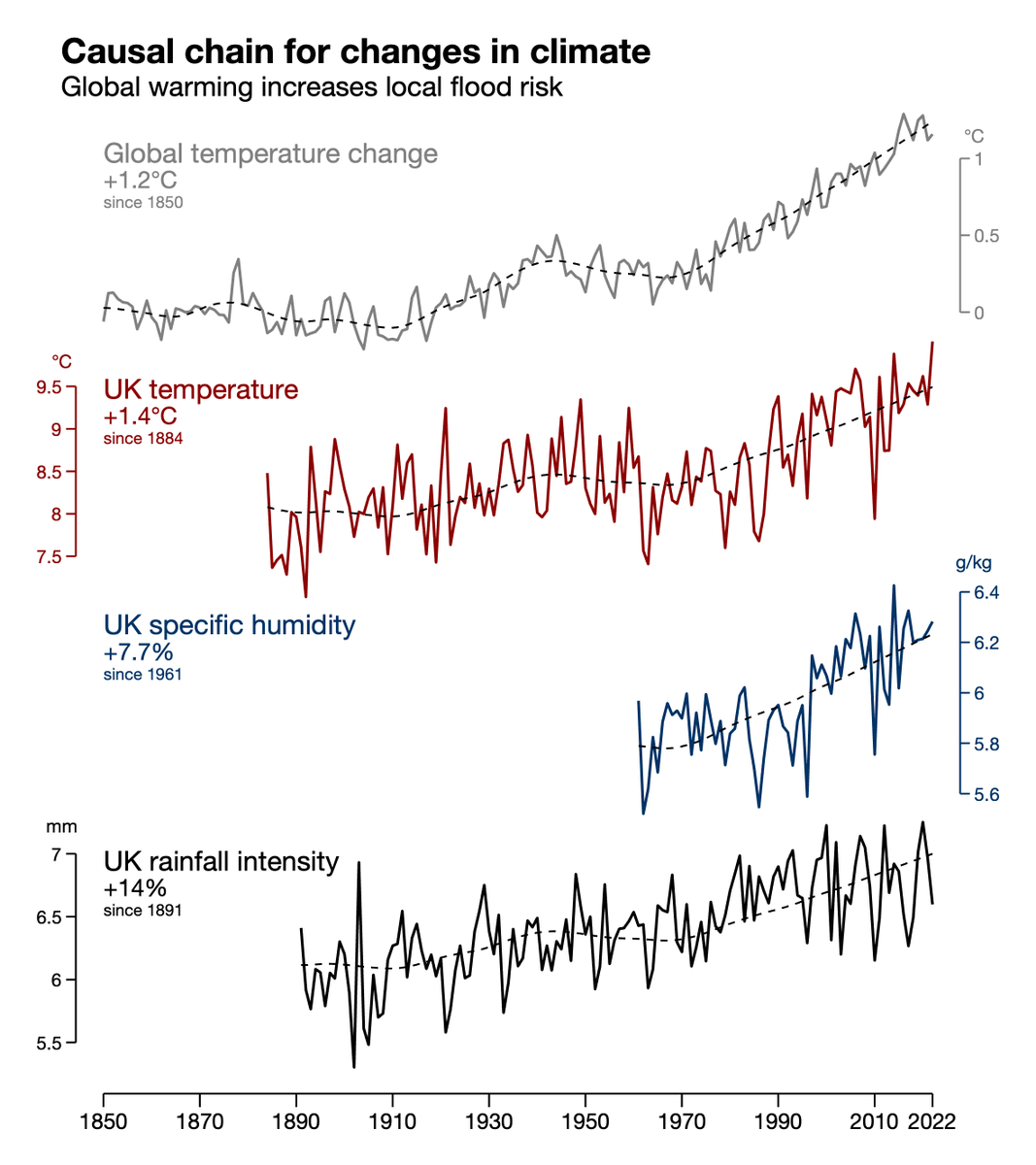
Global warming increases local flood risk.
How? A specific example for the UK:
As UK gets warmer, there is an increase in specific humidity as warmer air can hold more water.
In turn, this increases rainfall intensity. When it rains, it rains more. Meaning greater flood risk.
Excited to share our latest work on climate change and urban floods in Water Resources Reasearch (WRR) @theAGU!!
https://t.co/XvsGrDa10G
We propose a novel integrative framework to assess urban flood response to changing climate. (1/4)
@vmmerwade@siddsaksena@NOAA@UFOKN
The framework is demonstrated on an urbanized catchment in Houston Texas, USA (@ReadyHarris). We envisage its application to other major cities of the world facing frequent floods to support reliable risk assessment and adaption measures. (4/4)
of future precipitation to resolutions desired for urban flood applications.
It also provides quantitative estimates of uncertainty in historical and future design precipitation (using advanced ML methods) and their contribution to total uncertainty in flood simulations. (3/4)
Our latest work, led by Tao Huang, on quantifying and representing uncertainty in flood insurance rate maps is now published in ASCE Journal of Hydrologic Engineering. We need probabilistic inundation maps! Check it out at the link below and share!
https://t.co/SgC9pctnCz
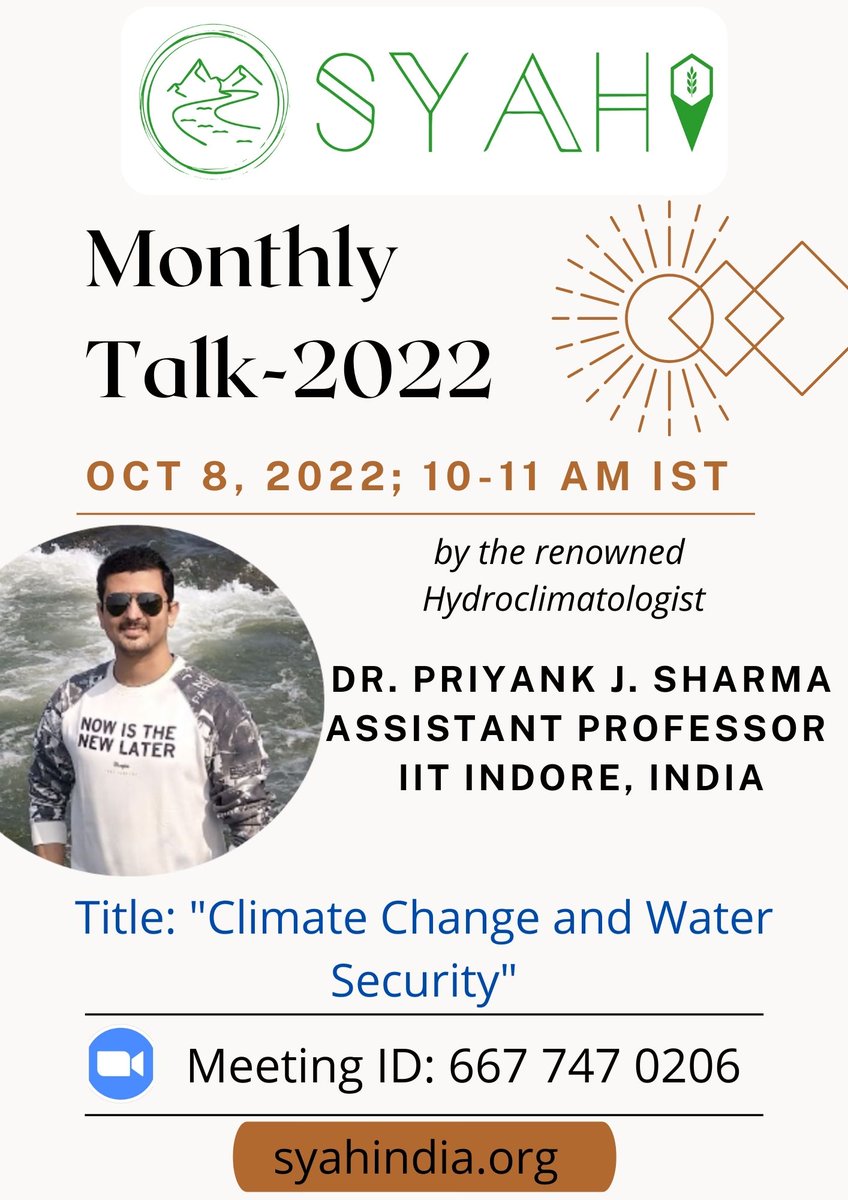
#SYAHI Monthly Talk on Climate Change and Water Security by Dr. Priyank J. Sharma, @IITIndore: OCT 8, 2022; 10-11 AM IST; Details-https://t.co/Hl0er3jRHD
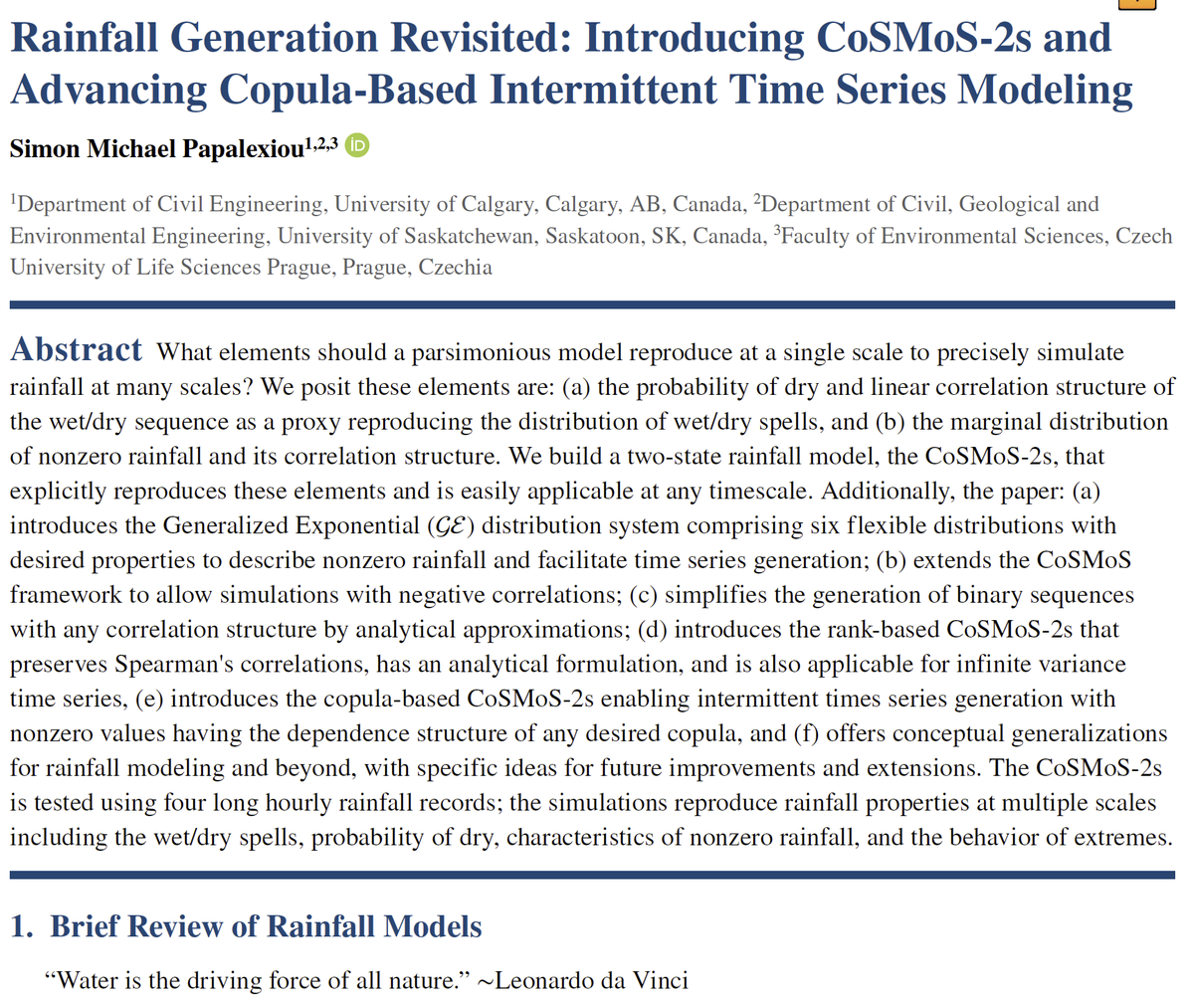
Interested in rainfall generation? Rainfall Generation Revisited…
New open access paper at #AGU's WRR: https://t.co/aO0Dy0DW4j
@Hydrology_AGU@usask_water@GWFutures
If you include computational tools including AI/ML in your teaching and developing new approaches/curriculum to include these topics in instruction, please consider submitting an abstract to the following @NSFiGUIDE related AGU session: https://t.co/iXYW0GjPVj
Successful installation of a RT WQ monitoring buoy station at Nainital lake, lesser Himalayas, India. Funded by Min. of Jal Shakti, Govn of India. Project partners - @iitroorkee, @cedar_himalaya and #FRI. Solar powered station monitors WQ parameters - Temp, DO, pH, EC & turbidity
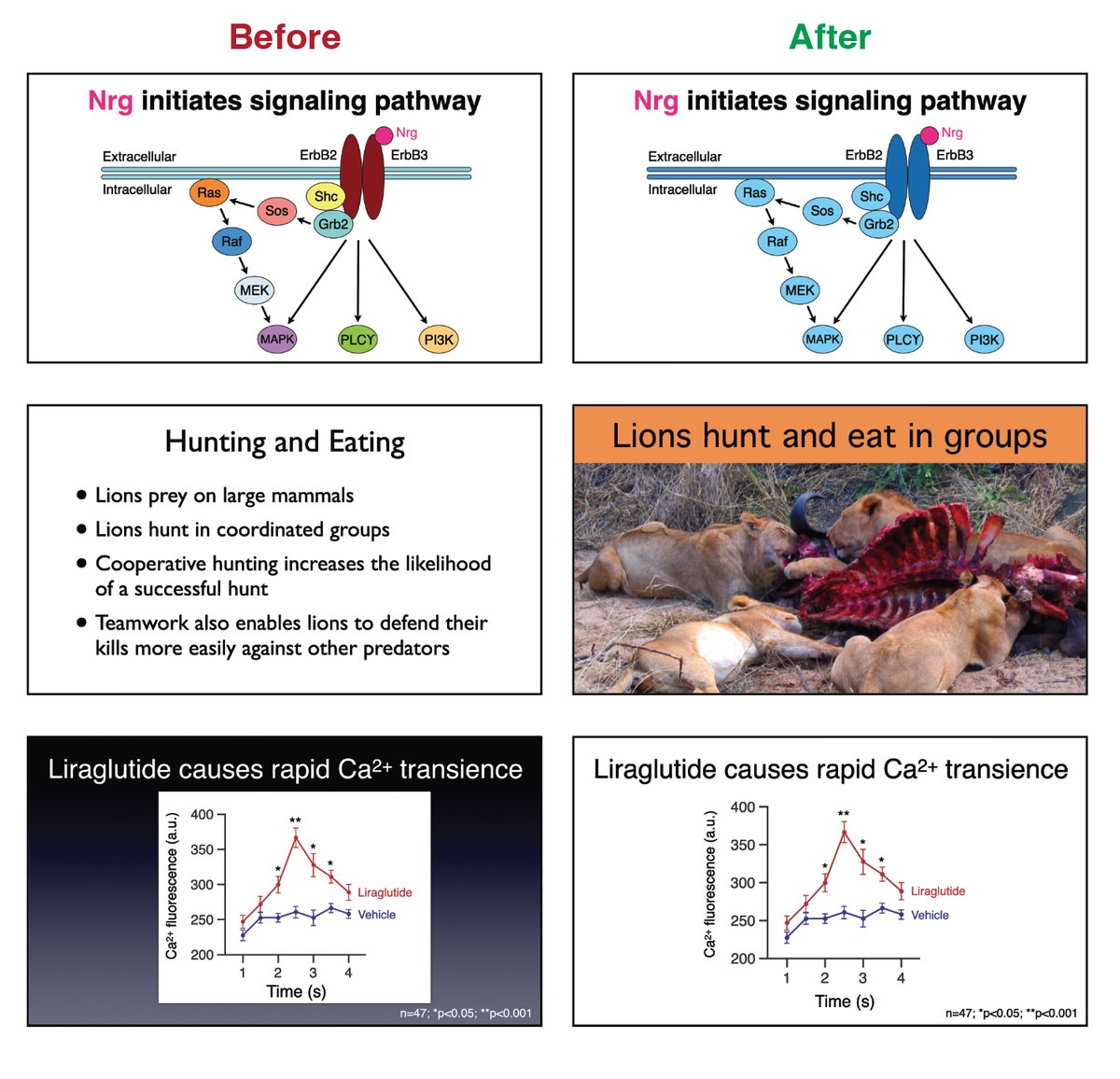
A thread on designing visually appealing slides. There are lots of great books/websites/videos about making slide presentations—this thread will focus on quick visual design tips that are easy to employ. Compiled by @__Matt_Carter__ . 🧵1/25