Conventional treatments such as chemotherapy remain essential for many patients, but they also damage healthy cells, impose significant physical burdens, and work unevenly across cancer types and individual patients. Precision oncology instead examines the molecular and genetic features of individual tumors, using next-generation sequencing, gene-expression analysis, and advanced computational tools, to understand why some cancers respond to a given treatment while others do not.
"Roughly half of all tumors still carry a working p53 gene," Gabi Hanna MD. says. "MDM2 is simply holding it hostage. Release it, and the cell's own defenses can do the work. If or when a drug like SA53 is approved, as many as half of all cancer patients could potentially benefit from SA53 as monotherapy or combined therapy."
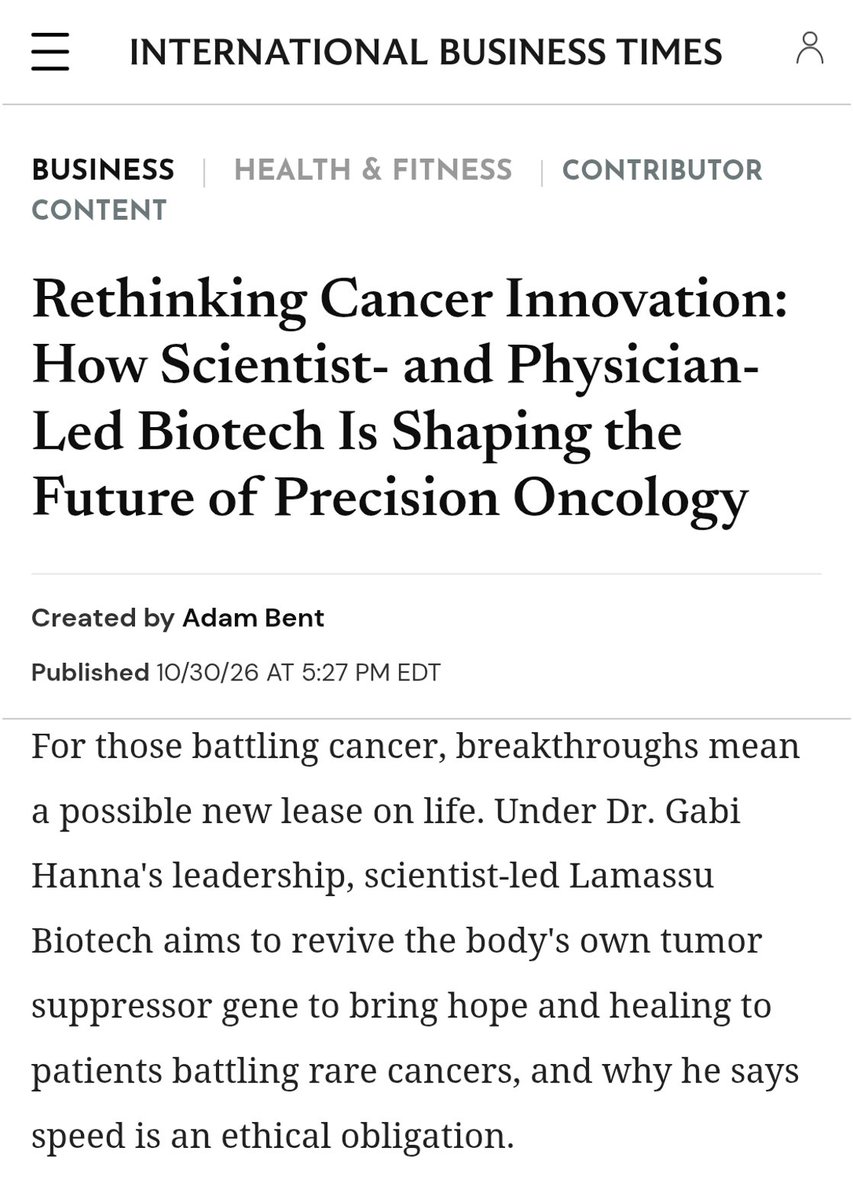
Rethinking Cancer Innovation: How Scientist- and Physician-Led Biotech Is Shaping the Future of Precision Oncology - @IBTimes
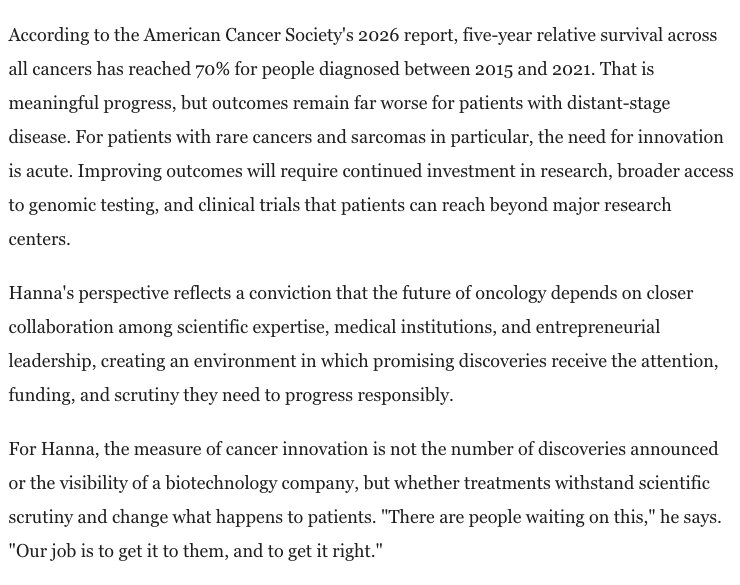
For Gabi Hanna, MD, the measure of cancer innovation is not the number of discoveries announced or the visibility of a biotechnology company, but whether treatments withstand scientific scrutiny and change what happens to patients. "There are people waiting on this," he says. "Our job is to get it to them, and to get it right."
Gabi Hanna MD.'s approach reflects a growing movement toward entrepreneur-, scientist-, and physician-led biotechnology. Rather than building a company primarily around financial investment first and science second, this model puts scientific knowledge, clinical experience, and unmet patient needs at the center of business development.
With experience across three drug companies, Hanna brings a firsthand understanding of what it takes to move a therapeutic concept from the laboratory toward the clinic. "Our job is to transfer scientific knowledge into tangible real products that help patients," he says.
🔬 This week, @LamassuBioTech announced interim safety and pharmacokinetic data from the ongoing first-in-human Phase 1/2a clinical trial of SA53, an oral MDM2 inhibitor, at the ESMO - European Society for Medical Oncology (@myESMO) Congress 2026.
🩺 The Phase 1 dose-escalation portion of the multicenter Phase 1/2a study remains ongoing. It aims to establish the maximum tolerated dose and recommended Phase 2 dose (RP2D) and to further characterize preliminary single-agent antitumor activity. Patient screening and enrollment are active.
Lamassu Biotech announced interim safety and pharmacokinetic data from the ongoing first-in-human Phase 1/2a clinical trial of SA53, an oral MDM2 inhibitor, at the European Society for Medical Oncology (@myESMO) Congress 2026.
Across four dose-escalation cohorts (0.054 to 0.44 mg/kg/day on a 3-day dosing schedule), SA53 has produced no dose-limiting toxicities (DLTs) and no Grade ≥2 treatment-emergent adverse events. MDM2 inhibition has shown antitumor activity by restoring the body’s natural p53 tumor-suppression pathway. Earlier MDM2 inhibitors have been limited by severe, dose-dependent hematologic toxicities, most notably thrombocytopenia.
🧬 SA53 is being developed as a targeted therapeutic approach designed to restore p53 activity in tumors retaining wild-type p53. If successful, SA53 may provide new hope for up to 50% of cancer patients.
🤝 Connect with Dr. Anderson and Lamassu Biotech’s team at ESMO to learn more about our research and the ongoing trial!
#ESMO26 #precisiononcology #oncology #MDM2Inhibitor #RareCancers
✈️ Meet Lamassu Biotech at @myESMO Congress 2026 in Madrid, Spain
🔬 Principal Investigator Peter Anderson, MD, PhD, an oncologist and sarcoma specialist at @ClevelandClinic, will present positive interim findings from the ongoing Phase I/II first-in-human clinical trial of SA53, Lamassu's novel oral MDM2 inhibitor.
🩺 Lamassu’s clinical trial focuses on determining a safe dosage for future trials, understanding pharmacokinetic profiles, and assessing early signs of effectiveness in treating soft tissue sarcomas and solid tumors with wild-type p53. The main goal is to advance SA53 through trials to offer a potential new and effective treatment option for patients.
#Oncology #Cancer #SA53 #RareCancer #healthcare #Medicine
🧬SA53 works by triggering the body’s natural defense mechanism, p53, which inhibits or blocks a protein called MDM2. MDM2 is the most important factor that regulates or blocks a protein called p53.
p53 works by suppressing or “putting the brakes on” the ability of cancers to grow, spread, and resist anti-cancer treatments. The p53 pathway is one of the most important natural defense mechanisms your body has against cancer. p53 activity is normally increased in response to many pro-cancer conditions. However, nearly all cancers find ways to bypass or prevent the activity of p53.