Claude Cowork is coming to mobile and web.
Hand Claude a task at your desk and pick up the finished work from your phone. Close the laptop and Claude keeps going.
Beta is rolling out over the next several weeks starting with the Max plan, with more plans to follow.
New Anthropic research: A global workspace in language models.
Of everything happening in your brain right now, only a tiny fraction is consciously accessible—thoughts you can describe, hold in mind, and reason with.
We found a strikingly similar divide inside Claude.
I was offered sex today by a very handsome 26yo. In exchange I was to advertise some bathroom cleaner on Twitter. Of course I declined because of my morals & strong willpower, which is as strong as Ajax, the super strong bathroom cleaner available scented with vanilla or lemon.
Following conversations with the US government, we’ve updated our cybersecurity safeguards.
The vast majority of coding work is unaffected.
In the near term, the new safeguards will flag a slightly higher fraction of harmless requests than the previous Fable safeguards; we’re working to refine these over the coming weeks. Users will be clearly notified when a request is flagged, and they’ll instead receive a response from Opus 4.8.
Our biology and chemistry classifiers are unchanged from our initial launch. These are still broader than we would like; they trigger fallbacks to Opus 4.8 on basic biology-adjacent questions. Improvements to these classifiers are landing soon.
As generative AI tools continue to evolve, we believe it's more important than ever to know what's AI-generated and what isn't. That’s why @GoogleDeepMind launched SynthID in 2023—a technology that adds a hidden digital watermark to AI content.
Here’s a summary of SynthID’s journey and where the provenance technology (the documented history and origin of digital content) is today:
— SynthID watermarking was originally built for images, but now supports video, audio, and text.
— The technology has watermarked over 100 billion images and videos, alongside 60,000 years of audio.
— You can now verify content with SynthID directly in Google Search, Gemini in Chrome, and the @GeminiApp, where it has been utilized over 50 million times.
— We’ve also adopted C2PA Content Credentials across a growing number of our generative AI tools. This includes the images and videos created within the Gemini app. So now, in addition to the SynthID watermark, you can also see where an image or video originated and how it’s been altered.
— We have open-sourced our text watermarking technology, and we are working with companies like @OpenAI, @NVIDIA, and @Apple to apply SynthID to generative media.
Let us know what you think of the tool so far!
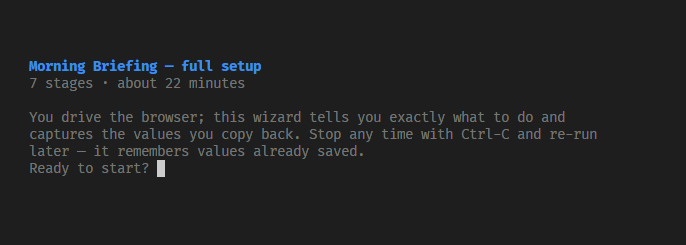
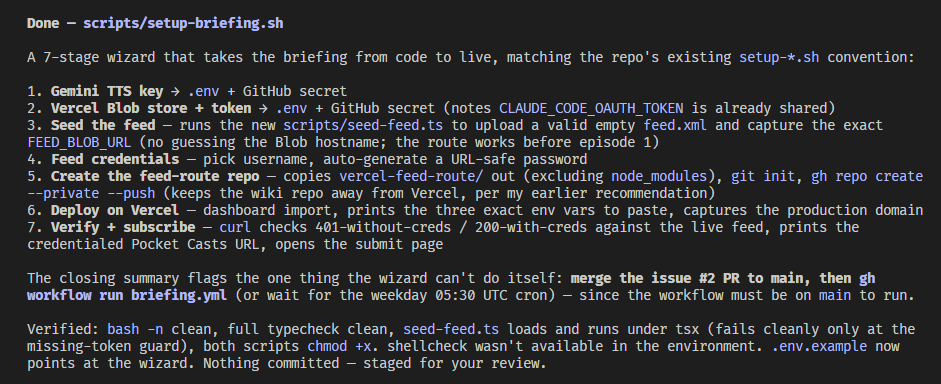
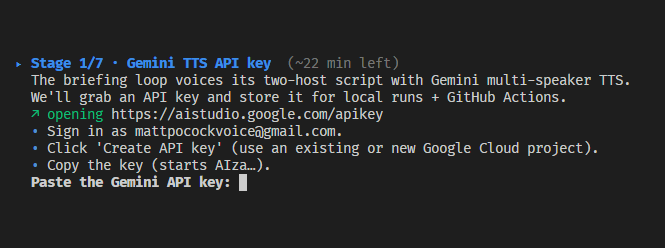
Getting sick of setting up third-party services
So I built a skill for it
/wizard builds you an interactive CLI for the task you're currently doing, and takes as much work off your hands as possible
#1 is how the agent described the wizard, #2-3 is what it looks like:
Claude Fable 5 will be available again globally tomorrow.
After a series of productive conversations with the US government, we're redeploying the model with a new set of classifiers to target and block more cybersecurity tasks. In the near term, some routine tasks like coding and debugging will fall back to Opus 4.8. We’ll continue to refine these classifiers over the coming weeks to reduce false positives and better distinguish genuine misuse from legitimate requests.
We’ve also begun drafting a consensus framework—with Amazon, Microsoft, Google, and other Glasswing partners—for assessing the severity of AI jailbreaks and how AI developers should respond to them. We invite other industry partners and model providers to join us in this effort.
Finally, we’re scaling up our collaboration with the US government on model testing and safeguards. This will include pre-release access to models and safeguards for evaluation, information sharing on jailbreaks and misuse, and dedicated resources for joint research.
Thank you to our users for your patience, and to our partners across the government, industry, and the research community who worked alongside us to make Fable 5 available again.
Read our full blog: https://t.co/VHyum831ri
Introducing Claude Sonnet 5, our most agentic Sonnet yet.
It makes plans, uses tools like browsers and terminals, and runs autonomously at a level that just a few months ago required larger and more expensive models.
We’ve received notice that the Department of Commerce has lifted export controls on Claude Fable 5 and Mythos 5.
We'll begin restoring access tomorrow, and will share an update soon.
We’re grateful to our users for their patience, and to everyone who worked with us on redeploying the models.
Introducing Claude Science, a new app designed with every stage of research in mind.
Artifacts traced to their code, environments managed on demand, and 60+ optional scientific databases that you can connect.
Available now in beta.
As engineering, product, design, DS, etc. melt into a new kind of role, I was reflecting on what roles might look like in the future. For example, when I look at the Claude Code team I see what I think is five archetypes:
1. Prototyper: comes up with brand new ideas; churns out many ideas, most of which don't ship
2. Builder: quickly turns a prototype/idea into production-grade product/infra
3. Sweeper: cleans up the UI, simplifies the code and system, unships, optimizes performance
4. Grower: takes a product that has been built and iterates on it to improve Product-Market Fit
5. Maintainer: owns a mature system to make it secure, reliable, fast, and efficient as it scales
Many people span across 2 roles, and sometimes 3 roles. I also notice that these roles are not really tied to job function -- eg. across Anthropic, some designers match category 1, some 2, some 3; same for engineers, PM, DS.
A healthy team needs a mix of these, depending on the product:
- A product that is new and pre-PMF needs people that are strong at 1+2+3
- A product that is growing and has found PMF needs 2+3+4 and some 5
- A product that has strong PMF needs 3+4+5 and some 2
Maybe product roles of the future will look more like this, and less like the domain-specific roles of today?