Launching a token is not the milestone.
Giving it real liquidity and allowing the market to discover its value is.
Every healthy on-chain economy reaches a point where participants no longer need permission to enter or leave. They can buy when they believe, sell when they’ve earned, and move capital freely based on conviction rather than constraints.
That’s what makes this moment significant for @CosmicSignature.
With $CST now live on Uniswap, the ecosystem extends beyond gameplay into open markets. Rewards become liquid, participation becomes more flexible, and every player gains greater control over how they engage with the economy.
This is not just another listing.
It’s the transition from a closed in-game asset to a token that can participate in the broader DeFi landscape, exactly where sustainable digital economies are built.
The strongest ecosystems don’t simply create tokens. They create markets.
Trade $CST on Uniswap:
https://t.co/xNeiElYJsZ…
Launching a token is not the milestone.
Giving it real liquidity and allowing the market to discover its value is.
Every healthy on-chain economy reaches a point where participants no longer need permission to enter or leave. They can buy when they believe, sell when they’ve earned, and move capital freely based on conviction rather than constraints.
That’s what makes this moment significant for @CosmicSignature.
With $CST now live on Uniswap, the ecosystem extends beyond gameplay into open markets. Rewards become liquid, participation becomes more flexible, and every player gains greater control over how they engage with the economy.
This is not just another listing.
It’s the transition from a closed in-game asset to a token that can participate in the broader DeFi landscape, exactly where sustainable digital economies are built.
The strongest ecosystems don’t simply create tokens. They create markets.
Trade $CST on Uniswap:
https://t.co/xNeiElYJsZ…
99% of Crypto Twitter thinks they're influential.
Now there's proof - and it pays.
Connect your X, get your influence score, and start earning $REIGN + real USDT for it.
The bigger your reign, the bigger the bag.
https://t.co/3x9UpEAb0h
Drop your score below 👇
🔥 New users, this is your best shot! 🔥
For the first 24 hours after joining XREIGN, you get access to a free roulette with the highest chance to win 10 USDT! 🎰
How to play:
1️⃣ Connect your X account
2️⃣ Spin for free
3️⃣ Claim your reward
⏳ Only for new users — don't miss out!
👉 Spin now: https://t.co/7cAdppqJwy
#XREIGN #Crypto #FreeSpin #USDT
I just minted 1,378 $REIGN and unlocked Veteran rank on @xreign_app, with a 6 $USDT starting bonus.
Think your X account ranks higher? Mint yours on @xreign_app — guaranteed $USDT bonus, then spin the Reign Wheel.
https://t.co/m47i2XyOVP
Mint proof: XR-92AE1F9E87
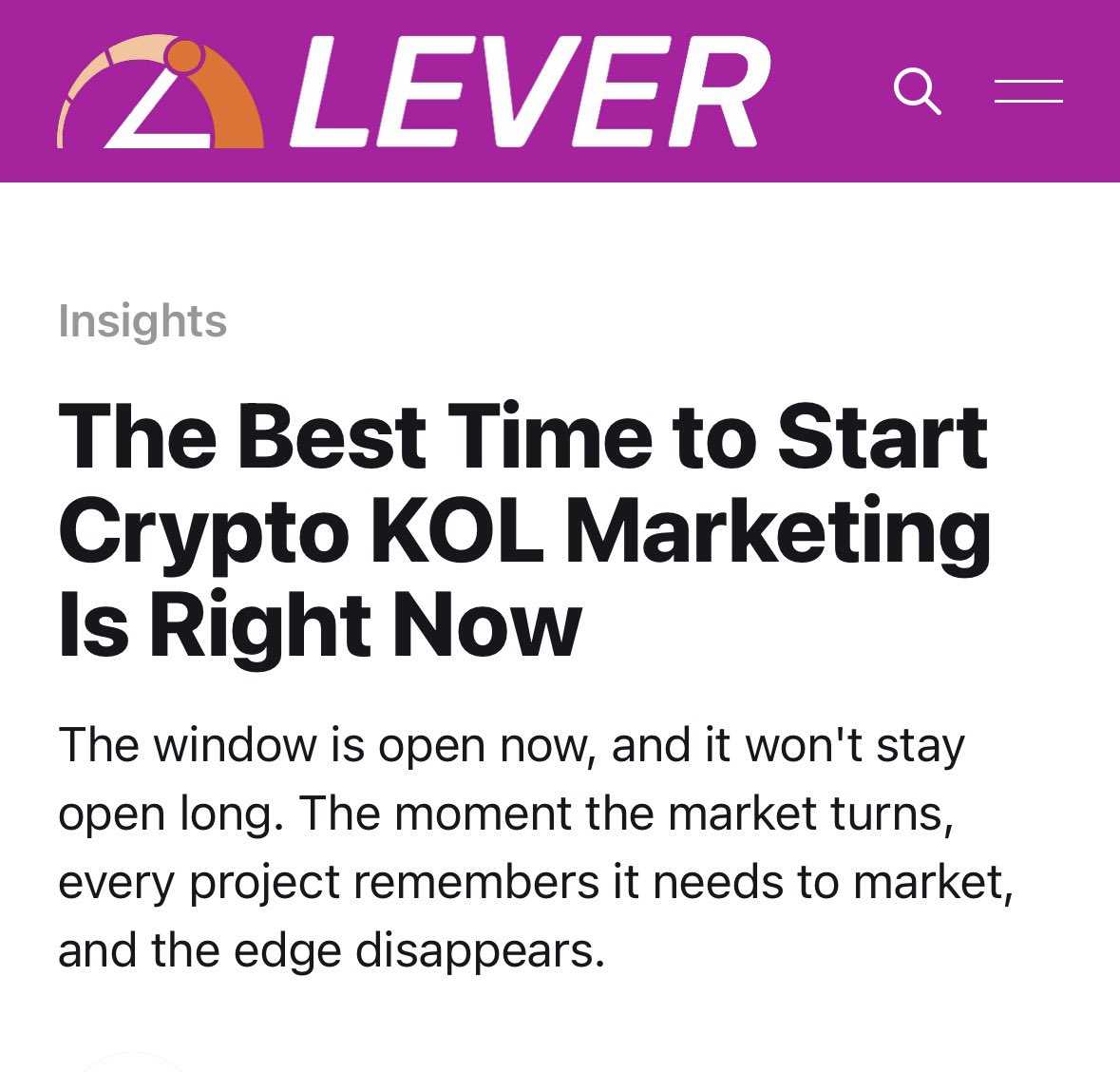
Most crypto projects react to a bear market the same way.
They cut marketing budgets, pause campaigns, and wait for sentiment to improve. The timeline gets quieter, creator partnerships slow down, and visibility fades.
It feels like the safe move. But that’s exactly where the opportunity is missed.
While others are stepping back, @lever_io is making the case for doing the opposite.
Bear markets create the best conditions to build attention. Creator calendars are more open, collaboration costs are lower, and there’s far less competition for mindshare. Every quality piece of content has a better chance of being seen, remembered, and trusted.
The projects that understand this aren’t just marketing through the bear, they’re positioning themselves to lead the next bull cycle.
Because when momentum returns, the winners won’t be the projects trying to introduce themselves for the first time.
They’ll be the ones who never stopped showing up.
If you’re building in Web3, this is well worth the read:
https://t.co/bT0asvL0a9
Launching a token is not the milestone.
Giving it real liquidity and allowing the market to discover its value is.
Every healthy on-chain economy reaches a point where participants no longer need permission to enter or leave. They can buy when they believe, sell when they’ve earned, and move capital freely based on conviction rather than constraints.
That’s what makes this moment significant for @CosmicSignature.
With $CST now live on Uniswap, the ecosystem extends beyond gameplay into open markets. Rewards become liquid, participation becomes more flexible, and every player gains greater control over how they engage with the economy.
This is not just another listing.
It’s the transition from a closed in-game asset to a token that can participate in the broader DeFi landscape, exactly where sustainable digital economies are built.
The strongest ecosystems don’t simply create tokens. They create markets.
Trade $CST on Uniswap:
https://t.co/xNeiElYJsZ…
Good Morning CT | Happy Friday!
Finish the week with the same energy you started it.
Many opportunities are won not by those who begin strongly, but by those who remain committed until the very end.
Don’t allow weekend thoughts to slow your momentum.
Complete your tasks.
Honor your commitments.
Deliver excellence.
Remember, every assignment completed with diligence adds another layer to your credibility, and credibility is one of the greatest assets you can build.
End the week stronger than you started it.
Wishing you a productive Friday filled with progress, impact, and new opportunities.
Keep building. Keep delivering.
One of the most expensive lessons in trading is learning that a signal is not the same thing as an opportunity.
I have seen traders rush into positions because of a sudden price spike. Others follow a whale wallet because it made headlines.
Some react to breaking news before understanding what the market is actually pricing in.
The problem is not the signal. The problem is the lack of context. A signal can tell you that something is happening.
Context tells you whether it matters.
A large wallet move may look bullish until you discover it is an internal transfer.
A price breakout may look strong until you notice volume is weak.
A trending narrative may attract attention while capital is quietly moving elsewhere.
That is why the best market decisions are rarely made from a single data point.
They come from connecting the dots.
That is what makes @tryquantio interesting. Quant AI helps users understand the bigger picture by bringing together:
🔹️ Smart money activity
🔹️ On-chain movement
🔹️ Market signals
🔹️ Social sentiment
🔹️ News and macro events
🔹️ Crypto, stocks, and commodities
Instead of chasing alerts and reacting to noise, users can ask better questions:
“What’s driving this move?”
“Is smart money actually involved?”
“Is sentiment supporting the trend?”
“What risks should I understand first?”
Because in markets, information is everywhere. Understanding is where the edge comes from.
Signals can get your attention. Context helps you make better decisions.
Join early below 👇
https://t.co/ZEcMclkHwG
#QuantAIPioneers
One of the most expensive lessons in trading is learning that a signal is not the same thing as an opportunity.
I have seen traders rush into positions because of a sudden price spike. Others follow a whale wallet because it made headlines.
Some react to breaking news before understanding what the market is actually pricing in.
The problem is not the signal. The problem is the lack of context. A signal can tell you that something is happening.
Context tells you whether it matters.
A large wallet move may look bullish until you discover it is an internal transfer.
A price breakout may look strong until you notice volume is weak.
A trending narrative may attract attention while capital is quietly moving elsewhere.
That is why the best market decisions are rarely made from a single data point.
They come from connecting the dots.
That is what makes @tryquantio interesting. Quant AI helps users understand the bigger picture by bringing together:
🔹️ Smart money activity
🔹️ On-chain movement
🔹️ Market signals
🔹️ Social sentiment
🔹️ News and macro events
🔹️ Crypto, stocks, and commodities
Instead of chasing alerts and reacting to noise, users can ask better questions:
“What’s driving this move?”
“Is smart money actually involved?”
“Is sentiment supporting the trend?”
“What risks should I understand first?”
Because in markets, information is everywhere. Understanding is where the edge comes from.
Signals can get your attention. Context helps you make better decisions.
Join early below 👇
https://t.co/ZEcMclkHwG
#QuantAIPioneers
One of the most expensive lessons in trading is learning that a signal is not the same thing as an opportunity.
I have seen traders rush into positions because of a sudden price spike. Others follow a whale wallet because it made headlines.
Some react to breaking news before understanding what the market is actually pricing in.
The problem is not the signal. The problem is the lack of context. A signal can tell you that something is happening.
Context tells you whether it matters.
A large wallet move may look bullish until you discover it is an internal transfer.
A price breakout may look strong until you notice volume is weak.
A trending narrative may attract attention while capital is quietly moving elsewhere.
That is why the best market decisions are rarely made from a single data point.
They come from connecting the dots.
That is what makes @tryquantio interesting. Quant AI helps users understand the bigger picture by bringing together:
🔹️ Smart money activity
🔹️ On-chain movement
🔹️ Market signals
🔹️ Social sentiment
🔹️ News and macro events
🔹️ Crypto, stocks, and commodities
Instead of chasing alerts and reacting to noise, users can ask better questions:
“What’s driving this move?”
“Is smart money actually involved?”
“Is sentiment supporting the trend?”
“What risks should I understand first?”
Because in markets, information is everywhere. Understanding is where the edge comes from.
Signals can get your attention. Context helps you make better decisions.
Join early below 👇
https://t.co/ZEcMclkHwG
#QuantAIPioneers
One of the most expensive lessons in trading is learning that a signal is not the same thing as an opportunity.
I have seen traders rush into positions because of a sudden price spike. Others follow a whale wallet because it made headlines.
Some react to breaking news before understanding what the market is actually pricing in.
The problem is not the signal. The problem is the lack of context. A signal can tell you that something is happening.
Context tells you whether it matters.
A large wallet move may look bullish until you discover it is an internal transfer.
A price breakout may look strong until you notice volume is weak.
A trending narrative may attract attention while capital is quietly moving elsewhere.
That is why the best market decisions are rarely made from a single data point.
They come from connecting the dots.
That is what makes @tryquantio interesting. Quant AI helps users understand the bigger picture by bringing together:
🔹️ Smart money activity
🔹️ On-chain movement
🔹️ Market signals
🔹️ Social sentiment
🔹️ News and macro events
🔹️ Crypto, stocks, and commodities
Instead of chasing alerts and reacting to noise, users can ask better questions:
“What’s driving this move?”
“Is smart money actually involved?”
“Is sentiment supporting the trend?”
“What risks should I understand first?”
Because in markets, information is everywhere. Understanding is where the edge comes from.
Signals can get your attention. Context helps you make better decisions.
Join early below 👇
https://t.co/ZEcMclkHwG
#QuantAIPioneers
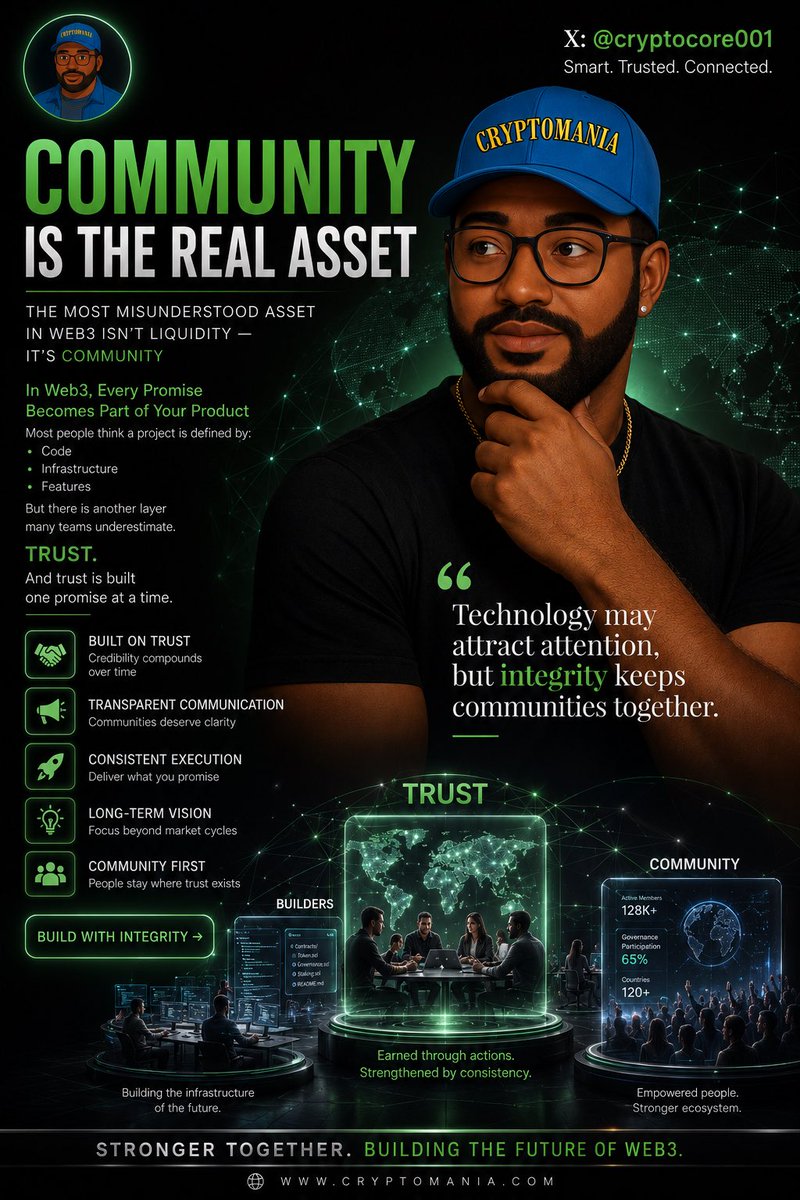
Dear Devs/Founders,
If there’s one asset in your project that deserves as much protection as your codebase, your treasury, and your product roadmap, it’s trust.
Because the moment your community stops believing your words, every other advantage you have starts losing value.
In Web3, Every Promise Becomes Part of Your Product
Most people think a project is defined by what’s on-chain, the smart contracts, the infrastructure, the features shipping on the roadmap. Those things matter. They’re the foundation everything else gets built on.
But there’s another layer underneath all of it that a lot of teams fundamentally underestimate: trust.
In this industry, trust isn’t a brand value you put in a pitch deck. It’s a ledger of its own, built one kept promise at a time, depleted by every one that isn’t.
I’ve watched projects launch with genuinely impressive technology. Talented dev teams. Strong, engaged communities. Roadmaps that made people excited about what was coming. Everything about the setup looked right.
Then the deadlines started slipping. Dev updates got less frequent. Questions in the community channels went unanswered longer than they used to. The same milestones that once generated real hype slowly became quiet reminders of what hadn’t shipped.
Nobody announced the shift. It just happened, the way trust usually erodes, not through one dramatic failure, but through a hundred small ones nobody bothered to address.
Why Communities Actually Leave
It’s almost never one catastrophic mistake that triggers the exodus. It’s the accumulation.
A missed update here. A delayed feature there. A commitment that quietly disappears from the roadmap without anyone acknowledging it happened. Individually, none of these feel significant enough to react to. Collectively, they’re exactly how confidence erodes in a space where confidence is the entire basis of participation.
This is why integrity carries more structural weight in Web3 than almost anywhere else in tech.
Built in Public Means Judged in Public
Most Web3 projects are built in public by design, that’s the whole premise of decentralization and community-owned development. But building in public means every announcement creates an expectation the community is watching. Every commitment becomes a benchmark people will eventually check you against.
There’s no private internal process where a team can quietly miss a deadline and nobody notices. The transparency that makes Web3 powerful is the same transparency that makes broken promises impossible to hide.
What the Strongest Founders Do Differently
They don’t overpromise to manufacture hype around a launch. They don’t chase the dopamine of short-term applause from an announcement they’re not fully confident they can deliver on.
They communicate clearly, even when what they’re communicating is a delay or a setback. They keep the community informed when the news isn’t good, because they understand something most teams learn the hard way: credibility is dramatically easier to maintain than it is to rebuild once it’s gone.
What Communities Actually Want
A healthy, mature community doesn’t demand perfection. People who’ve been in this space long enough understand that building is genuinely hard. Markets shift unpredictably. Technology evolves mid-build. Unexpected technical and regulatory challenges show up without warning. None of that surprises a community that’s paying attention.
What they want is honesty about all of it. Transparency when things go sideways. Confirmation that the people building are still genuinely committed to the same vision the community bought into in the first place, not a perfect track record. Just an honest one.
Dear Devs/Founders,
If there’s one asset in your project that deserves as much protection as your codebase, your treasury, and your product roadmap, it’s trust.
Because the moment your community stops believing your words, every other advantage you have starts losing value.
In Web3, Every Promise Becomes Part of Your Product
Most people think a project is defined by what’s on-chain, the smart contracts, the infrastructure, the features shipping on the roadmap. Those things matter. They’re the foundation everything else gets built on.
But there’s another layer underneath all of it that a lot of teams fundamentally underestimate: trust.
In this industry, trust isn’t a brand value you put in a pitch deck. It’s a ledger of its own, built one kept promise at a time, depleted by every one that isn’t.
I’ve watched projects launch with genuinely impressive technology. Talented dev teams. Strong, engaged communities. Roadmaps that made people excited about what was coming. Everything about the setup looked right.
Then the deadlines started slipping. Dev updates got less frequent. Questions in the community channels went unanswered longer than they used to. The same milestones that once generated real hype slowly became quiet reminders of what hadn’t shipped.
Nobody announced the shift. It just happened, the way trust usually erodes, not through one dramatic failure, but through a hundred small ones nobody bothered to address.
Why Communities Actually Leave
It’s almost never one catastrophic mistake that triggers the exodus. It’s the accumulation.
A missed update here. A delayed feature there. A commitment that quietly disappears from the roadmap without anyone acknowledging it happened. Individually, none of these feel significant enough to react to. Collectively, they’re exactly how confidence erodes in a space where confidence is the entire basis of participation.
This is why integrity carries more structural weight in Web3 than almost anywhere else in tech.
Built in Public Means Judged in Public
Most Web3 projects are built in public by design, that’s the whole premise of decentralization and community-owned development. But building in public means every announcement creates an expectation the community is watching. Every commitment becomes a benchmark people will eventually check you against.
There’s no private internal process where a team can quietly miss a deadline and nobody notices. The transparency that makes Web3 powerful is the same transparency that makes broken promises impossible to hide.
What the Strongest Founders Do Differently
They don’t overpromise to manufacture hype around a launch. They don’t chase the dopamine of short-term applause from an announcement they’re not fully confident they can deliver on.
They communicate clearly, even when what they’re communicating is a delay or a setback. They keep the community informed when the news isn’t good, because they understand something most teams learn the hard way: credibility is dramatically easier to maintain than it is to rebuild once it’s gone.
What Communities Actually Want
A healthy, mature community doesn’t demand perfection. People who’ve been in this space long enough understand that building is genuinely hard. Markets shift unpredictably. Technology evolves mid-build. Unexpected technical and regulatory challenges show up without warning. None of that surprises a community that’s paying attention.
What they want is honesty about all of it. Transparency when things go sideways. Confirmation that the people building are still genuinely committed to the same vision the community bought into in the first place, not a perfect track record. Just an honest one.